
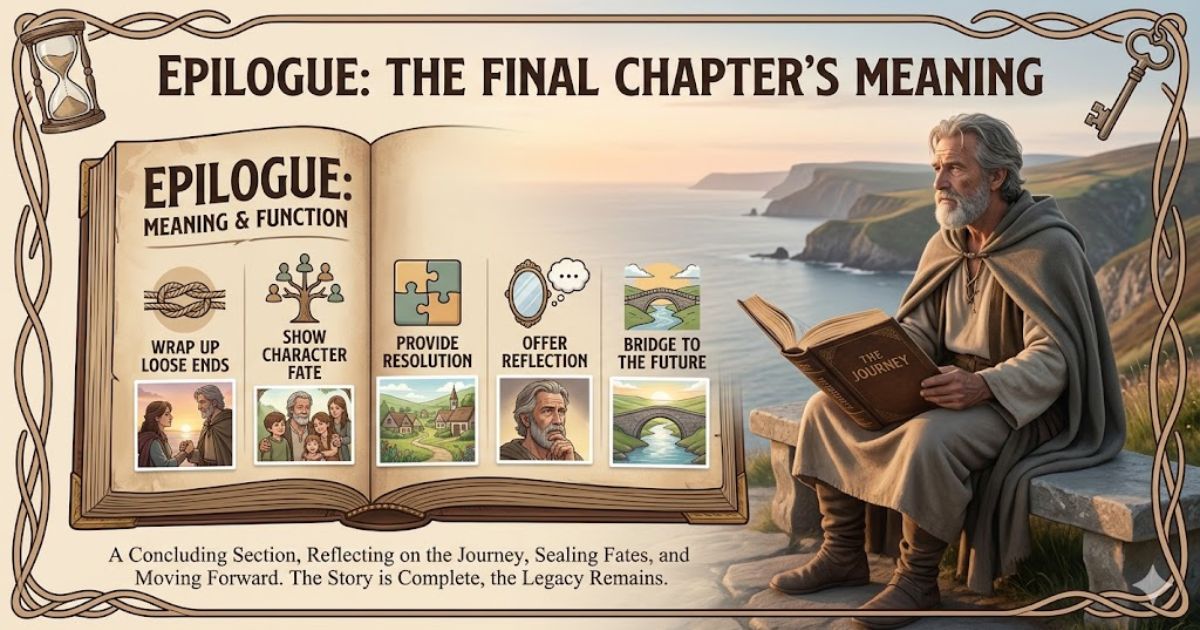
Have you ever finished a book or movie and then seen a short extra scene or section that tells you what happens after the ending? That part is called an epilogue. Many readers get confused when they come across this term because it sounds formal and a bit technical. In reality, the epilogue meaning is simply a way for writers to give closure and show what happens to the characters after the main story is already finished. It helps answer the “what next?” feeling that often stays in your mind after a strong ending.
Understanding the epilogue meaning makes storytelling much easier to enjoy. It appears in books, movies, plays, and even modern series where creators want to give final updates or emotional closure. Sometimes it shows happy futures, and other times it reveals deeper consequences of the story. Either way, it helps connect the ending with a sense of completion that feels natural and satisfying for the audience.
What Does Epilogue Meaning Actually Mean?
An epilogue is the final section of a story, book, play, or movie that comes after the main ending. It gives extra information about what happens to the characters or world after the story officially ends.
In simple words, an epilogue is the “what happens next” part after the ending.
Origin and Background of the Term
The word epilogue comes from the Greek word epilogos, which means “conclusion” or “final speech.” It was traditionally used in ancient plays where a narrator would speak directly to the audience after the story ended.
Over time, it became a common literary device in novels, films, and storytelling formats.
How Epilogue Is Used in Daily Life
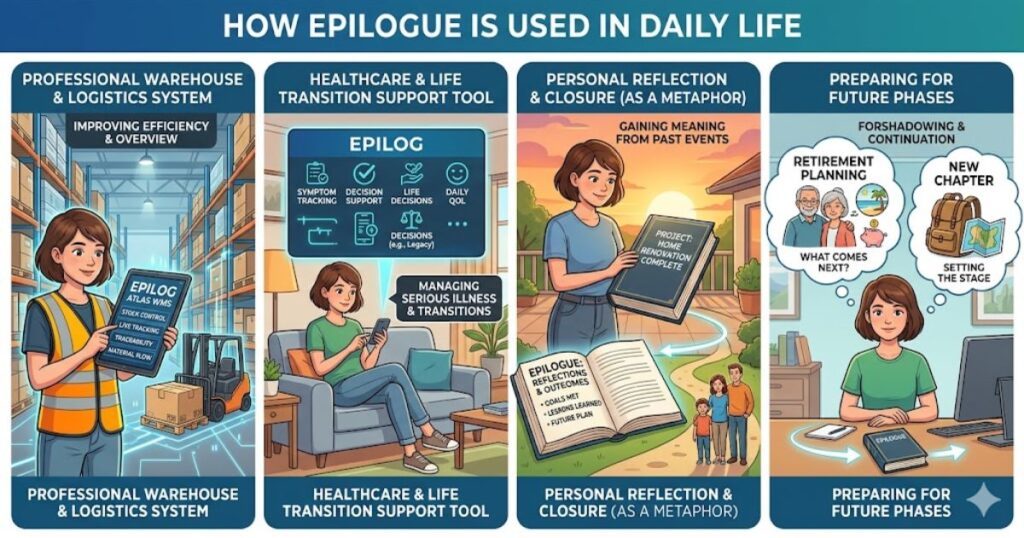
While epilogues are mostly found in literature and media, the concept appears in everyday storytelling.
- Book endings that explain character futures 📚
- Movie endings showing “years later” scenes 🎬
- TV series finales wrapping up loose ends 📺
- Personal storytelling when people explain “what happened after” 💬
- Articles or reports that summarize outcomes 🧾
It helps audiences understand closure beyond the main ending.
Read More: Enjambment Meaning in Poetry: Full Guide With Clear Examples for Beginners
Emotional and Practical Meaning of Epilogue
An epilogue adds emotional depth and closure.
- It provides final emotional satisfaction ❤️
- It shows consequences of events 🧠
- It answers unanswered questions ❓
- It gives closure to character journeys 🎭
- It helps readers or viewers move on 📖
So, it is both a storytelling tool and an emotional bridge.
Similar or Related Terms
Here are related storytelling terms:
- Conclusion
- Ending
- Finale
- Afterword
- Postscript
- Closing chapter
- Final scene
- Wrap-up
Each has a slightly different purpose but relates to ending content.
Common Misunderstandings About Epilogue
Many people confuse epilogue with the ending itself.
- It is not the main ending ❌
- It comes after the story is already finished 📖
- It is optional, not always included 🧩
- It is not part of the main conflict resolution ⚔️
- It focuses on “after effects,” not climax 🎬
Examples of Epilogue in Sentences
- “The epilogue showed the characters ten years later.” 📖
- “The book’s epilogue revealed what happened after the wedding.” 💍
- “I loved the epilogue because it gave closure.” ❤️
- “The movie had a short epilogue scene in the future.” 🎬
- “The epilogue explained the hero’s final journey.” 🧠
- “Without the epilogue, the story felt incomplete.” 📚
- “The epilogue answered all remaining questions.” ❓
- “Her favorite part was the emotional epilogue.” 😢
- “The epilogue tied everything together nicely.” 🎭
- “The novel ends, but the epilogue continues the story.” ✨
Why Understanding Epilogue Meaning Matters Today
Understanding epilogues helps in better reading and viewing experiences.
- Improves comprehension of stories 📖
- Helps analyze literature and films 🎬
- Enhances storytelling skills ✍️
- Builds appreciation for narrative structure 🧠
- Helps understand emotional closure ❤️
Also Read: Augment Meaning Explained Simply: Easy Definition, Examples & Real-Life Uses You Should Know
Frequently Asked Questions
What does epilogue mean in simple words?
It is the final section after a story’s ending that shows what happens next.
Is epilogue positive or negative?
It is neutral and depends on the story’s tone.
Where is epilogue commonly used?
It is used in books, movies, plays, and storytelling.
Is epilogue formal or informal?
It is a formal literary term.
Why do people search for epilogue meaning?
To understand story structure and improve reading comprehension.
Conclusion
An epilogue is an important storytelling tool that provides closure after a story ends. It helps explain what happens to characters afterward and gives readers or viewers a satisfying final understanding of the narrative.
