Ever scrolled through TikTok comments and seen someone call a movie “mid” and wondered if that’s a compliment or an insult? You’re not alone. This one little word has confused parents, teachers, and even some Gen Z newcomers who just aren’t plugged into internet slang yet.
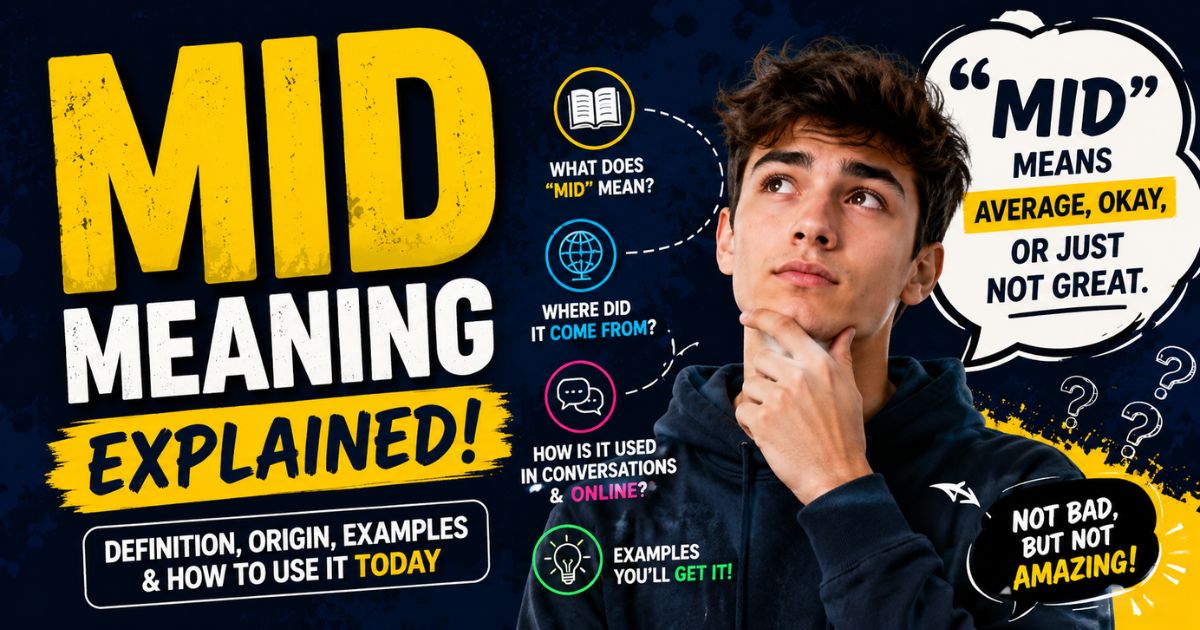
Here’s the short version: mid means average, unimpressive, or just plain “meh.” It’s not a compliment, but it’s not the harshest insult either. It sits right in that awkward middle zone between good and bad, which is honestly where the word gets its name.
In this guide, you’ll get the full picture. We’ll cover what mid actually means, where it came from, how people use it across different platforms, and why it’s become one of the most common words in modern internet vocabulary. By the end, you’ll never have to Google “what does mid mean” again.
Meaning & Definition of Mid
At its core, mid is a slang term that describes something as average or mediocre. It’s short, punchy, and gets the point across without needing a whole sentence. Instead of saying “that was pretty forgettable” or “I expected more,” people just say mid.
Primary Meaning:
The primary meaning of mid is simple: average quality, nothing special, not worth getting excited about. If a new song drops and it’s mid, that means it’s listenable but forgettable. It won’t make your playlist, but it also won’t make you skip the track in disgust. It’s the definition of “fine, I guess.”
This is different from calling something outright bad. When people say a movie is mid, they usually mean it had potential, maybe a decent trailer or a solid cast, but it didn’t deliver anything memorable. It’s underwhelming rather than terrible.
Secondary Meaning:
There’s a secondary layer to mid that shows up in more casual, personal contexts. Sometimes people use it to describe a person’s looks, an outfit, or even a vibe at a party. In these cases, mid still means average, but it carries a slightly more judgmental tone since it’s aimed at something personal rather than a product or piece of entertainment.
You’ll also hear mid used sarcastically, where someone calls something mid on purpose to downplay how much they actually liked it. It’s a way of staying cool and not seeming too enthusiastic, which, ironically, is a very Gen Z move.
Simple Examples:
“The new burger place was mid, honestly. Nothing wrong with it, just nothing exciting either.”
“His dance moves were mid at best, but he had fun, so who cares.”
“That album is mid compared to their last one.”
Each of these examples shows the same pattern. Something exists, it’s not bad, but it doesn’t stand out either. That’s the entire spirit of the word in one sentence.
Background & Origin of Mid
So where did mid actually come from? The word itself isn’t new. It’s simply a shortened form of “middle” or “mediocre,” and English speakers have used similar shorthand for decades. What’s new is how it exploded as internet slang, especially through gaming communities and hip-hop culture before spreading to mainstream social media.
Gamers were among the first to popularize mid as slang, using it to describe weak strategies, average player performance, or underwhelming game updates. If a new patch didn’t fix real problems, players would call it mid in forums and Discord servers.
From there, it crossed over into hip-hop and music criticism circles. Fans and critics started using mid to review albums and tracks without writing a full paragraph. It was fast, it was blunt, and it caught on because it worked. Once TikTok picked it up around 2021 and 2022, the word spread everywhere. Comment sections, reaction videos, and meme pages all leaned into it, and it became one of those words that just stuck.
What makes mid interesting from a language standpoint is how naturally it fits into casual speech. It doesn’t need explanation once you hear it a couple of times, and that ease of use is a big reason it became such a viral slang term instead of fading out like so many internet phrases do.
Usage in Different Contexts
Slang rarely stays in one lane, and mid is a perfect example of that. Depending on where you hear it, the tone and intensity can shift a little. Let’s break down how people actually use it in real conversations.
1. Social Conversations
In everyday chats with friends, mid works as a quick, low-effort way to share an opinion. Someone might ask how a party was, and the answer “it was mid” tells the whole story without needing details. It wasn’t a disaster, but nobody’s talking about it next week either.
2. Entertainment (Movies, Music, Shows)
This is where mid shows up the most. Movie reviews, album drops, and TV show finales all get hit with the mid label constantly. It’s become a go-to word for critics on social media who want to express disappointment without sounding overly dramatic. A show that had a strong first season but a weak follow-up often gets called mid by fans who feel let down but not betrayed.
3. Food Reviews
Food content is huge online, and mid has become a staple word in that space too. A restaurant that’s overpriced for what it delivers, or a viral recipe that doesn’t live up to the hype, often earns the mid label. It’s a gentler way of saying “don’t bother” without being harsh about it.
4. Personal Opinions
People also use mid to describe personal takes on things like fashion choices, workout routines, or even someone’s Instagram captions. In this context, it’s less about facts and more about vibe. If something feels uninspired or safe, it’s mid, plain and simple.
Meanings Across Platforms
While the core definition of mid stays the same everywhere, the way it’s used can shift slightly depending on the platform. Here’s a quick breakdown of how it shows up across the apps people use most.
| Platform | How “Mid” Is Typically Used |
|---|---|
| Casual texting between friends, often shortened further or paired with emojis | |
| Comment sections and captions, usually reacting to posts, reels, or outfits | |
| TikTok | Extremely common in comments and duets, often used for comedic effect |
| Snapchat | Quick reactions in chats or story replies, usually informal and blunt |
On WhatsApp, mid tends to show up in one-on-one or group chats where people are being blunt with close friends. Since WhatsApp conversations are more private, people feel free to use mid without softening it, since there’s no public audience to worry about.
Instagram comment sections are full of mid reactions, especially under celebrity posts, outfit reveals, or food content. It’s become such a common comment that some creators even joke about expecting it before they post anything new.
Read More: AEAP Meaning Decoded 2026 Ultimate Guide!
TikTok
TikTok is really where mid became a cultural phenomenon. It shows up in comments, stitches, and duets constantly. Creators sometimes even build entire videos around defending their content from being called mid, which shows just how much weight the word carries in that space.
Snapchat
Snapchat usage leans more private and personal, so mid here often applies to smaller, everyday moments, like a snap of someone’s lunch or a quick outfit check. It’s less about broadcasting an opinion and more about a quick, honest reaction between friends.
Other Fields & Technical Meanings
Outside of slang, “mid” has completely different meanings depending on the field. It’s worth knowing these so you don’t get confused if you see the word used in a non-slang context.
Physics / Mathematics
In physics and math, “mid” is often short for “midpoint,” referring to the exact middle value between two points or numbers. For example, the midpoint formula is used constantly in geometry to find the center of a line segment.
Aviation
In aviation, “mid” can refer to mid-altitude flight levels or appear in radio communication shorthand. Pilots and air traffic controllers use abbreviated terms constantly, and “mid” fits into that world as a practical, technical shorthand rather than slang.
Medical Context
In medical terminology, “mid” often appears as a prefix, like “midline” or “midbrain,” referring to a central or middle location in the body. This usage has existed for a long time and has nothing to do with internet culture at all.
Common Misconceptions & Mistakes
Because mid spread so fast, a lot of people misunderstand what it actually means. Let’s clear up the most common mix-ups.
Misconception 1: “Mid means bad”
This is probably the biggest misunderstanding. Mid doesn’t mean bad. It means average or forgettable. Something bad usually gets stronger reactions like “trash” or “awful.” Mid is reserved for things that are simply unremarkable, not things that are genuinely terrible.
Misconception 2: It is offensive
Some people assume mid is meant to be cruel or insulting, but in most contexts, it’s a pretty mild opinion. It’s more like a shrug in word form than a personal attack. That said, tone and context matter, since it can feel more pointed when aimed directly at a person rather than a product or piece of media.
Misconception 3: It always means insult
Not every use of mid is negative. Sometimes it’s used jokingly among friends, or even affectionately, especially when someone downplays something they secretly enjoyed. Context is everything here, and reading the room matters just as much as the word itself.
Similar Terms & Alternatives
If you want to switch things up instead of repeating mid every time, there are plenty of similar words that carry the same energy. Words like average, mediocre, underwhelming, so-so, basic, and unremarkable all capture a similar feeling. “Overrated” works too, though it leans a bit more critical since it implies something got more hype than it deserved.
Each of these alternatives has a slightly different flavor. “Basic” often points more toward something predictable rather than low quality. “Underwhelming” suggests expectations weren’t met, while “so-so” feels a little more neutral and lighthearted. Knowing these alternatives helps you match the right tone depending on how strong of an opinion you actually want to express.
How to Respond to “Mid”
Getting called mid, or having something you made called mid, can sting a little depending on the situation. Here’s how people typically respond.
Casual Responses:
A relaxed response usually sounds like “fair enough” or “to each their own.” This keeps things light and shows you’re not taking the comment too seriously, which is usually the best move in casual conversations.
Defensive Responses:
Some people push back with something like “you clearly don’t get it” or point out specific details the other person missed. This works fine among friends, but it can come across as a little too intense in public comment sections.
Funny Responses:
Humor tends to land best. Replying with something like “mid is still better than whatever you’re doing” turns the whole thing into a joke instead of a real argument. This approach usually gets the most engagement online too, since people enjoy a witty comeback.
Differences From Similar Words
It helps to compare mid directly against words people often confuse it with. “Bad” implies a clear failure, something that didn’t work at all. “Cringe” points to secondhand embarrassment rather than average quality. “Overrated” suggests something got too much praise relative to its actual quality, while mid simply means it never stood out in the first place. Understanding these small differences helps you use slang more accurately instead of just tossing words around interchangeably.
Relevance in Online Conversations & Dating Apps
Mid has even found its way into dating culture, especially on apps like Tinder, Hinge, and Bumble. People use it to describe a lackluster date, an unimpressive bio, or a match that just didn’t spark much excitement. “The date was mid” has become a common phrase among younger daters who want to summarize an experience quickly without writing a whole paragraph to their friends.
This ties into a bigger trend where slang from gaming and entertainment spaces spills into everyday personal life. Dating conversations move fast, and mid fits perfectly into that fast-paced, low-effort communication style that defines a lot of modern texting and app culture.
Popularity & Trends Over Time
Mid hit peak popularity between 2022 and 2023, largely thanks to TikTok trends, viral tweets, and reaction videos. Search interest spiked as more people encountered the term online and searched to understand what it meant. While the word has settled into steady, everyday use rather than staying at its viral peak, it hasn’t disappeared. It’s become part of the regular internet vocabulary, much like “cringe” or “cap” before it.
Language trends like this usually follow a similar pattern. They spike hard, cool off, and then either fade away completely or become a permanent fixture in casual speech. Based on how often mid still shows up across platforms today, it looks like it’s landed firmly in the second category.
FAQs
1. What does mid mean in slang?
Mid means something is average or unimpressive. It’s not terrible, but it’s not good either. It sits right in the middle, which is exactly where the word gets its name.
2. Is calling something mid an insult?
Not usually. It’s a mild opinion rather than a harsh insult. It simply means something didn’t stand out, though tone and context can make it feel more pointed in certain situations.
3. Where is mid used most?
Mid is most common on TikTok and Instagram, especially in comment sections reacting to movies, music, food, and personal posts.
4. Is mid a bad word?
No, mid isn’t offensive or inappropriate. It’s just casual slang used to express an average opinion about something.
5. Can mid mean something positive?
Not directly, but it can be used playfully or sarcastically among friends, sometimes softening what would otherwise be a more critical opinion.
Conclusion
At the end of the day, mid is one of those slang words that earns its popularity by being simple and useful. It lets people express an average, unimpressive opinion in a single word instead of writing a whole explanation. Whether it’s describing a movie, a meal, a date, or a new song, mid captures that exact feeling of “it’s fine, but nothing special.”
Now that you know where it came from, how it spreads across platforms, and how to use it correctly, you’ll never be confused the next time someone drops it in your comments or texts. And honestly, understanding slang like this is anything but mid.
Meta Description: Confused by the slang word “mid”? Learn its real meaning, origin, and how it’s used on TikTok, Instagram, and beyond.
