Have you ever seen someone comment “Bomboclat!” on TikTok, Instagram, or X (formerly Twitter) and wondered what they actually meant?
You’re not alone. The word Bomboclat has become one of the internet’s most recognizable slang expressions. People use it in memes, reaction posts, comment sections, and viral videos. However, many users don’t realize that the word comes from Jamaican Patois and carries a much stronger meaning than the playful way it’s often used online.
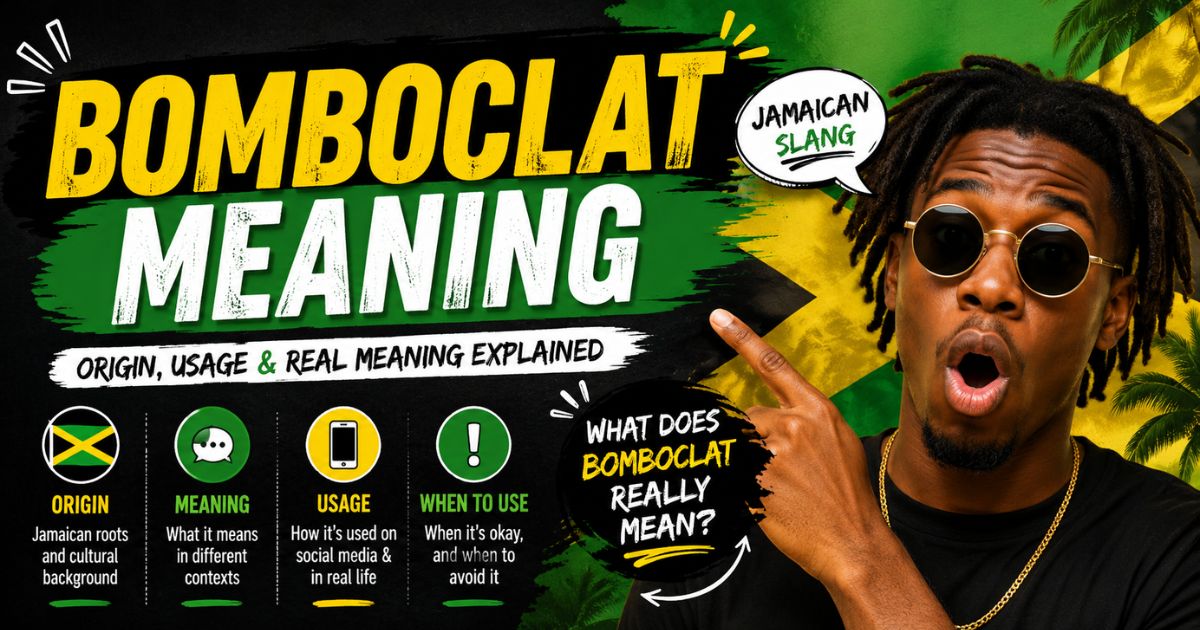
In this guide, you’ll learn the true Bomboclat meaning, where it came from, how it’s used across social media, whether it’s offensive, and when you should avoid using it. By the end, you’ll understand both its cultural significance and its modern internet usage.
What Does Bomboclat Mean?
The Bomboclat meaning depends entirely on the situation. In Jamaican Patois, it’s considered a strong profanity. On today’s internet, it’s often used as a reaction word expressing surprise, shock, excitement, frustration, or disbelief.
Think of it like this:
- Traditional Jamaican meaning = offensive swear word.
- Internet meaning = emotional reaction or meme caption.
Understanding this difference is important because what seems harmless online may still be offensive to many Jamaicans.
Primary Meanings
Originally, Bomboclat (also spelled Bumboclaat or Bomboclaat) literally refers to a sanitary cloth or toilet tissue. Over time, it evolved into one of the strongest swear words in Jamaican Patois.
People in Jamaica may use it to express:
- Anger
- Shock
- Disbelief
- Frustration
- Extreme surprise
Because of its offensive nature, it’s generally inappropriate in formal settings or around people you don’t know well.
Internet Meaning
Outside Jamaica, the internet has largely changed how people interpret the word.
Today, Bomboclat meaning in slang usually refers to:
- “Look at this!”
- “Can you believe this?”
- “This is wild!”
- “I’m speechless.”
- “This deserves a reaction.”
Instead of functioning as profanity, many people use it like a caption inviting others to react to an image or video.
For example:
Bomboclat 😂
This often means:
“Tell me what this picture makes you think.”
Quick Examples
Here are a few common examples.
Example 1
Friend: “I accidentally deleted my entire project.”
Reply:
Bomboclat 😭
Meaning: That’s unbelievable.
Example 2
TikTok caption:
Bomboclat 💀
Meaning: This video is so funny or shocking that I don’t know what to say.
Example 3
Instagram meme:
Bomboclat.
Meaning: Explain this image.
Background and Origin of Bomboclat
Understanding the history helps explain why the word carries so much weight.
Cultural Roots
The word comes from Jamaican Patois, the English-based Creole language widely spoken in Jamaica.
Many Jamaican expressions have deep cultural roots shaped by African languages, British English, and Caribbean history.
Like several Jamaican swear words ending in “-clat” or “-claat,” Bomboclat developed into an emotional exclamation over many generations.
Although many people outside Jamaica use it casually, native speakers often recognize it as strong profanity.
That’s why cultural context matters.
Viral Social Media Boom
Around 2019, the word exploded across social media.
People began posting random images with only one caption:
Bomboclat
Others would respond by explaining what the image reminded them of, almost like filling in a meme template.
The trend spread quickly across:
- TikTok
- X (formerly Twitter)
Over time, millions of users started treating Bomboclat as a reaction meme instead of a swear word.
Alternate Spellings
Because Jamaican Patois isn’t always written the same way, you’ll see several spellings.
Common versions include:
| Spelling | Notes |
|---|---|
| Bomboclat | Most popular online |
| Bomboclaat | Traditional spelling |
| Bumboclaat | Very common Jamaican spelling |
| Bumboclat | Less common variation |
| Bomboclot | Occasionally seen online |
All generally refer to the same expression, although pronunciation varies slightly.
How Bomboclat Is Used in Different Contexts
The meaning changes depending on who is using it and where.
In Casual Chat
Among friends online, Bomboclat often replaces expressions like:
- OMG
- No way!
- Seriously?
- That’s insane!
- What just happened?
It’s usually meant as an emotional reaction rather than an insult.
For example:
Friend:
“I just won free concert tickets.”
Reply:
Bomboclat! That’s amazing!
In Jamaica, however, using it casually with strangers could be considered disrespectful.
Read More: WTW Meaning: What It Really Means in Text, Snapchat, TikTok & Instagram (2026 Guide)
Examples
Here are a few texting examples.
Example 1
A: I crashed my bike.
B: Bomboclat! Are you okay?
Example 2
A: I passed every exam.
B: Bomboclat! Congratulations!
Example 3
A: Look what happened at the party.
B: Bomboclat 😂
Meaning: That situation is unbelievable or hilarious.
On Social Media
Online, Bomboclat frequently appears in:
- Meme captions
- Viral reactions
- Funny videos
- Comment sections
- Screenshot posts
Many creators use it simply because it’s become part of internet meme culture.
It often attracts comments and engagement because viewers immediately understand they’re expected to react.
Common Uses
You’ll commonly see Bomboclat used to express:
- Shock
- Excitement
- Confusion
- Disbelief
- Frustration
- Amazement
- Humor
The emotional tone depends entirely on the surrounding conversation.
In Music and Entertainment
Dancehall and reggae artists have long used Jamaican expressions, including Bomboclat, to add emotion and authenticity to lyrics.
As dancehall music became popular worldwide, many international audiences became familiar with Jamaican slang without fully understanding its cultural context.
Movies, viral interviews, and internet personalities have also helped spread the expression globally.
In Serious Situations
Using Bomboclat during serious discussions can easily be misunderstood.
For example, avoid using it:
- At work
- In professional emails
- During school presentations
- In business meetings
- When speaking with someone unfamiliar with internet slang
Even if you mean it humorously, others may interpret it as offensive or disrespectful.
Bomboclat Meaning Across Social Media Platforms
The Bomboclat meaning changes slightly depending on where you see it. While the core idea is usually an emotional reaction, each social platform has developed its own style of using the word.
Here’s a quick comparison.
| Platform | Typical Meaning | Common Usage |
|---|---|---|
| TikTok | Shock, humor, disbelief | Video captions and comments |
| Meme reaction | Image captions and comment sections | |
| Surprise or frustration | Private chats with friends | |
| Snapchat | Instant reaction | Snaps and chat replies |
| X (formerly Twitter) | Viral reaction or opinion | Memes, trending topics, quote posts |
The biggest takeaway is this: outside Jamaica, most people use Bomboclat as an emotional internet expression rather than its original meaning.
On WhatsApp, Bomboclat meaning in chat is usually much lighter than its Jamaican usage.
Friends may use it after hearing shocking news, seeing a funny photo, or reacting to an unexpected message. In most private chats, it simply replaces expressions like “OMG” or “No way!”
Examples
Friend: I just locked myself out of the house.
You: Bomboclat 😂
Friend: I won front-row concert tickets!
You: Bomboclat! That’s incredible!
Friend: Guess who texted me after five years?
You: Bomboclat 😳
In these conversations, the word expresses surprise rather than insulting someone.
On Instagram, Bomboclat meaning on Instagram is closely tied to meme culture.
You’ll often see users upload a funny or confusing image with a caption that simply says:
Bomboclat
The caption invites followers to explain the image, create a joke, or share what immediately comes to mind.
Example
A picture of a dog wearing sunglasses and sitting at a dinner table.
Caption:
Bomboclat.
Comments:
- “He looks like he’s about to fire his accountant.”
- “CEO of Treat Industries.”
- “When Mom says guests are coming.”
The humor comes from everyone’s creative reactions.
TikTok
The Bomboclat meaning on TikTok usually revolves around dramatic reactions.
Creators use it when:
- Something unexpected happens.
- Someone gets embarrassed.
- A prank goes horribly wrong.
- A transformation is unbelievable.
- A plot twist leaves viewers speechless.
You’ll often find comments such as:
Bomboclat 😭
Bomboclat, I wasn’t expecting that.
Bomboclat, replaying this five times.
In these situations, the word simply communicates intense surprise or amusement.
Snapchat
On Snapchat, the word is less common but still appears in private conversations.
People may send it after receiving:
- A shocking selfie
- A funny video
- Unexpected news
- A surprising Snap streak update
Because Snapchat conversations disappear quickly, Bomboclat is usually just a spontaneous reaction rather than a carefully chosen word.
Does Bomboclat Have Technical, Medical, or Other Meanings?
No.
Unlike many internet abbreviations, Bomboclat does not have a technical, scientific, medical, legal, or business definition.
It is purely:
- Jamaican Patois slang
- An internet expression
- A meme reaction
- A cultural term with historical significance
If you see websites claiming it has computer, medical, or engineering meanings, those claims are inaccurate.
Common Misconceptions and Mistakes
Many people misunderstand the Bomboclat meaning because they only encounter it through memes.
Here are the most common mistakes.
1: Thinking It Means “Cool”
This is probably the biggest misconception.
Bomboclat does not literally mean:
- Cool
- Awesome
- Nice
- Great
Instead, it’s an emotional reaction.
For example:
❌ Bomboclat, that’s a cool shirt.
✔ Bomboclat! I can’t believe you did that.
The second example feels much more natural.
2: Assuming It’s Always Funny
Internet users often treat Bomboclat as a joke.
However, many Jamaicans still consider it offensive because of its original meaning and cultural history.
That’s why context matters.
If you’re speaking with Jamaican friends or visiting Jamaica, it’s wise to avoid using the word casually unless you fully understand the setting.
3: Using It Professionally
Bomboclat should never appear in:
- Business emails
- Job interviews
- Workplace chats
- Customer support messages
- School assignments
- Professional presentations
Even if your coworkers understand memes, the word can appear immature or offensive.
4: Mispronouncing It
People often pronounce it exactly as it’s spelled.
A closer approximation is:
BUM-bo-claat
Because Jamaican Patois has its own pronunciation patterns, you’ll hear slight differences depending on the speaker and region.
Listening to native Jamaican speakers is the best way to understand its authentic pronunciation.
Similar Terms and Alternatives
If you’re looking for less offensive expressions that communicate the same emotions, consider these alternatives:
| Expression | Meaning | Offensive? |
|---|---|---|
| OMG | Surprise | No |
| Bruh | Disbelief | No |
| What?! | Shock | No |
| No way! | Surprise | No |
| Seriously? | Confusion | No |
| That’s wild! | Amazement | No |
| Sheesh | Excitement | No |
| Wow | General reaction | No |
These phrases are safer for everyday conversations and work across most situations.
How to Respond to Bomboclat
If someone sends you Bomboclat in a message or comment, your response depends on the context.
If they’re reacting to something funny, respond with humor. If they’re expressing shock, acknowledge what surprised them.
Funny Responses
Here are a few playful replies:
- “I know, right? 😂”
- “You weren’t ready for that!”
- “That’s exactly what I thought.”
- “The internet never disappoints.”
- “This just made my day.”
Meme-Style Replies
For meme culture, people often answer with another joke or caption.
Examples:
Bomboclat
Reply:
“When Monday arrives five minutes too early.”
Bomboclat
Reply:
“POV: You forgot your homework again.”
Bomboclat
Reply:
“The face you make when your Wi-Fi stops during the final episode.”
These creative responses are part of what made the trend go viral.
Chat Examples
Friend: I accidentally sent that message to my boss.
You: Bomboclat 💀
Friend: I found $100 in my old jacket.
You: Bomboclat! That’s lucky.
Friend: My flight got canceled.
You: Bomboclat… that’s rough.
Notice how the tone changes based on the situation, even though the same word is used.
Bomboclat vs Similar Words
Many people assume Bomboclat is interchangeable with other popular slang expressions. While they can all express emotion, they come from different cultures and carry different levels of intensity.
Understanding these differences helps you choose the right expression and avoid unintentionally offending someone.
Bomboclat vs Bloodclat
Bloodclat (also spelled Bloodclaat or Bloodclot) is another well-known Jamaican Patois swear word. Like Bomboclat, it’s considered offensive in Jamaica and is often used to express strong anger, frustration, or shock.
| Bomboclat | Bloodclat |
|---|---|
| Strong Jamaican swear word | Strong Jamaican swear word |
| Frequently used as an internet meme | Less commonly used in memes |
| Often expresses shock or disbelief online | More commonly expresses anger |
| Widely recognized on TikTok and Instagram | Mostly heard in Jamaican speech and music |
Although social media has softened the online perception of Bomboclat, both words should be used carefully because of their cultural significance.
Bomboclat vs Bruh
Bruh is one of the internet’s safest reaction words.
Here’s how they compare:
| Bomboclat | Bruh |
|---|---|
| Originates from Jamaican Patois | Originates from American slang |
| Can be offensive | Not offensive |
| Strong emotional expression | Mild reaction |
| Cultural meaning | Casual internet slang |
For example:
Friend: I forgot my passport.
You could say:
Bruh…
or
Bomboclat!
Both express disbelief, but Bruh is far less intense.
Bomboclat vs OMG
OMG (Oh My God) is another common reaction phrase.
| Bomboclat | OMG |
|---|---|
| Jamaican slang | English abbreviation |
| Stronger emotional impact | Mild surprise |
| Can offend some people | Generally acceptable |
| Cultural background matters | Widely understood worldwide |
If you’re unsure which to use, OMG is almost always the safer option.
Bomboclat in Online Conversations and Dating Apps
You’ll occasionally see Bomboclat used on messaging apps, dating platforms, gaming chats, and online communities.
In these spaces, it’s rarely meant literally. Instead, it functions as a quick emotional reaction.
Someone might use it after:
- Seeing an attractive profile.
- Reading a surprising message.
- Watching a funny clip.
- Reacting to unexpected news.
- Sharing a viral meme.
However, because not everyone understands the word—or its cultural background—it’s usually best to reserve it for casual conversations with people who are familiar with internet slang.
Example Uses
Here are a few examples of how the word appears in online conversations.
Dating App
Person A:
“I’ve climbed Mount Kilimanjaro.”
Person B:
Bomboclat 😳
Meaning: That’s seriously impressive.
Gaming Chat
Player:
“I just won a 1 vs. 5.”
Friend:
Bomboclat!!
Meaning: That was unbelievable.
Group Chat
Friend:
“I accidentally booked tickets for the wrong month.”
Everyone:
Bomboclat 😂
Meaning: We can’t believe that happened.
Best Practice
Before using Bomboclat, ask yourself a few questions:
- Is this a casual conversation?
- Will everyone understand the reference?
- Could someone find it offensive?
- Would another reaction word work just as well?
If you’re unsure, expressions like “OMG,” “Wow,” “Seriously?” or “No way!” communicate the same emotion without the cultural baggage.
Showing respect for the word’s Jamaican origins helps avoid misunderstandings.
Popularity and Trends Over Time
The journey of Bomboclat from Jamaican slang to global internet phenomenon is a fascinating example of how language evolves online.
A word once heard mainly in Jamaica is now recognized by millions of social media users worldwide.
Why It Went Viral
Several factors contributed to the explosion in popularity:
- Meme culture encouraged creative reactions.
- Twitter (now X) users turned it into a caption challenge.
- TikTok creators adopted it in videos and comments.
- Instagram meme pages shared it widely.
- Curiosity about its meaning fueled Google searches.
As more influencers and content creators used the word, it spread beyond Caribbean communities and entered mainstream internet vocabulary.
Google Search Trends
Interest in Bomboclat meaning has followed a familiar pattern seen with many viral internet slang terms.
Searches tend to spike when:
- A meme goes viral.
- A celebrity uses the term.
- TikTok trends feature the word.
- News outlets explain its meaning.
- New users encounter it for the first time.
Even years after its biggest viral moment, people continue searching:
- What does Bomboclat mean?
- Bomboclat meaning in text
- Bomboclat meaning on TikTok
- Bomboclat meaning in Jamaican
- Is Bomboclat offensive?
This ongoing curiosity shows that the word remains relevant in online culture.
Social Media Influence
Social media has dramatically changed how people interpret Bomboclat.
Originally, it was known almost exclusively within Jamaican communities. Today, millions of users recognize it as:
- A reaction word
- A meme caption
- A humorous expression
- A viral internet phrase
At the same time, discussions about cultural appropriation have reminded users that internet popularity doesn’t erase a word’s original meaning.
Learning the history behind the slang encourages more respectful communication and a better appreciation of Jamaican culture.
FAQs
Is Bomboclat a bad word?
Yes. In traditional Jamaican Patois, Bomboclat is considered a strong swear word. Although many people use it casually online, it can still be offensive, especially to native Jamaican speakers.
Why do people say Bomboclat on TikTok?
On TikTok, people usually use Bomboclat to express shock, surprise, amusement, or disbelief. It’s commonly seen in reaction videos, comment sections, and meme captions rather than as an insult.
Is Bomboclat offensive?
It can be. While internet users often treat it as harmless slang, many Jamaicans still view it as profanity. The level of offense depends on the audience and context.
What language is Bomboclat from?
The word comes from Jamaican Patois, an English-based Creole language spoken throughout Jamaica. It has deep roots in Caribbean history and culture.
Is Bomboclat the same as OMG?
No. Although both can express surprise, Bomboclat is a culturally significant Jamaican swear word, whereas OMG is a widely accepted English abbreviation. They’re not true equivalents.
How do you pronounce Bomboclat?
A common pronunciation is:
BUM-bo-claat
You’ll hear slight variations among native Jamaican speakers, as pronunciation differs across regions and individual accents.
Related Search Queries
If you’re researching Bomboclat meaning, you may also be interested in:
- Bomboclat meaning in text
- Bomboclat meaning in slang
- Bomboclat meaning in English
- Bomboclat meaning in Jamaican Patois
- Bomboclat meaning on TikTok
- Bomboclat meaning on Instagram
- Bomboclat meaning on Snapchat
- Bomboclat meaning on WhatsApp
- What does Bomboclat mean?
- Bomboclat pronunciation
- Bomboclat origin
- Bomboclat translation
- Bomboclat examples
- Bomboclat meme meaning
- Bomboclat internet slang
- Bomboclat vs Bloodclat
- Bomboclat vs Rasclat
- Jamaican slang words
- Jamaican curse words
- Caribbean slang expressions
- Viral internet slang
Conclusion
The Bomboclat meaning goes far beyond the memes and viral comments you see online. While the internet has transformed it into a reaction word used to express surprise, disbelief, or humor, its roots lie in Jamaican Patois, where it remains a strong and potentially offensive swear word.
If you come across Bomboclat on TikTok, Instagram, WhatsApp, Snapchat, or X, remember that the context is everything. In online conversations, it’s often used as a playful reaction. In Jamaican culture, however, it carries much more weight.
Understanding both meanings allows you to appreciate the word’s place in modern internet culture while showing respect for its cultural origin. When in doubt, choose less offensive alternatives like “OMG,” “Wow,” or “No way!”—especially in professional or unfamiliar settings.
