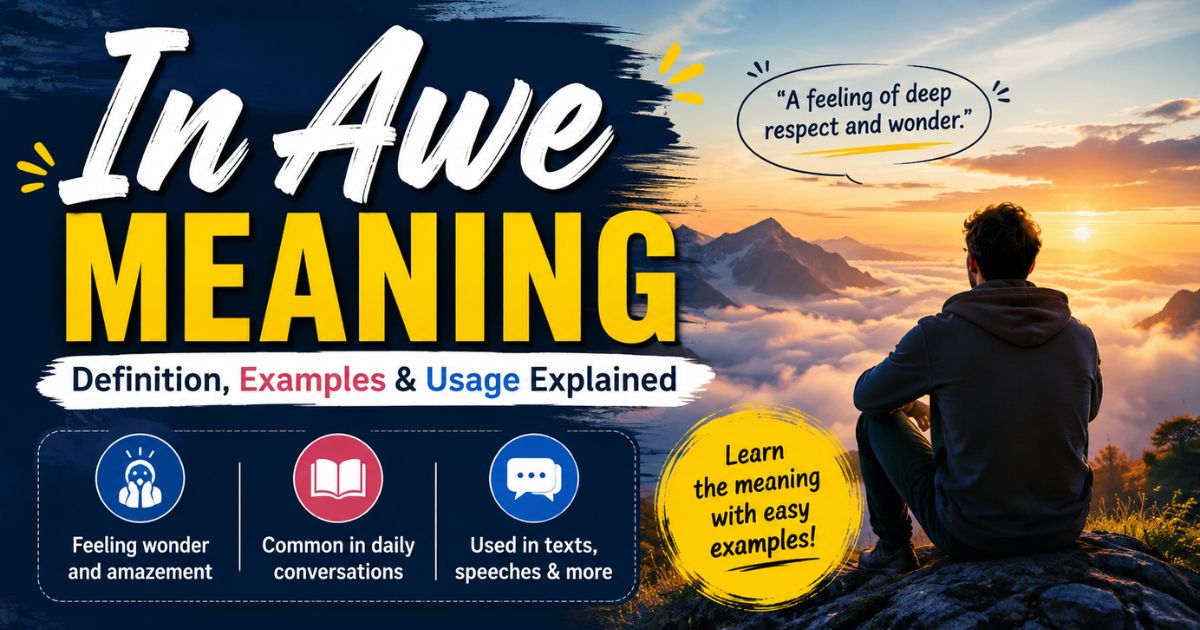
Have you ever looked at something so beautiful, impressive, powerful, or extraordinary that you couldn’t find the right words to describe your reaction? You were probably in awe.
The in awe meaning is being filled with a strong feeling of admiration, wonder, amazement, or deep respect toward someone or something. When you say, “I’m in awe of her talent,” you mean her talent impressed you so much that you feel genuine admiration.
But in awe isn’t limited to breathtaking views or incredible achievements. People use the expression when talking about relationships, celebrities, nature, accomplishments, art, and even moments that leave them speechless.
In this guide, we’ll break down what in awe means, where the expression comes from, how to use it naturally, and how it differs from words such as awesome, amazed, and admiration.
What Does In Awe Mean?
In awe means experiencing a powerful feeling of wonder, admiration, amazement, or respect because of something remarkable.
The word awe describes an intense emotional reaction to something perceived as extraordinary, magnificent, powerful, or sometimes even overwhelming.
So, when someone says:
“I’m in awe of your courage.”
They’re saying:
“Your courage impresses me deeply, and I genuinely admire it.”
The expression usually has a positive meaning, although awe can sometimes contain a mixture of admiration and fear when the thing being observed is extremely powerful.
For example:
“We stood in awe of the enormous waterfall.”
The people aren’t simply saying the waterfall looked nice. They were deeply impressed by its size, beauty, and power.
In Awe Meaning in Simple English
In simple terms, being in awe means being extremely impressed or amazed by someone or something.
Depending on the context, you could understand it as:
- Deeply impressed
- Amazed
- Filled with wonder
- Greatly admiring someone
- Overwhelmed by beauty or greatness
- Struck by something extraordinary
What Does “I’m in Awe of You” Mean?
If someone tells you, “I’m in awe of you,” it’s a strong compliment.
It usually means:
“I deeply admire you and what you’ve accomplished or who you are.”
For example:
“You worked two jobs while finishing college. I’m in awe of you.”
The speaker isn’t necessarily expressing romantic feelings. They’re showing sincere admiration for the person’s strength and dedication.
In Awe Origin
The expression in awe comes from the noun awe, a very old English word associated with feelings of profound respect, fear, wonder, and reverence.
The word traces back to Old Norse agi, meaning terror or fear, and entered Middle English through forms related to the Old Norse word. Over time, its meaning developed beyond fear and became strongly associated with wonder, reverence, and overwhelming admiration.
This evolution explains why awe can have more than one emotional shade.
For instance:
“The ancient temple left visitors in awe.”
Here, awe means wonder and admiration.
But:
“The sheer power of the storm left everyone in awe.”
This can suggest both admiration and a sense of being overwhelmed by something powerful.
The modern expression “in awe” is now commonly used in everyday English, particularly when someone wants to emphasize how deeply impressed they are.
Different Meanings of In Awe (Explained)
Although the core in awe meaning remains the same, the expression can communicate slightly different emotions depending on context.
In Awe Meaning as Admiration
This is probably the most common modern use.
“I’m in awe of her dedication.”
The speaker deeply admires her commitment.
In Awe Meaning as Amazement
Awe can also describe a reaction to something unexpected or extraordinary.
“We were in awe when the fireworks filled the entire sky.”
The emphasis is on wonder and amazement.
In Awe Meaning as Respect
Sometimes being in awe means having tremendous respect for someone.
“The team is in awe of their coach.”
This suggests that the coach’s knowledge, leadership, or achievements have earned deep respect.
In Awe Meaning as Wonder
You can also experience awe when something is beautiful or magnificent.
“I stood in awe beneath the northern lights.”
The person feels overwhelmed by the beauty of what they’re seeing.
In Awe Meaning as Overwhelmed Emotionally
Awe can describe a feeling that’s difficult to put into words.
“I was in awe when my daughter walked across the stage.”
The speaker may feel pride, happiness, admiration, and amazement all at once.
This emotional depth is what makes in awe stronger than simply saying impressed.
Read More: Gyatt Meaning Explained: The Real Meaning, Origin & How to Use It
Why Do People Say In Awe?
People say in awe when ordinary words like good, nice, or impressive don’t feel strong enough.
Imagine visiting a place you’ve dreamed about for years. Saying “It was nice” doesn’t capture the experience. You might say:
“I was completely in awe.”
The phrase communicates that the experience had a strong emotional impact.
People commonly use in awe when describing:
- Extraordinary achievements
- Natural beauty
- Incredible talent
- Acts of courage
- Powerful experiences
- Someone’s dedication
- Artistic performances
- Major life accomplishments
- Inspiring people
- Remarkable discoveries
The expression also adds emotional weight to a compliment.
Compare these:
“I admire your work.”
and:
“I’m in awe of your work.”
The second statement usually sounds stronger and more emotionally expressive.
Examples of In Awe Sentences
Learning in awe through examples makes the expression much easier to understand.
Everyday Examples
“I was in awe when I saw the mountains for the first time.”
“Everyone was in awe of her incredible singing voice.”
“He stood in awe of the massive building.”
“We were in awe of how quickly she solved the problem.”
“I’m still in awe of what you accomplished.”
Examples About People
“The students were in awe of their teacher’s knowledge.”
“I’m in awe of my mother’s strength.”
“Everyone is in awe of his dedication to helping others.”
“She was in awe of her brother’s determination.”
Examples About Nature
“We stood in awe as the sun disappeared below the horizon.”
“The hikers were in awe of the enormous waterfall.”
“I was completely in awe of the night sky.”
Examples About Achievements
“I’m in awe of how much you’ve achieved this year.”
“The audience was in awe of the dancer’s performance.”
“We were in awe of the athlete’s incredible endurance.”
Examples in Casual Conversation
Friend: “I finally finished the marathon.”
You: “I’m honestly in awe of you!”
Or:
Friend: “Look at this sunset.”
You: “Wow. I’m in awe.”
In casual speech, the phrase can be used as a short emotional reaction without explaining exactly what caused the feeling.
Read Moer: Crest Meaning Explained: Definition, Uses, Examples & Origins (2026 Guide)
In Awe Meaning In Love Or Relationship
In a romantic relationship, in awe usually means that you deeply admire, appreciate, or feel amazed by your partner.
For example:
“I’m in awe of the person you’ve become.”
This expresses admiration rather than simply physical attraction.
Similarly:
“I’m always in awe of how kind you are.”
The speaker is emphasizing how strongly they appreciate their partner’s personality.
Does “I’m in Awe of You” Mean Love?
It can, but it doesn’t automatically mean romantic love.
The phrase expresses deep admiration. In a romantic relationship, that admiration may naturally be part of love.
For example:
“After everything we’ve been through, I’m still in awe of you.”
In a romantic context, this could communicate love, appreciation, respect, and admiration at the same time.
However, if a friend, teacher, colleague, or family member says “I’m in awe of you,” it doesn’t necessarily have a romantic meaning.
The relationship and surrounding conversation determine the intended message.
“In Awe of You” as a Romantic Compliment
When used romantically, it can sound especially meaningful because it focuses on admiration rather than appearance alone.
For example:
“I’m in awe of your heart, your strength, and the way you care for everyone around you.”
That’s a deeper compliment than simply saying, “You’re amazing.”
In Awe Meaning In Social Media
On social media, in awe is often used in captions, comments, and posts to show admiration or amazement.
You’ll commonly see it beneath photos of:
- Beautiful scenery
- Weddings
- Art
- Fashion
- Personal achievements
- Family moments
- Travel experiences
- Celebrity performances
- Inspirational stories
For example, someone might comment:
“Absolutely in awe of this view! 😍”
Or:
“In awe of everything you’ve accomplished. ❤️”
On platforms such as Instagram and TikTok, the phrase can also be used as a short reaction:
“I’m literally in awe.”
This usually means:
“I’m extremely impressed or amazed.”
Is “In Awe” a Good Compliment?
Yes. In most contexts, in awe is a strong and sincere compliment.
If someone comments:
“I’m in awe of you.”
they’re generally expressing genuine admiration.
The phrase can feel more thoughtful than simply saying awesome because it describes the person’s emotional reaction rather than merely labeling something as good.
How to Use In Awe Correctly (With Examples)
The most common grammatical structure is:
be + in awe + of + person/thing
Examples:
“I’m in awe of her talent.”
“They were in awe of the performance.”
“He is in awe of his grandfather.”
“We stood in awe of the view.”
You can change the form of be depending on the tense.
Present Tense
“I am in awe of your creativity.”
“She is in awe of his achievements.”
Past Tense
“We were in awe of the performance.”
“I was in awe when I saw the Grand Canyon.”
Future or Conditional
“You’ll be in awe when you see the finished project.”
“I’m sure they’ll be in awe of your work.”
Using “In Awe” Without “Of”
You can also use in awe by itself when the object is obvious from the conversation.
“I walked into the room and just stood there in awe.”
You don’t need to repeat what caused the reaction because the context already explains it.
Common Grammar Mistake
A common mistake is saying:
“I am awe of her.”
That’s incorrect.
The correct expression is:
“I am in awe of her.”
The preposition in is an essential part of the standard expression.
In Awe Vs Awesome: What Is The Difference Between These Two Words?
Although awe and awesome share the same root, they aren’t used in exactly the same way.
In awe describes a person’s emotional state.
Awesome describes something as extremely good, impressive, or exciting.
Compare:
“I was in awe of the performance.”
Here, you’re describing your reaction.
“The performance was awesome.”
Here, you’re describing the performance.
| Expression | Meaning | Example |
|---|---|---|
| In awe | Feeling deep wonder or admiration | “I’m in awe of her talent.” |
| Awesome | Extremely good or impressive | “Her performance was awesome.” |
| Awe | A powerful feeling of wonder or respect | “The view filled me with awe.” |
| Amazed | Very surprised or impressed | “I was amazed by the result.” |
There’s also a difference in intensity and tone. In everyday American English, awesome is often used casually to mean great or excellent.
In awe usually sounds more emotionally significant.
In Awe Vs Other Similar Words
Several words and expressions are related to in awe, but each carries a slightly different meaning.
In Awe vs Amazed
Amazed usually focuses on surprise or astonishment.
“I was amazed by how quickly he finished.”
In awe adds a stronger sense of admiration or wonder.
“I was in awe of his dedication.”
In Awe vs Impressed
Impressed means something made a positive impact on you.
“I was impressed by her presentation.”
In awe generally suggests a deeper emotional reaction.
“I was in awe of her ability to perform under pressure.”
In Awe vs Admire
Admire is usually a deliberate feeling of respect or appreciation.
“I admire her honesty.”
In awe often suggests that the person or thing feels extraordinary or overwhelming.
“I’m in awe of her courage.”
In Awe vs Amazement
Amazement is the noun describing a feeling of great surprise or wonder.
“He watched the performance in amazement.”
In awe is a phrase describing the person’s emotional state.
In Awe vs Inspired
Being inspired means something motivates or encourages you.
“Her story inspired me to keep going.”
Being in awe means you’re deeply impressed or filled with wonder.
A person can feel both at the same time.
“I was in awe of her journey, and it inspired me to work harder.”
Common Misconceptions About the Word ‘In Awe’
“In Awe” Always Means Fear
Not necessarily.
The word awe has historical connections with fear and reverence, but modern everyday usage often focuses on wonder, admiration, and amazement.
“I’m in awe of your kindness.”
Clearly doesn’t mean the speaker is afraid.
“In Awe” Only Describes Beautiful Things
That’s another misconception.
You can be in awe of a person’s courage, intelligence, determination, generosity, talent, or achievement.
For example:
“I’m in awe of how she handled such a difficult situation.”
The subject isn’t necessarily beautiful. It’s admirable.
“In Awe of You” Always Means Romantic Love
No.
Friends, family members, teachers, mentors, and colleagues can all say “I’m in awe of you.”
The phrase means deep admiration. Romance depends on the context.
“Awesome” and “In Awe” Mean Exactly the Same Thing
They are related, but they’re not interchangeable in every sentence.
Awesome usually describes a person, thing, event, or experience.
In awe describes the emotional state of the person experiencing something remarkable.
“In Awe” Is Only Formal English
Not at all.
The phrase works in formal writing and everyday conversation.
You could write:
“The researchers were in awe of the discovery.”
Or casually say:
“I’m still in awe of that concert!”
The expression fits many different situations.
FAQs
What Is the Simple Meaning of In Awe?
In awe means feeling extremely impressed, amazed, or filled with wonder and admiration toward someone or something.
What Does “I’m in Awe of You” Mean?
It means “I deeply admire you” or “I’m extremely impressed by you.” In a romantic context, it can also express love and appreciation, but it isn’t automatically romantic.
Is Being in Awe a Good Thing?
Usually, yes. Being in awe generally describes a strong positive reaction involving admiration, wonder, respect, or amazement.
What Is a Synonym for In Awe?
Depending on the context, synonyms or close alternatives include amazed, impressed, astonished, fascinated, overwhelmed, admiring, amazed by, and filled with wonder.
Is “In Awe” the Same as “Amazing”?
No. Amazing describes something that causes strong surprise or admiration, while in awe describes the emotional state of the person experiencing it.
For example:
“The view is amazing.”
describes the view, while:
“I’m in awe of the view.”
describes your reaction to it.
Can You Say “I’m in Awe” by Itself?
Yes. If the context already makes the subject clear, you can simply say:
“I’m in awe.”
This is common in casual conversation and social media.
Conclusion
The in awe meaning is simple at its core: to feel deeply amazed, impressed, respectful, or filled with wonder because of someone or something extraordinary.
The phrase is stronger than a casual “nice” or “cool.” When you say you’re in awe, you’re describing a reaction that genuinely moved or impressed you.
You can be in awe of a breathtaking landscape, an athlete’s achievement, a friend’s courage, a partner’s character, or an artist’s talent. And while the expression can appear in romantic conversations, “I’m in awe of you” doesn’t automatically mean “I love you.” It primarily communicates deep admiration.
The easiest way to remember it is this:
“In awe” describes how deeply something affects you.
So, when something leaves you amazed, impressed, and almost speechless, you can say you’re in awe.
