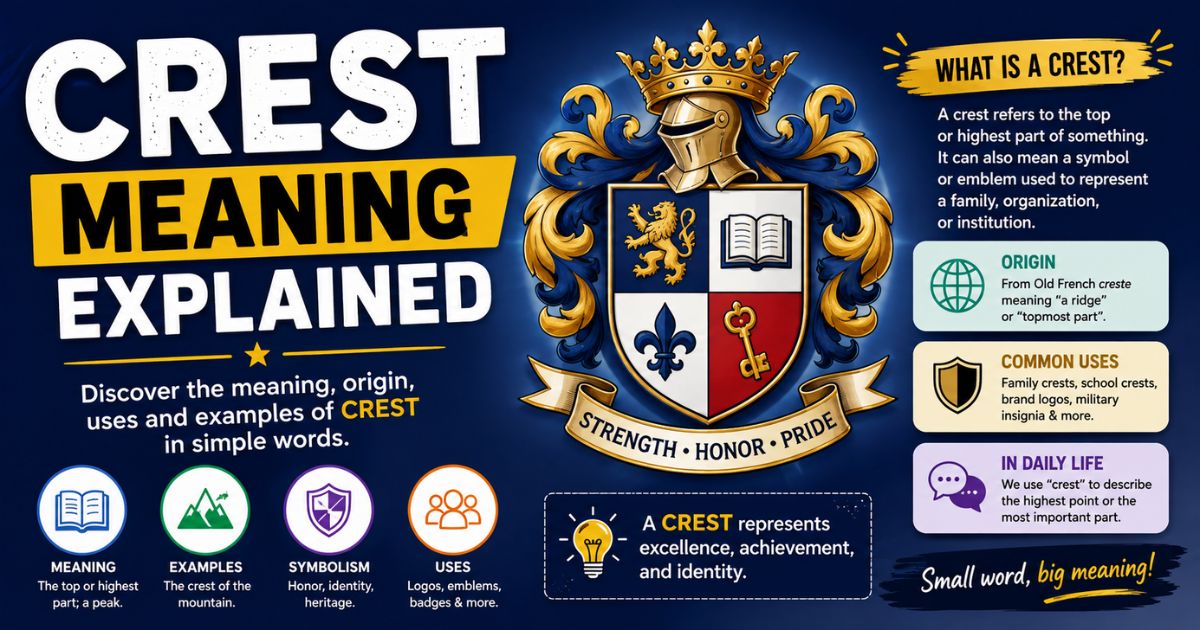
Have you ever heard someone talk about the crest of a wave, the crest of a hill, or even a family crest and wondered what the word crest actually means? You’re not alone. It’s one of those English words that appears in many different contexts, from geography and science to history and everyday conversations.
The crest meaning changes slightly depending on where it’s used, but the core idea remains the same. In simple terms, a crest usually refers to the highest point, top part, or a distinctive feature on something. It can describe the peak of a mountain, the highest part of an ocean wave, a decorative emblem representing a family, or even a tuft of feathers on a bird’s head.
In this guide, you’ll learn what does crest mean, how to use it correctly, its origin, common examples, related words, and the differences between crest, peak, summit, and other similar terms. Whether you’re learning English, improving your vocabulary, or simply curious about the word, this article will give you everything you need to know.
What Does Crest Mean?
The crest meaning is:
Crest (noun): The highest point, top edge, or a distinctive feature that rises above the rest.
Although the definition sounds simple, the word is surprisingly versatile. That’s why you’ll find it in dictionaries, textbooks, literature, and everyday speech.
For example:
- The crest of a hill is its highest point.
- The crest of a wave is the top part before it breaks.
- A family crest is a symbol representing a family’s heritage.
- Some birds have a crest made of feathers on top of their heads.
The exact meaning depends on the context, but it always relates to something that stands out or rises above its surroundings.
Simple Definition
In everyday English, crest means:
- The highest part of something.
- A raised feature or ridge.
- A symbol or emblem representing a family, organization, or institution.
- A tuft of feathers or hair on the head of certain animals.
Because of these multiple meanings, crest is a valuable word to understand if you’re expanding your English vocabulary.
Crest Pronunciation
The word crest is pronounced:
/krest/
It rhymes with words like:
- Best
- Rest
- Nest
- Test
It’s a one-syllable word that’s easy to pronounce once you’ve heard it a few times.
Crest Meaning in Different Contexts
One reason people search for crest meaning explained is that the word appears in many different subjects. Let’s explore the most common ones.
Crest in Geography
In geography, a crest refers to the highest point of a natural landform, such as a hill, ridge, or mountain.
For example:
- We stopped at the crest of the hill to enjoy the view.
- Snow covered the mountain’s crest throughout winter.
Think of a crest as the point where you stop climbing because you’ve reached the top.
Crest in Waves
If you’ve ever watched the ocean, you’ve seen a wave rise before crashing onto the shore.
That highest part is called the crest.
Example:
- The surfer balanced perfectly on the crest of the wave.
- Strong winds created high wave crests along the coast.
In weather reports and marine forecasts, the word crest is commonly used to describe wave height.
Crest in Heraldry
A family crest is one of the oldest meanings of the word.
Historically, knights wore decorative symbols on top of their helmets during battles and tournaments. Over time, these symbols became associated with noble families and eventually evolved into family crests and coats of arms.
Today, people often use “family crest” to refer to a family’s historical emblem, although in traditional heraldry, a crest is technically just one part of a larger coat of arms.
Examples include:
- University crests
- Military crests
- Club crests
- Family crests
These symbols often represent history, achievements, values, or identity.
Crest in Biology
In biology, a crest is a raised structure found on certain animals.
For example:
- A rooster has a bright red crest on its head.
- Cockatoos can raise and lower their feather crest.
- Some dinosaurs are believed to have had crests for display or communication.
The crest often helps with communication, attracting mates, or identifying species.
Read More: Pookie Meaning: What It Really Means in Text, TikTok & Social Media (2026 Guide)
Crest in Everyday English
Outside science and history, people use crest figuratively.
For example:
- The company reached the crest of its success.
- She was riding the crest of public popularity.
Here, crest represents the highest point of achievement or success rather than a physical location.
This figurative meaning appears frequently in books, newspapers, speeches, and business writing.
Quick Meaning Table
| Context | Meaning of Crest | Example |
|---|---|---|
| Geography | Highest point of land | Crest of a hill |
| Ocean | Top of a wave | Crest of the wave |
| Heraldry | Decorative emblem | Family crest |
| Biology | Raised feathers or structure | Bird’s crest |
| Figurative | Highest level of success | Crest of popularity |
| Architecture | Decorative top section | Roof crest |
Origin and History of the Word “Crest”
The word crest has a long and fascinating history.
It comes from the Latin word crista, which meant tuft, plume, or comb, especially the comb on a rooster’s head.
From Latin, it passed into Old French as creste, before becoming crest in Middle English.
Originally, the word referred to something that stood upright or projected upward, such as feathers or decorative helmet ornaments.
Over centuries, its meaning expanded to include:
- Hilltops
- Mountain ridges
- Ocean waves
- Family symbols
- Peaks of success
Despite these different uses, the central idea has remained the same: something that rises above everything else.
How to Use “Crest” Correctly
Now that you know the crest meaning, the next step is learning how to use the word naturally. Although crest has several meanings, it’s easy to use once you understand the context.
Here are the most common situations where you’ll see or hear the word.
In Daily Conversations
People often use crest when talking about places, nature, or achievements.
Examples:
- We finally reached the crest of the hill after a long hike.
- The sun appeared just above the mountain’s crest.
- She stood on the crest of the sand dune and admired the view.
These examples all refer to the highest point of something.
In Writing
Writers frequently use crest to create vivid descriptions.
For example:
The golden sunlight touched the crest of every wave.
Dark clouds gathered over the crest of the mountain.
Because the word paints a clear picture, it’s popular in novels, travel writing, and poetry.
In Academic Contexts
You’ll also encounter crest in textbooks covering subjects like geography, biology, history, and oceanography.
Examples include:
- The crest of the wave is measured when studying wave height.
- Certain bird species develop colorful crests during mating season.
- Medieval knights displayed decorative crests on their helmets.
Real-Life Examples of Crest
Seeing the word in complete sentences makes it much easier to remember.
Geography
- We paused at the crest of the hill to enjoy the sunset.
- Snow remained on the mountain crest throughout spring.
Ocean
- The surfer rode the crest of the wave all the way to shore.
- The boat rose gently as it crossed each wave crest.
Family Crest
- Their family crest dates back hundreds of years.
- The old castle displayed the royal crest above its entrance.
Birds
- The cockatoo raised its colorful crest when it became excited.
- The rooster’s bright red crest made it easy to recognize.
Figurative Examples
- The company reached the crest of its success after launching a new product.
- The singer was at the crest of her career when she won multiple awards.
These examples show that crest can describe both physical objects and abstract ideas like success or popularity.
Crest Synonyms and Antonyms
Learning related words helps you expand your vocabulary and choose the right word for different situations.
Synonyms of Crest
Depending on the context, crest may be replaced with:
- Peak
- Summit
- Top
- Apex
- Ridge
- Crown
- High point
- Pinnacle
- Tip
- Vertex
Each synonym has a slightly different meaning, so choose carefully.
For example, peak and summit usually refer to mountains, while apex is often used in formal or scientific writing.
Antonyms of Crest
Common opposites include:
- Bottom
- Base
- Foot
- Valley
- Low point
- Depression
- Hollow
Example:
The hikers climbed from the valley to the crest of the mountain.
Common Phrases with Crest
The word crest appears in several common English expressions.
At the Crest of a Wave
This phrase can be literal or figurative.
Literal:
The surfer balanced at the crest of the wave.
Figurative:
The company is riding the crest of recent success.
In both cases, it refers to being at the highest point.
Crest of a Hill
One of the most common uses.
Example:
A small farmhouse stood on the crest of the hill.
Ride the Crest
This idiom means to enjoy a period of success or popularity.
Example:
The athlete rode the crest of public admiration after winning the championship.
Crestfallen (Related Word)
Although it looks similar, crestfallen has a different meaning.
It means:
Feeling disappointed, discouraged, or dejected.
Example:
He looked crestfallen after hearing the news.
Interestingly, the word comes from the image of a bird lowering its crest when it loses confidence.
Common Mistakes People Make
Even native English speakers occasionally misuse the word.
Here are the most common mistakes.
Confusing Crest with Peak
Although similar, they aren’t always identical.
A peak is usually a pointed mountain top.
A crest can refer to any highest point, including hills, waves, roofs, or figurative situations.
Thinking Family Crest Means the Entire Coat of Arms
Many people use these terms interchangeably.
Technically:
- A coat of arms is the complete heraldic design.
- A crest is only one element, usually positioned above the shield.
In everyday conversation, however, “family crest” is widely accepted.
Using Crest Only for Mountains
Some learners believe crest applies only to hills or mountains.
In reality, it can describe:
- Ocean waves
- Birds
- Helmets
- Buildings
- Success
- Hairstyles
- Symbols
Its meaning is much broader than many people realize.
Crest vs Similar Words
Choosing the right word can make your writing more precise.
Crest vs Peak
| Crest | Peak |
|---|---|
| Highest part of many objects | Pointed top of a mountain |
| Used literally and figuratively | Mostly physical landforms |
Crest vs Summit
| Crest | Summit |
|---|---|
| Highest edge or ridge | Exact highest point of a mountain |
A mountain may have a long crest but only one summit.
Crest vs Ridge
| Crest | Ridge |
|---|---|
| Top line of a ridge | Long elevated landform |
Think of the ridge as the entire raised area and the crest as its highest line.
Crest vs Crown
These words sometimes overlap but differ slightly.
Crown usually refers to:
- The top of a person’s head
- A royal headpiece
- The upper part of a tree
Crest refers more generally to raised tops or distinctive upper features.
Why Understanding “Crest” Matters
Learning the crest meaning does more than improve your vocabulary. It helps you understand books, news articles, documentaries, travel guides, scientific texts, and everyday conversations with greater confidence.
Because the word appears in so many contexts—from geography and oceanography to history and biology—it’s a useful addition to your English vocabulary. Once you recognize that crest usually refers to the highest point or a distinctive raised feature, you’ll find it much easier to understand and use naturally.
Whether you’re describing the crest of a wave, identifying a family crest, or talking about reaching the crest of success, the word conveys the idea of standing above the rest.
Frequently Asked Questions
What is the literal meaning of crest?
The literal meaning of crest is the highest point or top part of something, such as a hill, wave, or mountain. It can also refer to a raised feature like a bird’s feathers or a decorative emblem.
What does crest mean in geography?
In geography, a crest is the highest part of a hill, ridge, or mountain. It marks the point where the land reaches its greatest elevation before sloping downward.
Is crest the same as peak?
Not exactly. A peak is typically a pointed mountain top, while a crest is any highest point or upper edge. For example, waves have crests but not peaks in standard usage.
What does crest mean in a wave?
The crest of a wave is the highest point of the wave just before it begins to fall or break. It’s the opposite of the trough, which is the lowest point.
What is a family crest?
A family crest is a symbolic design associated with a family or lineage. Traditionally, it was part of a larger coat of arms and represented identity, heritage, or achievements.
How do you use crest in a sentence?
Here are a few examples:
- We reached the crest of the hill before sunset.
- The surfer rode the crest of the wave.
- Their family crest has been passed down for generations.
- The company is at the crest of its success.
Final Thoughts
The crest meaning may seem simple at first, but it’s a versatile word with applications across geography, history, biology, literature, and everyday English. At its core, crest refers to the highest point or a distinctive feature that stands above its surroundings.
By understanding the different meanings and contexts, you’ll be able to use the word accurately and confidently in both speech and writing. Whether you’re reading about the crest of a mountain, the crest of a wave, or a family crest, you’ll know exactly what it means and why it’s being used.
Expanding your vocabulary with words like crest not only improves your English but also makes reading and communication more enjoyable. The next time you come across this word, you’ll recognize its meaning instantly and appreciate the rich history behind it.
