
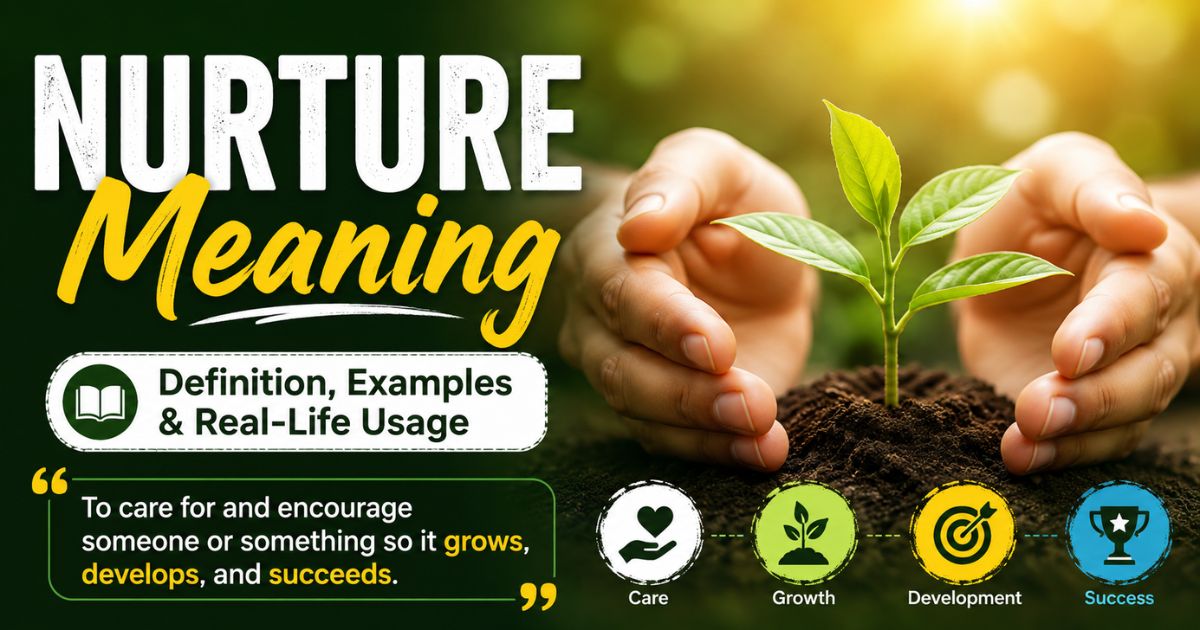
What does it really mean to nurture someone or something?
You may hear the word in conversations about parenting, relationships, education, personal growth, business, or even gardening. Although nurture sounds simple, it carries a deeper idea: helping something or someone develop through care, attention, encouragement, and support.
The nurture meaning can change slightly depending on the context. You might nurture a child by providing love and guidance, nurture a friendship by staying connected, or nurture a plant by giving it water and sunlight. In business, a company might nurture a customer relationship over time.
In simple terms, to nurture means to care for something or someone in a way that helps them grow, develop, or become stronger.
Understanding this word is useful because it describes more than basic care. Nurturing usually involves patience, consistency, and an active effort to support progress.
What Does Nurture Mean?
Nurture means to care for, encourage, protect, or support someone or something as it develops.
It can be used as both a verb and a noun.
As a verb:
“Parents nurture their children by providing love, guidance, and support.”
Here, nurture means helping children develop emotionally, socially, and physically.
As a noun:
“Children need proper nurture during their early years.”
In this form, nurture refers to the care, upbringing, or environment that supports development.
The word can apply to people, relationships, ideas, skills, plants, animals, and organizations.
For example:
- Nurture a child
- Nurture a friendship
- Nurture talent
- Nurture creativity
- Nurture an idea
- Nurture a business
- Nurture a plant
The central idea remains the same: providing conditions that encourage healthy growth.
Origin and Background of the Term
The word nurture has a long history in the English language.
It comes from Middle English and Old French forms related to care, feeding, and upbringing, ultimately connected to the Latin word nutrire, meaning “to feed” or “to nourish.”
That origin helps explain why nurture has always been connected with growth.
At first, the concept was closely associated with physically feeding and caring for children. Over time, its meaning expanded.
Today, you can nurture something that doesn’t need food at all.
You can nurture:
- A relationship
- A creative idea
- A skill
- A career
- A community
- Confidence
- An ambition
This broader meaning reflects an important idea: growth requires the right kind of support.
How Nurture Is Used in Daily Life
You probably encounter the concept of nurture more often than you realize.
Parenting
Parents nurture children by providing:
- Love
- Safety
- Food
- Education
- Encouragement
- Boundaries
- Emotional support
Nurturing isn’t about giving a child everything they want. Healthy nurture also involves teaching responsibility and helping children develop independence.
Relationships
A healthy relationship needs ongoing attention.
You can nurture a friendship by checking in, listening, remembering important moments, and being there when someone needs support.
For example:
“They nurtured their friendship despite living in different cities.”
The sentence suggests that both people actively maintained the relationship.
Education
Teachers nurture students by encouraging curiosity and creating opportunities to learn.
A teacher might notice that a student has a talent for writing and encourage them to develop it.
That’s nurturing a skill.
Career Development
You can also nurture your career.
Learning new skills, seeking feedback, building professional relationships, and taking on meaningful challenges can help your career grow over time.
Gardening and Nature
The literal meaning of nurture is especially easy to understand when talking about plants.
“She nurtured the seedlings until they were strong enough to move outdoors.”
Water, sunlight, nutrients, and attention provide the conditions needed for growth.
That same basic idea applies metaphorically to people and relationships.
Emotional or Practical Meaning of Nurture
The word nurture can describe both emotional and practical support.
Emotional Nurture
Emotional nurturing involves helping someone feel:
- Loved
- Safe
- Valued
- Heard
- Encouraged
- Supported
For example:
“Her parents nurtured her confidence.”
This doesn’t mean they simply told her she was great. They may have encouraged her to try new things, helped her learn from mistakes, and supported her when she struggled.
Read More: Crest Meaning Explained: Definition, Uses, Examples & Origins (2026 Guide)
Practical Nurture
Practical nurturing involves providing tangible support.
For example:
“The organization nurtures young entrepreneurs by providing training and funding.”
Here, nurture means creating conditions that make development easier.
The distinction is useful because nurturing isn’t always emotional. Sometimes it’s about resources, opportunities, guidance, or protection.
Similar or Related Terms
Several words are closely related to nurture, but they aren’t perfect synonyms.
Care
To care means to provide attention, concern, or support.
Nurture often suggests care specifically intended to encourage growth.
Encourage
To encourage means to give someone confidence or motivation.
Nurturing may include encouragement, but it usually involves more than words.
Support
Support means helping someone or something succeed or cope.
Nurture is a form of support focused strongly on development.
Nourish
Nourish literally means providing food or nutrients. Figuratively, it can mean supporting emotional or intellectual growth.
Foster
Foster means to encourage or promote development.
For example:
“The program fosters creativity.”
This is very close to:
“The program nurtures creativity.”
Cultivate
Cultivate originally relates to farming but is often used figuratively.
“She cultivated her writing skills.”
This means she deliberately developed them over time.
Common Misunderstandings About Nurture
Despite its straightforward definition, the word can sometimes be misunderstood.
Nurture Doesn’t Mean Spoil
Nurturing someone doesn’t mean giving them everything they want.
A parent can nurture a child while still setting boundaries and expectations.
In fact, healthy boundaries can be part of nurturing because they help children develop responsibility and emotional stability.
Nurturing Isn’t Always Gentle
People sometimes associate nurture with softness.
But nurturing can require honesty.
For example, a good mentor might tell you that your work needs improvement. If the feedback helps you develop, it can still be nurturing.
Nurture Isn’t Only About Children
The word is often associated with parenting, but its meaning is much broader.
You can nurture:
- Friendships
- Careers
- Ideas
- Businesses
- Talents
- Communities
- Plants
- Animals
Nurture Usually Implies Time
Nurturing rarely happens instantly.
It suggests an ongoing process.
A single compliment may encourage someone, but consistently supporting their development is more accurately described as nurturing.
Examples of Nurture in Sentences
Here are natural examples showing different uses of the word.
Personal Development
“She nurtured her confidence by practicing public speaking.”
Parenting
“Parents play an important role in nurturing their children’s emotional development.”
Friendship
“They made an effort to nurture their friendship after moving apart.”
Education
“The teacher nurtured his interest in science.”
Business
“The company uses regular communication to nurture customer relationships.”
Creativity
“Reading widely helped nurture her creativity.”
Nature
“The gardener carefully nurtured the young plants.”
Ideas
“The team nurtured the idea until it became a workable business plan.”
Community
“Local programs help nurture a stronger sense of community.”
Talent
“The coach recognized her talent and nurtured it over several years.”
These examples demonstrate why nurture meaning depends partly on the object being nurtured. The action may look different, but the underlying idea remains growth through care and support.
Why Understanding Nurture Matters Today
The concept of nurture matters because development rarely happens in isolation.
People need environments that allow them to learn, make mistakes, receive feedback, and improve.
A child may have natural abilities, but supportive parenting and education can help those abilities develop.
An employee may have potential, but good mentoring can turn that potential into practical expertise.
A friendship may begin naturally, but maintaining it usually requires attention.
The same principle applies to businesses and creative projects.
Think of nurture like tending a garden. Planting a seed is only the beginning. The plant needs water, light, nutrients, and time. Human development works differently, of course, but the analogy captures the basic idea: potential needs the right conditions to grow.
Understanding nurture also encourages people to think beyond quick results.
Instead of asking:
“Why hasn’t this grown yet?”
you might ask:
“What conditions would help it grow?”
That shift can be useful in parenting, education, relationships, leadership, and personal development.
Frequently Asked Questions
What does nurture mean in simple words?
Nurture means to care for, support, and encourage someone or something so it can grow or develop. For example, parents nurture children, gardeners nurture plants, and people nurture friendships.
Is nurture positive or negative?
Nurture is generally positive. It usually describes care, encouragement, protection, and support that helps someone or something develop. However, the quality of nurturing depends on how that care is provided.
Where is nurture commonly used?
Nurture is commonly used when discussing parenting, education, relationships, personal development, careers, business, psychology, gardening, and emotional well-being.
Is nurture formal or informal?
Nurture is a standard English word and can be used in both formal and informal writing. You’ll find it in everyday conversations as well as academic, professional, and educational contexts.
For example:
“The program aims to nurture young talent.”
This sentence is perfectly appropriate in a professional report.
Why do people search for nurture?
People may search for the nurture meaning because they encounter the word in parenting discussions, relationships, education, psychology, personal development, or phrases such as “nature vs. nurture.”
They may also want to understand how the word differs from terms such as care, support, encourage, foster, and cultivate.
Conclusion
The nurture meaning centers on care, support, encouragement, and growth.
To nurture someone or something means to provide the attention, resources, guidance, or environment needed for development. You can nurture a child, friendship, skill, idea, career, business, plant, or community.
The word has its roots in the idea of feeding and nourishing, but its modern meaning has expanded far beyond physical care. Today, nurture often describes the long-term process of helping potential become reality.
A simple way to remember it is:
Nurture means helping something grow by giving it the care and support it needs.
Whether you’re supporting a child, developing a talent, strengthening a relationship, or growing an idea, nurture is ultimately about creating the conditions in which growth can happen.
