
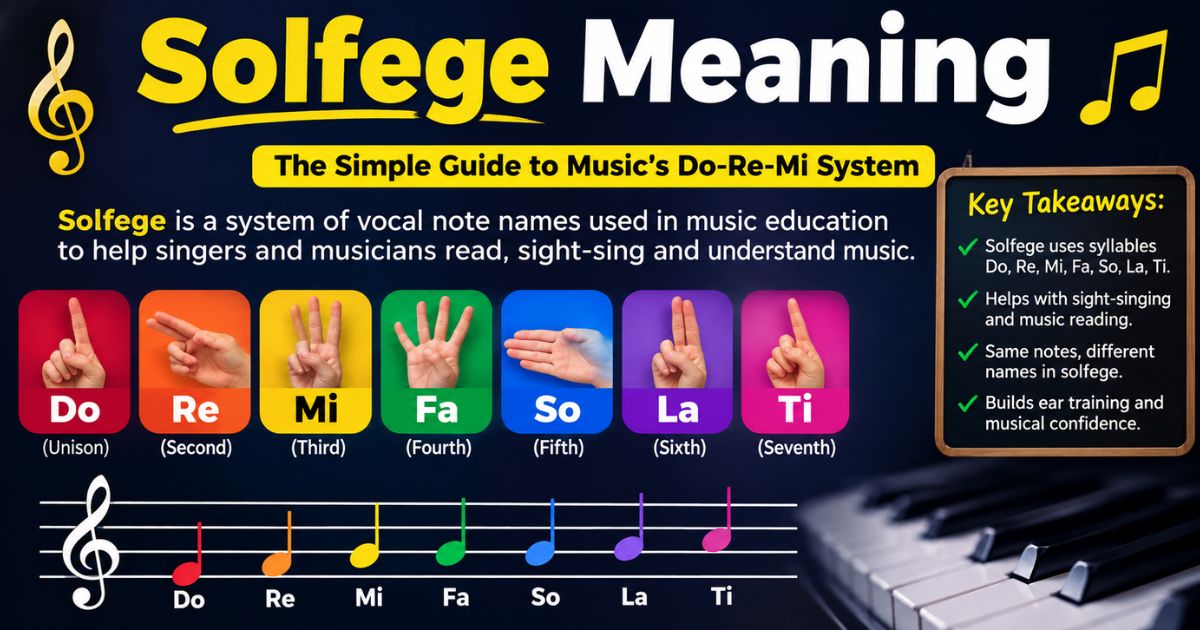
Have you ever heard a singer practice with sounds like “do, re, mi, fa, sol, la, ti” and wondered what those syllables actually mean?
That system is called solfege, also spelled solfège. It’s one of the most useful tools in music education because it helps you connect what you see on a musical page with what you hear and sing.
In simple terms, solfege is a method of teaching and learning music by assigning syllables to musical notes or scale degrees. The familiar sequence is do, re, mi, fa, sol, la, ti, followed by do again at the octave.
But solfege isn’t just about memorizing seven words. Depending on the system, the syllables can help musicians understand pitch relationships, improve sight-singing, develop their ears, and learn melodies more accurately.
Meaning & Definition of Solfege
Solfege is a music-training system that uses syllables to represent notes or scale degrees.
The most familiar sequence is:
Do – Re – Mi – Fa – Sol – La – Ti – Do
You may also see “so” instead of “sol,” depending on the teaching system or country.
Primary Meaning:
The primary solfege meaning is a system for learning and practicing pitch through specific syllables.
Instead of singing a melody only with lyrics, a student can sing:
Do – Re – Mi – Fa – Sol
This makes it easier to focus on the musical pitches themselves.
Solfege can be especially helpful when you’re learning to recognize how notes move relative to one another.
For example, if you know the sound of do to mi, you can begin to recognize that interval when you hear it in another melody.
Secondary Meaning:
Solfege can also refer more broadly to ear-training and sight-singing techniques that use these syllables.
There are two major approaches you’ll commonly encounter:
Fixed-do solfege: “Do” represents the same pitch every time. This approach is common in several European music traditions.
Movable-do solfege: “Do” represents the first degree of the current major key, or the tonal center in systems that adapt it to different keys.
For example, in movable-do, the same melody pattern can be sung with the same syllables even when the entire song is transposed to another key.
That’s one reason solfege is so useful for understanding musical relationships rather than simply memorizing absolute pitches.
Background & Origin of Solfege
The history of solfege goes back centuries.
The system is strongly associated with Guido of Arezzo, an Italian music theorist and teacher who lived around the 11th century. Guido developed an influential method for teaching singers to learn melodies and pitches more efficiently.
The original syllables came from the opening syllables of lines in a medieval Latin hymn traditionally known as “Ut queant laxis.”
The early sequence used:
Ut – Re – Mi – Fa – Sol – La
The syllable “Ut” eventually became “Do” in many traditions because “Do” was easier to sing and pronounce.
Later, the note Ti was added in systems that use the seven syllables.
Over time, solfege developed into several different teaching traditions. Today, you’ll find variations in conservatories, schools, choirs, universities, and private music lessons around the world.
Usage in Different Contexts
Solfege isn’t limited to one type of musician. It can be useful anywhere people need to understand pitch.
1. Music Education
Music teachers often introduce solfege to help students understand scales, melodies, and pitch relationships.
Rather than asking a beginner to memorize every note separately, a teacher can demonstrate how notes relate to one another through syllables.
For example:
Do – Re – Mi – Re – Do
can represent a simple melodic pattern.
Students gradually learn to hear and reproduce that pattern.
2. Singing Practice
Singers use solfege for vocal exercises, pitch accuracy, and sight-singing.
A vocal teacher might play a sequence of notes and ask a student to sing:
Do – Mi – Sol – Mi – Do
The exercise isn’t about the words themselves. It’s about hearing and producing the correct pitches.
Over time, this can strengthen a singer’s pitch control and musical memory.
3. Music Production
Solfege isn’t normally a replacement for notation or digital production tools, but producers can still benefit from understanding it.
Knowing scale degrees makes it easier to discuss melodies, harmonies, and chord relationships.
For example, a producer might describe a melody as moving from the tonic to the third and fifth rather than relying only on specific note names.
That becomes especially useful when changing the key of a song.
4. Choir Training
Choirs frequently use solfege during rehearsals.
A conductor might have different sections sing their parts using syllables before introducing the lyrics.
This can help singers focus on:
- Pitch
- Intervals
- Rhythm
- Harmony
- Vocal entrances
- Key relationships
It’s particularly helpful when a choir is learning a complicated piece.
5. Personal Learning
You don’t need to attend a conservatory to benefit from solfege.
If you’re teaching yourself music, you can use solfege to practice:
- Scales
- Ear training
- Sight-singing
- Intervals
- Melody recognition
- Pitch matching
Even a few minutes of daily practice can make musical patterns easier to recognize.
Meanings Across Platforms (WhatsApp, Instagram, TikTok, Snapchat)
Solfege isn’t primarily internet slang, so its meaning doesn’t significantly change across social platforms.
However, you may encounter the word in music-related content.
Music teachers, students, and choir members may use WhatsApp to share solfege exercises, recordings, or lesson material.
Someone might text:
“Practice do-re-mi before tomorrow’s lesson.”
Here, solfege refers directly to music practice.
Instagram musicians and vocal coaches may use solfege in educational posts, Reels, and tutorials.
For example, a singer might demonstrate an exercise such as:
“Do – Re – Mi – Fa – Sol”
and explain how each pitch relates to the scale.
Read More: Crest Meaning Explained: Definition, Uses, Examples & Origins (2026 Guide)
TikTok
TikTok has made music education more accessible through short tutorials.
Creators may explain solfege using:
- Singing exercises
- Ear-training challenges
- Vocal warmups
- Music theory lessons
- Popular song examples
The platform can make a technical concept feel much easier to understand because users can actually hear the pitches.
Snapchat
Solfege may occasionally appear in conversations between music students, singers, teachers, and musicians.
For example:
“I finally got that solfege exercise right 😂.”
In this context, it simply refers to the student’s music practice.
Other Fields & Technical Relevance
Solfege is primarily associated with music theory, music education, vocal training, and ear training.
It isn’t a technical acronym with separate meanings in fields such as medicine or engineering.
However, its concepts connect with several areas of music study.
Ear training: Solfege helps students identify and reproduce pitches.
Sight-singing: Singers use syllables to perform unfamiliar melodies from written music.
Music theory: Solfege can help explain scale degrees and tonal relationships.
Choir education: Directors can use syllables to teach vocal parts.
Aural skills: Students develop the ability to hear intervals, scales, and melodic patterns.
So while the word itself belongs mainly to music, its practical applications are broad.
Common Misconceptions & Mistakes
One common misconception is that solfege simply means “do, re, mi.”
Those syllables are a major part of solfege, but the concept is broader. Solfege is a teaching and training system designed to connect syllables with musical pitch relationships.
Another misconception is that there is only one correct solfege system.
There are different approaches, particularly fixed-do and movable-do.
A further mistake is assuming that solfege is only for children.
Professional singers, conductors, composers, university music students, and instrumentalists can all use it.
It’s also incorrect to assume that you must already be a strong singer to learn solfege. In fact, beginners often use it precisely because it helps build musical skills from the ground up.
Similar Terms & Alternatives
Solfege is closely related to several music concepts, but they aren’t identical.
Scale: An ordered sequence of notes.
Scale degrees: The positions of notes within a scale.
Ear training: Exercises designed to improve musical hearing and recognition.
Sight-singing: Singing music from notation without having heard it beforehand.
Letter names: Note names such as A, B, C, D, E, F, and G.
Number system: A method that identifies scale degrees using numbers instead of solfege syllables.
For example, in a major scale:
Do = 1
Re = 2
Mi = 3
Fa = 4
Sol = 5
La = 6
Ti = 7
The exact relationship can vary depending on the solfege system being taught.
How to Respond to “Solfege Meaning” in Chat
If someone asks you “What does solfege mean?”, a simple answer is:
“Solfege is a music-learning system that uses syllables like do, re, mi, fa, sol, la, and ti to represent notes or scale degrees.”
For a shorter casual response, you could say:
“It’s the do-re-mi system used to learn music and pitch.”
If someone asks why musicians use it, you can explain:
“It helps singers and musicians hear, understand, and reproduce musical notes and relationships.”
Differences From Similar Words
Solfege and solfège refer to the same basic concept. The difference is mainly spelling and language tradition.
Solfege is the simplified spelling commonly used in English.
Solfège retains the French-style accented spelling.
The terms do-re-mi and solfege are also related but aren’t exactly interchangeable. Do, re, mi, and the other syllables are the building blocks used within solfege systems.
Likewise, music theory is much broader than solfege. Music theory includes harmony, rhythm, notation, scales, chords, form, counterpoint, and many other concepts.
Relevance in Online Conversations & Learning Apps
Solfege remains highly relevant because digital tools have made music education more interactive.
Modern learning apps can combine:
- Audio examples
- Visual notation
- Pitch detection
- Singing exercises
- Ear-training games
- Interactive quizzes
A learner might see a sequence such as:
Do – Mi – Sol
and then sing it into a microphone.
Some software can analyze the pitch and provide immediate feedback.
This turns solfege from something traditionally practiced with a teacher or piano into something you can work on independently.
Online tutorials have also made it easier to hear the difference between intervals and scale degrees.
Popularity & Trends Over Time
Solfege has survived for centuries because it solves a basic musical problem: how do you teach people to hear and reproduce pitch relationships?
The tools have changed, but that need hasn’t.
In traditional classrooms, students may have practiced with a teacher and piano.
Today, the same principles appear in:
- YouTube lessons
- Music-learning apps
- Online courses
- Digital keyboards
- Vocal-training software
- Choir resources
- Ear-training platforms
The rise of online music education has made solfege accessible to people who might never have studied it in a traditional classroom.
Its continued use also shows that some fundamental music-learning methods remain valuable even as technology changes.
FAQs
1. What is solfege meaning in simple words?
Solfege is a way of learning music using syllables such as do, re, mi, fa, sol, la, and ti.
It helps musicians understand and reproduce pitches and musical relationships.
2. Is solfege only for singers?
No.
Although singers often use solfege, instrumentalists can benefit from it too.
It can improve ear training, pitch recognition, sight-reading, and understanding of musical structure.
3. Who invented solfege?
Solfege is strongly associated with Guido of Arezzo, an 11th-century Italian music theorist and teacher.
He developed an influential system for teaching singers, and the original solfege syllables were derived from a medieval hymn.
The modern system developed gradually over time rather than being created in exactly its present form by one person.
4. Is solfege still used today?
Yes.
Solfege remains common in music schools, conservatories, vocal lessons, choirs, universities, and online music education.
Different countries and teachers may use different approaches.
5. What is the purpose of solfege?
The main purpose is to help musicians hear, understand, remember, and reproduce musical pitches and relationships.
It can improve sight-singing, ear training, pitch accuracy, and overall musical understanding.
Conclusion
The solfege meaning is simple once you see how the system works.
Solfege is a method of music education that uses syllables such as do, re, mi, fa, sol, la, and ti to help musicians understand pitch and musical relationships.
It has roots stretching back to the medieval period and is strongly associated with Guido of Arezzo, whose teaching system helped establish the foundation for the syllables used today.
Solfege isn’t just a children’s “do-re-mi” exercise. Singers use it to improve pitch, choirs use it to learn parts, music students use it for ear training, and musicians can use it to understand melodies and scale relationships.
The most important thing to remember is that there isn’t only one approach. Fixed-do and movable-do systems serve different purposes, and different music traditions teach solfege in different ways.
