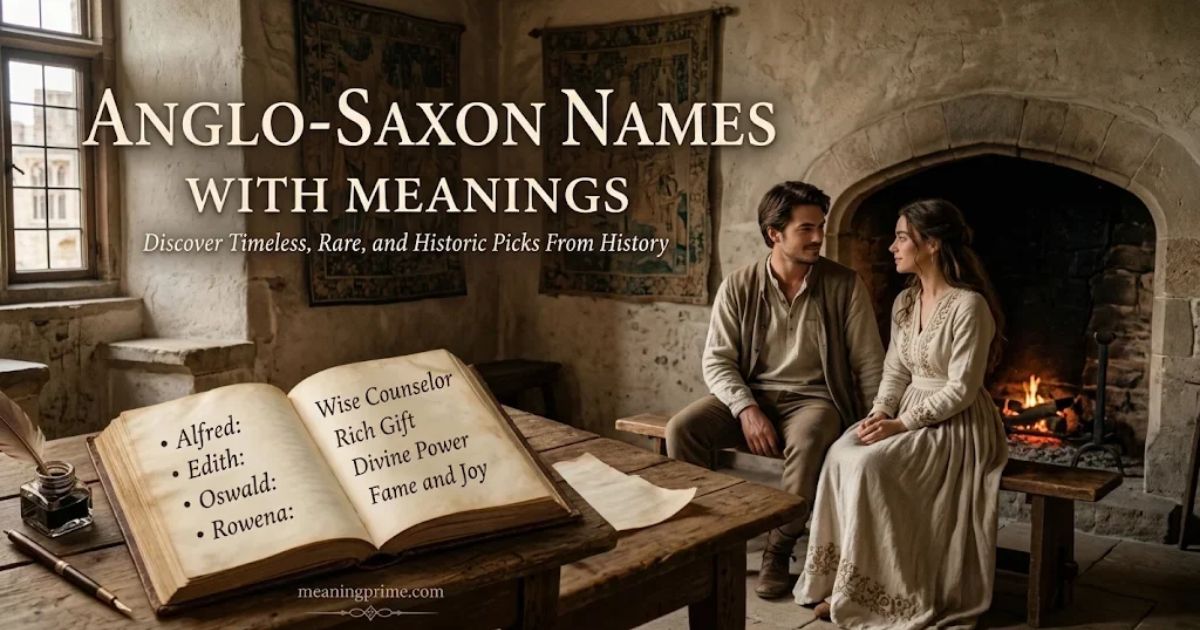
Are you searching for a name that feels ancient, meaningful, and full of character? Anglo-Saxon names offer a wonderful combination of history, strength, and timeless beauty. Dating back to early medieval England, these names often reflect qualities such as bravery, wisdom, royalty, friendship, protection, and prosperity.
From traditional male names like Alfred, Edward, and Wulfric to beautiful female names like Edith, Hilda, and Æthelflæd, there’s something for every taste. Some names remain familiar today, while others are rare historical discoveries that deserve more attention.
Whether you’re choosing a baby name, researching your ancestry, creating a medieval character, or exploring Old English culture, this collection of Anglo-Saxon names with meanings will help you find interesting options for boys and girls.
What Are Anglo-Saxon Names?
Anglo-Saxon names are personal names used by the Germanic-speaking communities who settled in parts of Britain from around the fifth century onward. Their language, known as Old English, played a major role in shaping modern English.
These names often had meaningful elements connected to personal qualities, family traditions, nature, religion, and social status. Parents frequently chose names that expressed the qualities they hoped their children would develop.
For example, Alfred comes from Old English elements associated with elves and counsel, while Edward combines elements meaning prosperity and guardian.
Anglo-Saxon names commonly reflected:
- Strength and bravery: Names connected to warriors, wolves, battles, and protection.
- Royal heritage: Names containing elements associated with nobility and leadership.
- Friendship: Names expressing loyalty, affection, and companionship.
- Prosperity: Names connected to wealth, good fortune, and valuable gifts.
- Nature: Names inspired by animals, stones, and the natural environment.
- Faith: Names connected to religious beliefs and divine protection.
Old English spelling also makes these names distinctive. Letters such as Æ, þ, and ð appeared in the language, representing sounds that aren’t written in the same way in modern English.
Understanding these historical roots makes it easier to appreciate why Anglo-Saxon names remain interesting choices for modern families.
Anglo-Saxon Names Male
Anglo-Saxon male names often expressed courage, leadership, protection, and noble character. Many were formed by combining two Old English elements, creating names with meanings that reflected the values of early English society.
Some were associated with kings and powerful nobles, while others appeared in religious records and historical documents.
Here are 35 male Anglo-Saxon names worth exploring.
| Name | Meaning |
|---|---|
| Alfred | Elf counsel |
| Edward | Prosperous guardian |
| Edmund | Prosperous protector |
| Edwin | Prosperous friend |
| Harold | Army ruler |
| Æthelred | Noble counsel |
| Æthelstan | Noble stone |
| Æthelberht | Noble brightness |
| Godric | Divine ruler |
| Godwin | God’s friend |
| Leofric | Beloved ruler |
| Wulfric | Wolf ruler |
| Wulfstan | Wolf stone |
| Oswald | Divine ruler |
| Oswine | Divine friend |
| Osric | Divine ruler |
| Beorn | Warrior or nobleman |
| Hereward | Army guardian |
| Cuthbert | Famous brightness |
| Dunstan | Dark stone |
| Ælfred | Elf counsel |
| Ælfric | Elf ruler |
| Ælfwine | Elf friend |
| Æthelwulf | Noble wolf |
| Eadgar | Prosperity spear |
| Eadric | Prosperous ruler |
| Eadweard | Prosperous guardian |
| Cynewulf | Royal wolf |
| Cyneric | Royal ruler |
| Wulfhere | Wolf army |
| Beornwulf | Warrior wolf |
| Sigebeorht | Victory brightness |
| Ealdred | Ancient counsel |
| Leofwine | Beloved friend |
| Godmund | Divine protection |
These names offer a variety of personalities. Alfred and Edward feel familiar and traditional, while Wulfric and Æthelstan have a stronger medieval character.
Read More: TMB Means: Full Meaning, Common Uses & Real-Life Text Examples
Anglo-Saxon Names Girl
Anglo-Saxon female names often carried beautiful meanings connected to prosperity, friendship, peace, beauty, and strength.
Many historical women had names combining elements such as ēad (prosperity), gifu (gift), hild (battle), and wynn (joy).
Here are 35 female Anglo-Saxon names and their meanings.
| Name | Meaning |
|---|---|
| Edith | Prosperity in battle |
| Hilda | Battle |
| Æthelflæd | Noble beauty |
| Æthelthryth | Noble strength |
| Eadgifu | Prosperous gift |
| Eadburh | Prosperity fortress |
| Ealdgyth | Ancient battle |
| Ælfgifu | Elf gift |
| Ælfthryth | Elf strength |
| Ælfwynn | Elf joy |
| Ælfflæd | Elf beauty |
| Cyneburh | Royal fortress |
| Cynegifu | Royal gift |
| Osburh | Divine fortress |
| Wulfhild | Wolf battle |
| Wulfgifu | Wolf gift |
| Godgifu | God’s gift |
| Mildred | Gentle strength |
| Mildburg | Gentle fortress |
| Leofrun | Beloved mystery |
| Leofgifu | Beloved gift |
| Leofwynn | Beloved joy |
| Ealhswith | Temple strength |
| Frideswide | Strong peace |
| Hildburh | Battle fortress |
| Hildgyth | Battle strength |
| Wynflæd | Joyful beauty |
| Oswynn | Divine joy |
| Eadgyth | Prosperity battle |
| Eadwynn | Prosperity joy |
| Eadflaed | Prosperity beauty |
| Æthelgyth | Noble battle |
| Æthelgifu | Noble gift |
| Mildgyth | Gentle battle |
| Ælfgyth | Elf battle |
Some of these names are extremely rare today, making them interesting choices if you prefer something outside modern naming trends.
For a familiar option, Edith or Hilda works beautifully. If you want something more distinctive, Eadgifu, Æthelflæd, and Cyneburh offer fascinating historical connections.
List of Anglo-Saxon Names
If you want more variety, this larger list brings together traditional male and female names, along with additional Old English forms.
The meanings are based on historical name elements, although some individual names have uncertain origins or spelling variations.
Male names:
- Alfred — Elf counsel.
- Ælfric — Elf ruler.
- Ælfgar — Elf spear.
- Ælfhere — Elf army.
- Ælfweard — Elf guardian.
- Ælfwine — Elf friend.
- Æthelred — Noble counsel.
- Æthelstan — Noble stone.
- Æthelberht — Noble brightness.
- Æthelwulf — Noble wolf.
- Æthelweard — Noble guardian.
- Æthelbald — Noble and bold.
- Æthelmund — Noble protector.
- Eadgar — Prosperity spear.
- Eadric — Prosperous ruler.
- Eadwine — Prosperous friend.
- Eadweard — Prosperous guardian.
- Eadmund — Prosperous protector.
- Eadwulf — Prosperity wolf.
- Godric — Divine ruler.
- Godwin — God’s friend.
- Godwine — God’s friend.
- Leofric — Beloved ruler.
- Leofwine — Beloved friend.
- Leofstan — Beloved stone.
- Wulfric — Wolf ruler.
- Wulfstan — Wolf stone.
- Wulfhere — Wolf army.
- Wulfgar — Wolf spear.
- Oswald — Divine ruler.
Female names:
- Æthelflæd — Noble beauty.
- Æthelthryth — Noble strength.
- Æthelburh — Noble fortress.
- Æthelgifu — Noble gift.
- Ælfgyth — Elf battle.
- Ælfwynn — Elf joy.
- Ælfflæd — Elf beauty.
- Ælfthryth — Elf strength.
- Eadgifu — Prosperous gift.
- Eadburh — Prosperity fortress.
- Eadgyth — Prosperity battle.
- Eadwynn — Prosperity joy.
- Ealdgyth — Ancient battle.
- Ealhswith — Temple strength.
- Cyneburh — Royal fortress.
- Cynegifu — Royal gift.
- Frideswide — Strong peace.
- Godgifu — God’s gift.
- Hilda — Battle.
- Wulfhild — Wolf battle.
- Mildred — Gentle strength.
- Mildburg — Gentle fortress.
- Osburh — Divine fortress.
- Leofrun — Beloved mystery.
- Leofgifu — Beloved gift.
- Wulfgifu — Wolf gift.
- Wynflæd — Joyful beauty.
- Eadflaed — Prosperity beauty.
- Oswynn — Divine joy.
- Ælfwaru — Elf protection.
These names provide a starting point for exploring Old English naming traditions. Some are well-attested historical personal names, while others are less common forms that should be checked against historical records if authenticity is important.
Anglo-Saxon Male Names and Meanings
Male Anglo-Saxon names frequently included elements associated with power, protection, bravery, and loyalty. Their construction reveals how important these qualities were in early English society.
Here are some additional names with their meanings and historical character.
| Name | Meaning | Style |
|---|---|---|
| Beorhtric | Bright ruler | Noble |
| Beorhtwulf | Bright wolf | Strong |
| Cenwulf | Bold wolf | Warrior |
| Cenric | Bold ruler | Royal |
| Cyneheard | Royal strength | Powerful |
| Cyneweard | Royal guardian | Protective |
| Ealdhelm | Ancient protection | Traditional |
| Ealdwulf | Ancient wolf | Fierce |
| Ealhhere | Temple army | Historical |
| Frithuwulf | Peace wolf | Distinctive |
| Garwulf | Spear wolf | Warrior |
| Heardric | Strong ruler | Powerful |
| Sigeric | Victory ruler | Noble |
| Sigeweard | Victory guardian | Protective |
| Sigewulf | Victory wolf | Bold |
| Osbeorn | Divine warrior | Strong |
| Osweald | Divine power | Royal |
| Wiglaf | Battle heir | Heroic |
| Ordgar | Spear power | Warrior |
| Hereweald | Army ruler | Leadership |
A particularly interesting feature is the repeated use of elements such as wulf, ric, and weard. These elements allowed families to create names that expressed different combinations of strength, authority, and protection.
For example, Wulfweard emphasizes guardianship, while Wulfric suggests a wolf-like ruler.
Viking and Anglo-Saxon Names
Viking and Anglo-Saxon names are often grouped together because both cultures have Germanic roots. However, they developed different languages, traditions, and naming customs.
Anglo-Saxon names generally came from Old English, while Viking names originated in Old Norse.
Manuscripts in the Anglo-Saxon Kingdoms – A Monument of Fame
The Christianization of Anglo-Saxon England | TheCollector
Ученые разгадали тайну древнего камня викингов: о чем говорят руны
8
Here are some examples that show the differences.
| Anglo-Saxon name | Meaning | Viking or Old Norse name | Meaning |
|---|---|---|---|
| Alfred | Elf counsel | Erik | Ever-ruler |
| Edward | Prosperous guardian | Leif | Heir or descendant |
| Harold | Army ruler | Harald | Army ruler |
| Wulfric | Wolf ruler | Ulf | Wolf |
| Oswald | Divine ruler | Thorsten | Thor’s stone |
| Edmund | Prosperous protector | Bjorn | Bear |
| Godwin | God’s friend | Ragnar | Warrior or judgment-related name |
| Edwin | Prosperous friend | Ivar | Yew-related warrior name |
| Æthelstan | Noble stone | Gunnar | Warrior |
Some names, such as Harold and Harald, are closely related forms found in different Germanic naming traditions.
However, they shouldn’t automatically be treated as identical cultural names.
If you’re choosing a name for a historical character, consider whether the person belongs to an Anglo-Saxon English community or a Scandinavian Norse community. This small distinction can make a character’s background much more believable.
Modern Anglo-Saxon Names Male
You don’t have to choose an extremely unusual medieval spelling to enjoy Anglo-Saxon naming traditions. Several historical names have survived into modern English and remain easy to recognize.
Here are some modern-friendly male choices.
| Name | Historical meaning | Why consider it? |
|---|---|---|
| Edward | Prosperous guardian | Classic and recognizable |
| Alfred | Elf counsel | Traditional and intelligent |
| Edmund | Prosperous protector | Distinguished |
| Edwin | Prosperous friend | Gentle and familiar |
| Harold | Army ruler | Strong historical background |
| Edgar | Prosperity spear | Short and traditional |
| Oswald | Divine ruler | Distinctive |
| Ethelbert | Noble brightness | Royal character |
| Dunstan | Dark stone | Unusual and historic |
| Godwin | God’s friend | Meaningful |
| Cuthbert | Famous brightness | Traditional |
| Eadric | Prosperous ruler | Rare but approachable |
If you prefer a name that’s easy to spell and pronounce, Edward, Alfred, and Edmund are particularly practical choices.
For a more unusual option, Oswald and Dunstan have a strong historical personality.
Rare Anglo-Saxon Names
Rare names can make a person stand out, especially when they have meaningful historical roots.
Many Anglo-Saxon names are rarely heard today because their original spellings have become unfamiliar. However, their meanings and connections to early English history make them worth exploring.
Here are 30 unusual choices.
| Name | Meaning |
|---|---|
| Ælfgar | Elf spear |
| Ælfhere | Elf army |
| Ælfweard | Elf guardian |
| Ælfstan | Elf stone |
| Ælfthryth | Elf strength |
| Ælfgyth | Elf battle |
| Ælfflæd | Elf beauty |
| Ealdgyth | Ancient battle |
| Ealdwulf | Ancient wolf |
| Ealhswith | Temple strength |
| Eadflaed | Prosperity beauty |
| Eadgifu | Prosperous gift |
| Eadburh | Prosperity fortress |
| Cyneburh | Royal fortress |
| Cynegifu | Royal gift |
| Cynewulf | Royal wolf |
| Leofrun | Beloved mystery |
| Leofstan | Beloved stone |
| Leofwine | Beloved friend |
| Wulfhild | Wolf battle |
| Wulfweard | Wolf guardian |
| Wulfgifu | Wolf gift |
| Osburh | Divine fortress |
| Oswine | Divine friend |
| Osric | Divine ruler |
| Godgifu | God’s gift |
| Frideswide | Strong peace |
| Mildburg | Gentle fortress |
| Eadwynn | Prosperity joy |
| Æthelgyth | Noble battle |
My favorites: Wulfric, Æthelstan, Eadgifu, Frideswide, and Ælfwynn. They offer a lovely mix of unusual sounds, historical depth, and meaningful name elements.
Anglo-Saxon Last Names
Anglo-Saxon surnames developed differently from modern first names. During early medieval England, people were often identified through their family relationships, occupations, locations, or personal characteristics.
Hereditary surnames became more established gradually, particularly after the Norman Conquest.
Many modern English surnames have roots in Old English words, although not every surname with an English appearance is exclusively Anglo-Saxon.
Here are some examples of surnames with Old English or early English roots.
| Last name | Meaning or origin |
|---|---|
| Smith | Metalworker or blacksmith |
| Baker | Bread maker |
| Wright | Worker or craftsman |
| Taylor | Occupational name from French-derived tailor |
| Cooper | Barrel maker |
| Fletcher | Arrow maker |
| Shepherd | Sheep keeper |
| Miller | Person who operates a mill |
| Clark | Clerk or religious scholar |
| Wood | Someone associated with a wood or forest |
| Hill | Person living near a hill |
| Ford | River crossing |
| Brook | Small stream |
| Green | Village green or grassy area |
| Stone | Rocky place or stone-related location |
| Hall | Residence or large building |
| West | Directional or geographical surname |
| Easton | Settlement associated with the east |
| Hampton | Home settlement |
| Burton | Settlement or farmstead |
These surnames can provide clues about family history, geography, and traditional occupations.
For example, someone with the surname Ford might have ancestors who lived near a river crossing. A surname such as Smith could indicate a family connection to metalworking.
However, surnames often developed independently in different regions. Their meanings should be treated as general historical explanations rather than proof of a particular family’s ancestry.
35 Anglo-Saxon Names With Meanings
Some names deserve a closer look because of their historical importance, memorable meanings, and connections to early English figures.
The following 35 names include both male and female choices. They represent different parts of Anglo-Saxon naming culture, from royal leadership to religious devotion.
Alfred
Meaning: Elf counsel.
Alfred comes from the Old English name Ælfrǣd, combining ælf (elf) and rǣd (counsel). Its most famous historical bearer was Alfred the Great, King of Wessex, who ruled during the ninth century. The name represents wisdom, intelligence, and leadership.
Æthelred
Meaning: Noble counsel.
Æthelred combines æðel (noble) and rǣd (counsel). It was used by Anglo-Saxon kings and noblemen. One famous bearer was Æthelred the Unready, whose reign was marked by Viking attacks and political challenges.
Edmund
Meaning: Prosperous protector.
Edmund comes from ēad (wealth or prosperity) and mund (protection). It was associated with Edmund the Martyr, a ninth-century king of East Anglia. The name has a classic sound and a meaningful connection to protection.
Edward
Meaning: Prosperous guardian.
Edward combines ēad (wealth or good fortune) and weard (guardian). It was used by several English kings and became one of the most enduring names from Old English traditions.
Harold
Meaning: Army ruler.
Harold is the modern form associated with Old English Hereweald, combining here (army) and weald (rule or power). Harold Godwinson was the last crowned Anglo-Saxon king of England before the Norman Conquest in 1066.
Cedric
Meaning: Uncertain; a later literary name.
Cedric is frequently included in Anglo-Saxon-inspired name collections, but it isn’t an established Old English personal name. Walter Scott popularized it in his 1819 novel Ivanhoe, apparently adapting the historical name Cerdic. The original meaning of Cerdic remains uncertain.
Godric
Meaning: Divine ruler.
Godric combines god (god or deity) and rīc (power or rule). It was used in early English naming traditions and has a strong medieval sound. The name is an interesting choice for someone who enjoys rare historical names.
Leofric
Meaning: Beloved ruler.
Leofric combines lēof (dear or beloved) and rīc (ruler). It was famously borne by Leofric, Earl of Mercia, an influential nobleman during the eleventh century. The name combines affection with authority.
Oswald
Meaning: Divine ruler.
Oswald comes from ōs (a god or divine being) and weald (power or ruler). Saint Oswald was a seventh-century king of Northumbria who became an important figure in early English Christianity.
Wulfric
Meaning: Wolf ruler.
Wulfric combines wulf (wolf) and rīc (ruler or power). Wolves were important symbolic animals in Germanic cultures, often associated with strength and courage. This rare name has a bold and memorable personality.
Beorn
Meaning: Warrior or nobleman.
Beorn is an Old English word associated with a warrior or nobleman. It has a short, confident sound and works well for anyone interested in historical or medieval-inspired names.
Cuthbert
Meaning: Famous or bright.
Cuthbert comes from the Old English name Cūðbeorht, traditionally interpreted through elements meaning known or famous and bright. Saint Cuthbert was a respected seventh-century religious figure in Northumbria.
Æthelstan
Meaning: Noble stone.
Æthelstan combines æðel (noble) and stān (stone). King Æthelstan was an important tenth-century ruler who helped unite much of England under one king. The name represents strength, stability, and leadership.
Hereward
Meaning: Army guardian.
Hereward combines here (army) and weard (guardian). It is associated with Hereward the Wake, a medieval figure remembered for resisting Norman rule. Its historical character makes it particularly suitable for a fictional warrior or leader.
Dunstan
Meaning: Dark stone.
Dunstan combines dunn (dark or brown) and stān (stone). Saint Dunstan was an influential tenth-century Archbishop of Canterbury. The name has a distinctive medieval sound and a strong religious history.
Godwin
Meaning: God’s friend.
Godwin combines god (god) and wine (friend). Godwin of Wessex was a powerful English nobleman and the father of Harold Godwinson. The name expresses friendship and loyalty.
Edwin
Meaning: Prosperous friend.
Edwin combines ēad (wealth or prosperity) and wine (friend). It was borne by Edwin, a seventh-century king of Northumbria. The name feels gentle and traditional while maintaining its historical identity.
Æthelflæd
Meaning: Noble beauty.
Æthelflæd combines æðel (noble) and flǣd, an element traditionally associated with beauty. She was the celebrated Lady of the Mercians, a tenth-century ruler who played an important role in defending Mercia against Viking attacks.
Edith
Meaning: Prosperity in battle.
Edith comes from ēad (wealth or fortune) and gȳð (battle). It was a traditional Anglo-Saxon female name, including among royal families. Its modern form remains elegant and familiar.
Eadgifu
Meaning: Prosperous gift.
Eadgifu combines ēad (wealth or prosperity) and gifu (gift). Several royal women carried this name. It is a beautiful example of how Old English names could express positive wishes for a person’s future.
Ealdgyth
Meaning: Ancient battle.
Ealdgyth combines eald (old or ancient) and gȳð (battle). It was used by historical noblewomen in early medieval England. Its rare spelling gives it a distinctive historical personality.
Mildred
Meaning: Gentle strength.
Mildred comes from the Old English name Mildþryð, combining milde (gentle) and þrȳð (strength). Saint Mildred was an early English abbess. The name represents the idea that kindness and strength can exist together.
Winifred
Meaning: Traditionally associated with blessed peace; Welsh in origin.
Winifred is derived from the Welsh name Gwenfrewi rather than Old English. It is often included in collections of traditional British names and is associated with Saint Winifred.
Frideswide
Meaning: Strong peace.
Frideswide comes from Old English elements associated with peace and strength. Saint Frideswide was traditionally regarded as the patron saint of Oxford. The name combines a gentle meaning with an interesting historical background.
Hilda
Meaning: Battle.
Hilda comes from the Old English name element hild, meaning battle. Saint Hilda of Whitby was an influential seventh-century abbess known for her religious leadership and learning.
Leofrun
Meaning: Beloved mystery.
Leofrun combines lēof (beloved) and rūn (secret or mystery). It is a rare Old English feminine name with a poetic quality.
Osburh
Meaning: Divine fortress.
Osburh combines ōs (a god or divine being) and burh (fortress). It was borne by Osburh, the mother of Alfred the Great. The name has a strong connection to the royal history of Wessex.
Wulfhild
Meaning: Wolf battle.
Wulfhild combines wulf (wolf) and hild (battle). It is a rare feminine name that brings together two powerful elements from Old English naming traditions.
Godgifu
Meaning: God’s gift.
Godgifu combines god (god) and gifu (gift). It was the original name behind the Latinized form Godiva, famously associated with Lady Godiva of medieval England.
Cyneburh
Meaning: Royal fortress.
Cyneburh combines cyne (royal) and burh (fortress). It was used by Anglo-Saxon noblewomen and reflects ideas of protection, dignity, and royal heritage.
Æthelthryth
Meaning: Noble strength.
Æthelthryth combines æðel (noble) and þrȳð (strength). Saint Æthelthryth, also known as Etheldreda, was a seventh-century queen who later became an abbess.
Ealhswith
Meaning: Temple strength.
Ealhswith combines ealh (temple or sanctuary) and swiþ (strong). It was the name of Alfred the Great’s wife and is an important example of an authentic Anglo-Saxon royal woman’s name.
Ælfgifu
Meaning: Elf gift.
Ælfgifu combines ælf (elf or supernatural being) and gifu (gift). It was used by several Anglo-Saxon noblewomen and reflects the imaginative side of early English naming customs.
Eadburh
Meaning: Prosperity fortress.
Eadburh combines ēad (wealth or prosperity) and burh (fortress). It appeared in Anglo-Saxon royal and noble families and has a meaning connected to good fortune and protection.
Mildburg
Meaning: Gentle fortress.
Mildburg combines milde (gentle) and burh (fortress). It is a rare historical feminine name with an interesting contrast between softness and strength.
Anglo-Saxon Boy Names (Male Names and Meanings)
If you’re specifically searching for a traditional boy’s name, Anglo-Saxon history offers many choices beyond the familiar Alfred and Edward.
Here are 30 more names with meanings.
| Name | Meaning |
|---|---|
| Ælfwine | Elf friend |
| Ælfweard | Elf guardian |
| Ælfgar | Elf spear |
| Ælfstan | Elf stone |
| Æthelweard | Noble guardian |
| Æthelwine | Noble friend |
| Æthelmund | Noble protector |
| Æthelbald | Noble and bold |
| Eadric | Prosperous ruler |
| Eadwulf | Prosperity wolf |
| Eadwine | Prosperous friend |
| Ealdred | Ancient counsel |
| Ealdhelm | Ancient protection |
| Ealdwulf | Ancient wolf |
| Cenwulf | Bold wolf |
| Cenric | Bold ruler |
| Cynewulf | Royal wolf |
| Cyneheard | Royal strength |
| Beornwulf | Warrior wolf |
| Beornheard | Warrior strength |
| Wulfgar | Wolf spear |
| Wulfhere | Wolf army |
| Wulfweard | Wolf guardian |
| Sigebeorht | Victory brightness |
| Sigeweard | Victory guardian |
| Sigeric | Victory ruler |
| Godmund | Divine protection |
| Leofstan | Beloved stone |
| Oswine | Divine friend |
| Beorhtwulf | Bright wolf |
These names work particularly well for parents who enjoy historical names or writers developing medieval characters.
Anglo-Saxon Girl Names (Female Names and Meanings)
Female Anglo-Saxon names often combined beautiful meanings with strong cultural and religious associations.
Here are 25 additional names to consider.
| Name | Meaning |
|---|---|
| Ælfwynn | Elf joy |
| Ælfflæd | Elf beauty |
| Ælfgyth | Elf battle |
| Ælfthryth | Elf strength |
| Æthelburh | Noble fortress |
| Æthelgifu | Noble gift |
| Æthelgyth | Noble battle |
| Eadgyth | Prosperity battle |
| Eadwynn | Prosperity joy |
| Eadflaed | Prosperity beauty |
| Ealhgyth | Temple battle |
| Cynewynn | Royal joy |
| Cynegyth | Royal battle |
| Frithuwynn | Peace and joy |
| Hildburh | Battle fortress |
| Hildgyth | Battle strength |
| Leofgifu | Beloved gift |
| Leofwynn | Beloved joy |
| Oswynn | Divine joy |
| Osgyth | Divine battle |
| Osfrith | Divine peace |
| Wulfgifu | Wolf gift |
| Wulfflæd | Wolf beauty |
| Wynburh | Joyful fortress |
| Wynswith | Joyful strength |
These names are useful starting points for exploring female Old English naming elements. However, not every possible combination is independently recorded in surviving historical sources.
Strong and Badass Anglo-Saxon Names
Anglo-Saxon names have a special appeal if you want something associated with bravery, warriors, wolves, and leadership.
The following names have especially powerful meanings or historical associations.
Powerful male names:
- Wulfric — Wolf ruler.
- Æthelwulf — Noble wolf.
- Beornwulf — Warrior wolf.
- Hereward — Army guardian.
- Godric — Divine ruler.
- Æthelstan — Noble stone.
- Cynewulf — Royal wolf.
- Wulfstan — Wolf stone.
- Harold — Army ruler.
- Oswald — Divine ruler.
Powerful female names:
- Æthelflæd — Noble beauty.
- Æthelthryth — Noble strength.
- Wulfhild — Wolf battle.
- Cyneburh — Royal fortress.
- Hilda — Battle.
- Ealhswith — Temple strength.
- Ealdgyth — Ancient battle.
- Mildred — Gentle strength.
- Frideswide — Strong peace.
- Osburh — Divine fortress.
What makes these names interesting is that strength wasn’t always expressed through violence. Names connected to protection, peace, and loyalty also reflected important qualities in early medieval society.
Rare Anglo-Saxon Names
If common names don’t appeal to you, rare Anglo-Saxon names provide a different kind of inspiration.
Here are 20 more unusual choices:
| Name | Meaning |
|---|---|
| Ælfheah | Elf high or exalted |
| Ælfgar | Elf spear |
| Ælfhere | Elf army |
| Ælfstan | Elf stone |
| Ealdhelm | Ancient protection |
| Ealdwulf | Ancient wolf |
| Ealhswith | Temple strength |
| Eadflaed | Prosperity beauty |
| Eadburh | Prosperity fortress |
| Leofrun | Beloved mystery |
| Leofstan | Beloved stone |
| Wulfweard | Wolf guardian |
| Osburh | Divine fortress |
| Godgifu | God’s gift |
| Cyneburh | Royal fortress |
| Frideswide | Strong peace |
| Mildburg | Gentle fortress |
| Wynflæd | Joyful beauty |
| Æthelgyth | Noble battle |
| Ælfwynn | Elf joy |
For historical research, distinguish between names recorded in medieval documents and combinations reconstructed from Old English name elements.
Common Old English Name Elements and Their Meanings
Many Anglo-Saxon names become easier to understand when you learn the individual words used to create them.
Here are some common elements and examples.
| Element | Meaning | Example |
|---|---|---|
| Æthel | Noble | Æthelred |
| Ead | Wealth or prosperity | Edward |
| Ælf | Elf | Alfred |
| Wulf | Wolf | Wulfric |
| Beorn | Warrior or nobleman | Beornwulf |
| Here | Army | Hereward |
| Ræd | Counsel | Alfred |
| Ric | Ruler or power | Godric |
| Weard | Guardian | Edward |
| Wine | Friend | Godwin |
| Gifu | Gift | Ælfgifu |
| Burh | Fortress | Eadburh |
| Beorht | Bright | Cuthbert |
| Stan | Stone | Æthelstan |
| Mund | Protection | Edmund |
| Hild | Battle | Hilda |
| Gyth | Battle | Ealdgyth |
| Swith | Strong | Ealhswith |
| Wynn | Joy | Ælfwynn |
| Frith | Peace | Frideswide |
| Gar | Spear | Eadgar |
| Cyne | Royal | Cyneburh |
| Weald | Power or rule | Hereweald |
| Heard | Brave or hardy | Heardric |
| Thryth | Strength | Æthelthryth |
These elements reveal the values and imagery behind Old English names.
For example, the element wulf appears in Wulfric and Æthelwulf, connecting both names to wolves. Meanwhile, ēad appears in Edward, Edmund, and Edwin, expressing prosperity or good fortune.
It’s worth remembering that the exact meaning of a complete name can sometimes be uncertain, especially when historical spelling changed over time.
Are Anglo-Saxon Names Still Used Today?
Yes. Several Anglo-Saxon names have survived for hundreds of years and remain recognizable in modern English.
Edward, Alfred, Edmund, Edwin, Edith, and Harold are good examples. Their spellings have changed slightly from earlier Old English forms, but their historical roots remain clear.
Other names, including Æthelred, Eadgifu, and Cyneburh, are much less common today.
There are several reasons some names survived while others disappeared:
- Royal families helped preserve certain traditional names.
- Christian saints and religious figures influenced naming customs.
- Norman French names became increasingly popular after 1066.
- Old English gradually developed into Middle English.
- Naming preferences changed across different generations.
Today, historical names are attracting interest from parents who want something meaningful and distinctive.
Modern Anglo-Saxon Names for Boys and Girls
If you like historical names but prefer something practical for modern life, these are good options.
Boys:
- Edward — Prosperous guardian.
- Alfred — Elf counsel.
- Edmund — Prosperous protector.
- Edwin — Prosperous friend.
- Harold — Army ruler.
- Edgar — Prosperity spear.
- Oswald — Divine ruler.
- Dunstan — Dark stone.
- Godwin — God’s friend.
- Ethelbert — Noble brightness.
Girls:
- Edith — Prosperity in battle.
- Hilda — Battle.
- Mildred — Gentle strength.
- Ethel — Noble.
- Etheldreda — Historical form associated with Æthelthryth.
- Aldith — Later form associated with Ealdgyth.
- Eadgyth — Prosperity battle.
- Elswith — Modernized form inspired by Ealhswith.
One important distinction: some familiar names, including Winifred, have Welsh rather than Anglo-Saxon origins. If you want an authentic Old English name, checking its original language is worthwhile.
Anglo-Saxon Names vs. Viking Names
Anglo-Saxon and Viking names have similar historical backgrounds because both traditions developed from Germanic languages.
However, their origins are different.
Anglo-Saxon names generally came from Old English, while Viking names came from Old Norse, the language spoken by Scandinavian communities.
| Category | Anglo-Saxon | Viking |
|---|---|---|
| Language | Old English | Old Norse |
| Main historical region | England | Scandinavia |
| Common themes | Royalty, protection, prosperity | Warriors, gods, animals |
| Male names | Alfred, Edward, Harold | Erik, Leif, Ragnar |
| Female names | Edith, Hilda, Æthelflæd | Astrid, Sigrid, Freydis |
| Writing | Old English manuscripts | Runic and Old Norse writing |
Some names have related forms across Germanic languages. Harold and Harald are good examples.
However, a name that sounds Viking-inspired isn’t automatically Anglo-Saxon. If historical accuracy matters, the language and cultural background should guide your choice.
How to Choose and Pronounce an Anglo-Saxon Name
Choosing an Anglo-Saxon name can be exciting, but some historical spellings are difficult for modern readers.
Before selecting one, consider the meaning, historical background, pronunciation, and everyday usability.
Here are a few useful tips:
1. Start with the meaning. Decide whether you prefer names connected to courage, prosperity, peace, or friendship.
2. Check its historical origin. Some names are genuinely Old English, while others are later literary creations or come from Welsh and other languages.
3. Consider the spelling. Letters such as Æ and þ may look unfamiliar, so check whether a modern spelling is available.
4. Practice pronunciation. Say the name aloud before choosing it, especially if it contains several Old English elements.
5. Think about everyday use. A rare historical name can be beautiful, but consider whether people will be able to spell and pronounce it easily.
Anglo-Saxon Nicknames and Short Forms
Long historical names can have attractive shorter versions. These modern nickname ideas make them easier to use in everyday conversations.
| Full name | Possible nickname |
|---|---|
| Alfred | Alf, Alfie, Fred |
| Edward | Ed, Eddie, Ted |
| Edmund | Ed, Eddie, Ned |
| Edwin | Ed, Win |
| Harold | Harry, Hal |
| Æthelred | Athel, Red |
| Æthelstan | Athel, Stan |
| Godric | Ric |
| Leofric | Leo, Ric |
| Oswald | Oz, Ozzie |
| Wulfric | Wolf, Ric |
| Cuthbert | Cuth, Bert |
| Dunstan | Dun, Stan |
| Edith | Edie |
| Hilda | Hild |
| Mildred | Millie |
| Eadgifu | Ead, Gifu |
| Æthelflæd | Ethel |
| Æthelthryth | Ethel |
| Ealhswith | Ealh |
These are suggested modern short forms, not necessarily nicknames documented in Anglo-Saxon records.
How to Say Hello in Old English
Learning a few Old English expressions is a fun way to explore Anglo-Saxon culture beyond names.
One commonly taught greeting is “Ēala!”, meaning “Hello!”
Another expression is “Wes þū hāl,” which means “Be well.” It could be used as a greeting or farewell.
Here are a few additional expressions:
| Old English | English meaning |
|---|---|
| Ēala! | Hello! |
| Wes þū hāl | Be well |
| Gōdne dæg | Good day |
| Gōdne mergen | Good morning |
| Gōd æfen | Good evening |
| Gōd niht | Good night |
| Welcumen | Welcome |
| Hū færst þū? | How are you? |
| Frēond | Friend |
| Lufu | Love |
Old English pronunciation differs from modern English, so these expressions are best understood as historical language examples rather than exact modern conversational equivalents.
Frequently Asked Questions
What are some strong Anglo-Saxon names?
Strong Anglo-Saxon male names include Wulfric, Æthelstan, Hereward, Godric, Oswald, and Æthelwulf. For girls, Æthelflæd, Wulfhild, Hilda, Cyneburh, and Æthelthryth are excellent choices. Many are associated with leadership, warriors, protection, and courage.
How do you say “hi” in Anglo-Saxon?
A commonly taught Old English greeting is “Ēala!” meaning “Hello!” You can also say “Wes þū hāl,” which means “Be well.” Both expressions offer a glimpse into early English communication.
What are common Anglo-Saxon names?
Commonly recognized Anglo-Saxon names include Alfred, Edward, Edmund, Edwin, Harold, Edith, Hilda, Oswald, and Mildred. Several remain familiar in modern English-speaking communities.
What are some modern Anglo-Saxon names?
Edward, Alfred, Edmund, Edwin, Harold, Edith, Hilda, and Mildred are traditional names that still feel suitable today. They have recognizable spellings and strong historical connections.
What is a cool Viking name?
Some interesting Viking-inspired names include Ragnar, Bjorn, Erik, Leif, Ivar, Astrid, Sigrid, and Freydis. These names have Old Norse origins and are different from traditional Anglo-Saxon names.
What are some Anglo-Saxon words?
Some well-known Old English words include:
- Hūs — House.
- Wulf — Wolf.
- Stān — Stone.
- Dæg — Day.
- Wæter — Water.
- Cyning — King.
- Frēond — Friend.
- Lufu — Love.
- Eorþe — Earth.
- Sunu — Son.
These words also help explain the meanings of many traditional Old English names.
Are Viking names and Anglo-Saxon names the same?
No. Anglo-Saxon names generally come from Old English, while Viking names come from Old Norse. Both have Germanic roots, but their languages, cultures, and naming traditions developed differently.
What are some modern Anglo-Saxon names?
For boys, Edward, Alfred, Edmund, Edwin, and Edgar are good choices. For girls, Edith, Hilda, Mildred, and Ethel are recognizable options with historical roots.
Why did most Anglo-Saxon names disappear after 1066?
The Norman Conquest brought major cultural and political changes to England. Norman French names became increasingly fashionable among the ruling classes, while many traditional Old English names gradually lost popularity.
The spread of Christianity, changes in language, and shifting social preferences also influenced naming traditions. However, names such as Edward, Alfred, and Edith survived and continued to be used in later centuries.
Conclusion
Anglo-Saxon names offer a beautiful connection to early English history, language, and culture. From powerful male names like Alfred, Wulfric, and Æthelstan to meaningful female choices like Edith, Hilda, and Æthelflæd, there’s a wide variety of options to explore.
Some names remain familiar today, while others are rare historical treasures with fascinating meanings. Whether you prefer a traditional royal name, a warrior-inspired choice, or something unusual and beautiful, Old English naming traditions provide plenty of inspiration.
Take your time exploring their meanings, spellings, and origins. The right historical name can offer more than a distinctive sound; it can carry a story, a cultural connection, and a meaningful identity.
