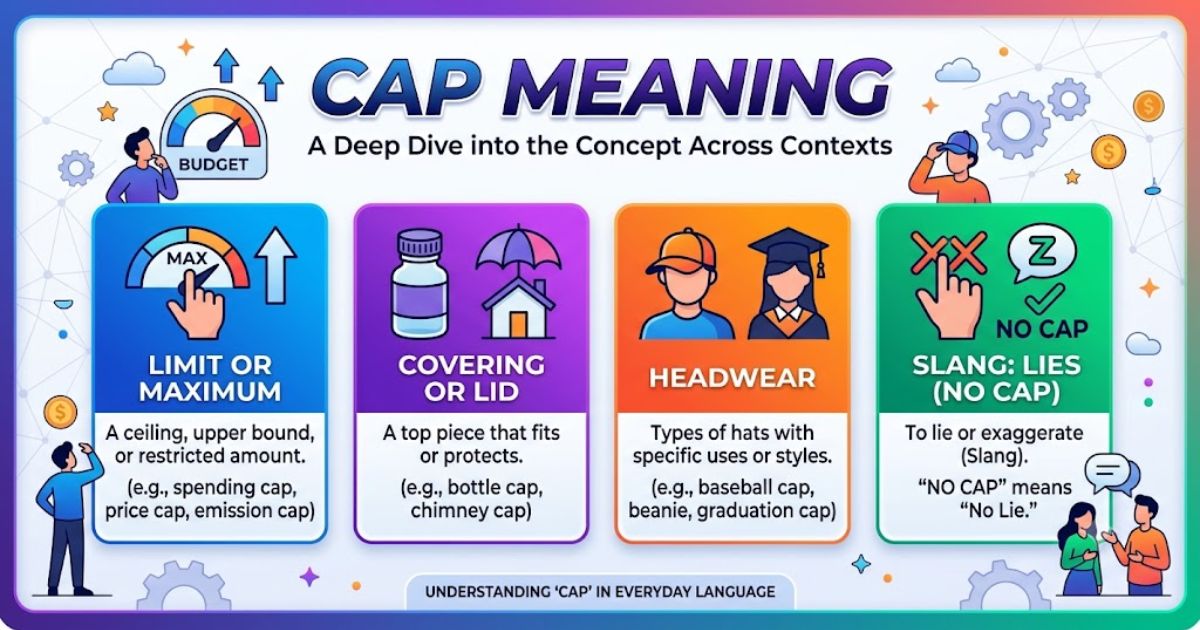
Seen someone reply “that’s cap” and wondered whether they meant a hat, a limit, or something else entirely? In texting and online slang, cap usually means a lie, an exaggeration, or a claim that does not sound believable.
The meaning depends on context. “That’s cap” challenges what someone said. “No cap” does the opposite. It means “I am serious,” “for real,” or “no lie.” Here is how to understand it without sounding confused or forcing slang into the wrong conversation.
1. Meaning & Definition of Cap 🧢
In modern slang, cap means a false statement, an exaggeration, or an attempt to sound more impressive than the truth allows. It can be a noun or a verb.
When someone says, “That’s cap,” they mean, “That is not true,” or “I do not believe you.” When they say, “You’re capping,” they mean, “You are lying,” “You are exaggerating,” or “You are pretending.”
The opposite phrase is no cap. It signals sincerity. For example, “That restaurant has the best fries, no cap” means the speaker genuinely believes it.
Common forms include:
- That’s cap — That is false or exaggerated.
- You’re capping — You are not being honest.
- Stop capping — Stop lying or overdoing the story.
- No cap — Seriously, honestly, or for real.
- All cap — Completely false.
- Capper — Someone who regularly exaggerates or lies.
2. Background & Origin of Cap 📜
The slang use of cap did not begin with TikTok or Instagram. It has roots in Black slang and African American English, where related forms of “cap” referred to boasting, exaggerating, fronting, or lying. Over time, hip-hop culture and online conversations helped bring the phrase to a much wider audience.
The phrase no cap became especially recognizable during the 2010s. It appeared in music, memes, gaming chats, and social media comments. Its meaning stayed simple: “I am telling the truth.”
It is worth using the term with some awareness. Calling every youth phrase “Gen Z slang” can erase where it came from. Cap became mainstream through internet culture, but its linguistic roots go deeper than a trending hashtag.
3. Usage in Different Contexts 💬
The meaning of cap stays broadly the same across casual spaces, but tone matters. A playful comment between friends can sound harsh in a serious discussion.
1. Social Media 📱
On social media, cap often appears in comments, reactions, captions, and replies. It is usually short because the word carries a lot of meaning on its own.
Examples:
- “You finished that whole cake alone? That’s cap.”
- “This is the best outfit I have ever seen, no cap.”
- “Stop capping. You said you were leaving ten minutes ago.”
On public posts, people often use it for light teasing. Still, do not assume it is always a joke. Tone can disappear quickly in text.
2. Chat Conversations 💭
In private messages, cap is commonly used to challenge a friend’s story or react to an unbelievable claim.
For example:
- Friend: “I woke up at 5 a.m. and went running.”
- You: “Cap. Show the proof.”
It can also be a friendly way to make a point:
- “No cap, you handled that situation really well.”
The phrase works best with people who already understand casual internet slang. With someone unfamiliar with it, plain language may be clearer.
3. Entertainment & Memes 🎬
Memes, reaction videos, gaming clips, and celebrity posts often use cap because it is quick and expressive. A person may point at a “cap” emoji, use a baseball-cap graphic, or write “🧢” as shorthand for “I do not believe this.”
A meme might say:
“Me saying I will save money this month.”
“My online shopping cart: cap.”
The humor comes from exposing a contradiction. The person says one thing, then does another.
4. Professional Tone (rare) 💼
In professional communication, avoid using cap to accuse someone of lying. It can sound dismissive, immature, or unnecessarily confrontational.
Instead of saying, “That’s cap,” use clearer alternatives such as:
- “That does not match the available information.”
- “Could you clarify the source for that claim?”
- “I think there may be an error here.”
- “That estimate appears optimistic.”
Slang works in casual settings. Professional writing needs precision.
4. Meanings Across Platforms 📱
The word itself does not change completely from one app to another. What changes is the style, speed, and tone of the conversation.
WhatsApp 💬
On WhatsApp, cap usually appears in private chats or group messages between friends. It is often playful and conversational.
Example: “You said you were five minutes away an hour ago. Stop capping.”
Because WhatsApp conversations can be more personal, use it carefully. A joke can feel sharper when someone is already upset.
Read More: DND Meaning in Text: Full Explanation, Uses, and Hidden Context You Should Know
Instagram 📸
On Instagram, cap often appears in comments and captions. People use it to react to glamorous photos, bold claims, fitness updates, travel posts, or food content.
Example: “Best coffee in town, no cap.”
It works well when the image supports the statement. A photo of a huge dessert, a dream beach, or a major achievement makes “no cap” feel natural.
TikTok 🎵
TikTok uses cap heavily in reaction culture. People may comment “cap” under an unpopular opinion, a dramatic storytime, or an exaggerated life hack.
Example: “You can make a full meal for one dollar.”
Reply: “Cap.”
TikTok also uses “no cap” for exaggerated praise. The phrase often adds energy to quick, informal content.
Snapchat 👻
On Snapchat, cap is common in casual friend-to-friend messages. It may appear as a quick reply to a selfie, location update, or story.
Example: “You are awake at 6 a.m.? Cap.”
Because Snapchat feels informal and temporary, people often use the phrase with less explanation. Shared context matters more than perfect grammar.
5. Other Fields Meanings 🧠
Outside slang, cap has several completely different meanings. This is why context is important.
A cap can mean a hat, especially a baseball cap. It can also mean a limit or maximum amount, such as a spending cap, data cap, salary cap, or price cap.
In gaming, a level cap is the highest level a player can reach. In finance, market cap is short for market capitalization. In dentistry, some people casually call a dental crown a tooth cap. In writing, “caps” can mean capital letters, as in “Please do not type the whole email in all caps.”
So if someone says, “There is a cap on spending,” they are not calling anyone a liar. They mean there is a limit.
6. Common Misconceptions & Mistakes ❌
One common mistake is thinking cap always means “lie” in a serious, factual sense. Often, it simply means someone is exaggerating or making a claim that sounds unlikely.
For example, if a friend says, “I am the best driver in this city,” replying “cap” may be playful teasing rather than a direct accusation of dishonesty.
Another mistake is using no cap in formal writing. It may work in a casual brand caption aimed at a young audience, but it does not belong in a job application, legal document, academic essay, or business proposal.
It is also easy to overuse the phrase. Saying “no cap” after every sentence can make your writing sound forced. A little slang feels natural. Too much can make it look copied from a comment section.
7. Similar Terms & Alternatives 🔁
Several phrases overlap with cap, but they are not always identical.
- No lie — Very close to “no cap.”
- For real — Signals agreement or sincerity.
- Seriously — A more neutral way to show you mean something.
- Facts — Shows strong agreement with a statement.
- Fronting — Pretending to be more confident, wealthy, or important than you are.
- Flexing — Showing off; this is not automatically dishonest.
- Fake — Something not genuine.
- Bogus — False or untrustworthy.
- BS — A stronger, less polite way to call something untrue.
“Cap” is usually more casual and more playful than directly saying, “You are lying.”
8. How to Respond to “Cap” 💬
Your response depends on whether the person is joking, doubtful, or genuinely challenging you.
For a playful reply, try:
- “No cap. I have receipts.”
- “I wish I was joking.”
- “Ask anyone. It really happened.”
- “The proof is in my camera roll.”
- “You do not have to believe me yet.”
For a calm response in a serious conversation, skip the slang:
- “I understand why that sounds surprising.”
- “Here is what actually happened.”
- “I can explain what I mean.”
- “I am being honest.”
Do not turn every “cap” comment into an argument. Sometimes it is simply a funny reaction.
9. Differences From Similar Words 🔍
Cap is not the same as every slang word related to dishonesty or showing off.
A person who is capping may be lying, exaggerating, or making a claim that sounds doubtful. A person who is flexing is showing off. They may be telling the truth while doing it.
A person who is fronting is putting on a false image. That can involve pretending to have money, confidence, status, or experience they do not really have.
“Sus” means suspicious. It does not automatically mean someone is lying. “Fake” means not genuine. “Cap” is often a quick reaction to a specific statement.
Example:
- “He says he owns three sports cars.”
- “That sounds cap.”
- “He might be flexing.”
- “It seems sus.”
Each phrase points to doubt, but each has a slightly different flavor.
10. Relevance in Online Conversations & Dating Apps ❤️
On dating apps, cap can add playful energy when used sparingly. It can help turn a basic exchange into friendly teasing.
Examples:
- “You say you make the best pasta? That’s cap until I get a taste test.”
- “No cap, your dog is carrying this profile.”
- “You like pineapple on pizza? I need proof.”
The key is keeping it light. Do not use “cap” to accuse someone of lying about serious personal details. Dating-app conversations need trust. Friendly teasing is fine, but pressure or suspicion is not attractive.
In online conversations, “no cap” can also make a compliment sound more genuine:
“No cap, that was a really thoughtful answer.”
It is simple, but it can make praise feel warmer and more direct.
11. Popularity & Trends Over Time 📈
Cap is a good example of how slang moves. It had roots in Black speech communities long before most people saw it in short videos and comments. Hip-hop culture helped broaden its reach, and social platforms made it easy to repeat, remix, and spread.
By the late 2010s, “no cap” had become a familiar phrase in online culture. It remains widely understood in 2026, especially among younger internet users, gamers, music fans, and people who spend time on social platforms.
Still, slang changes fast. Some people use “cap” naturally. Others use it ironically. For some audiences, it may already feel overused. The safest approach is simple: understand it, use it when it fits, and do not force it into every sentence.
FAQs ❓
1. What does cap mean in slang? 🧢
In slang, cap means a lie, exaggeration, or claim that does not seem true. Saying “that’s cap” is similar to saying, “I do not believe that.”
2. What does no cap mean? ✅
No cap means “no lie,” “seriously,” or “I am telling the truth.” It is used to make a statement sound more sincere or emphatic.
3. Is cap a bad word? 🚫
No. “Cap” is not a swear word. However, calling someone a liar can still feel rude, especially in a serious conversation. Use it carefully and pay attention to tone.
4. Where is cap mostly used? 📱
It is common in texting, group chats, gaming, hip-hop culture, memes, TikTok comments, Instagram replies, Snapchat messages, and casual conversations between friends.
5. Can I use cap in formal writing? 💼
It is better not to. In formal writing, use clear words such as “incorrect,” “unsupported,” “exaggerated,” or “inaccurate” instead.
6. What does “stop capping” mean? 🛑
“Stop capping” means “stop lying,” “stop exaggerating,” or “stop pretending.” It may be playful between friends, but it can sound confrontational in serious conversations.
Conclusion ✨
Cap is a short slang word with a clear modern meaning: a lie, exaggeration, or doubtful claim. No cap means the opposite. It signals honesty and emphasis.
Once you understand the tone, the phrase is easy to use. Keep it casual, use it with people who understand the reference, and switch to plain language when clarity matters more than slang.
