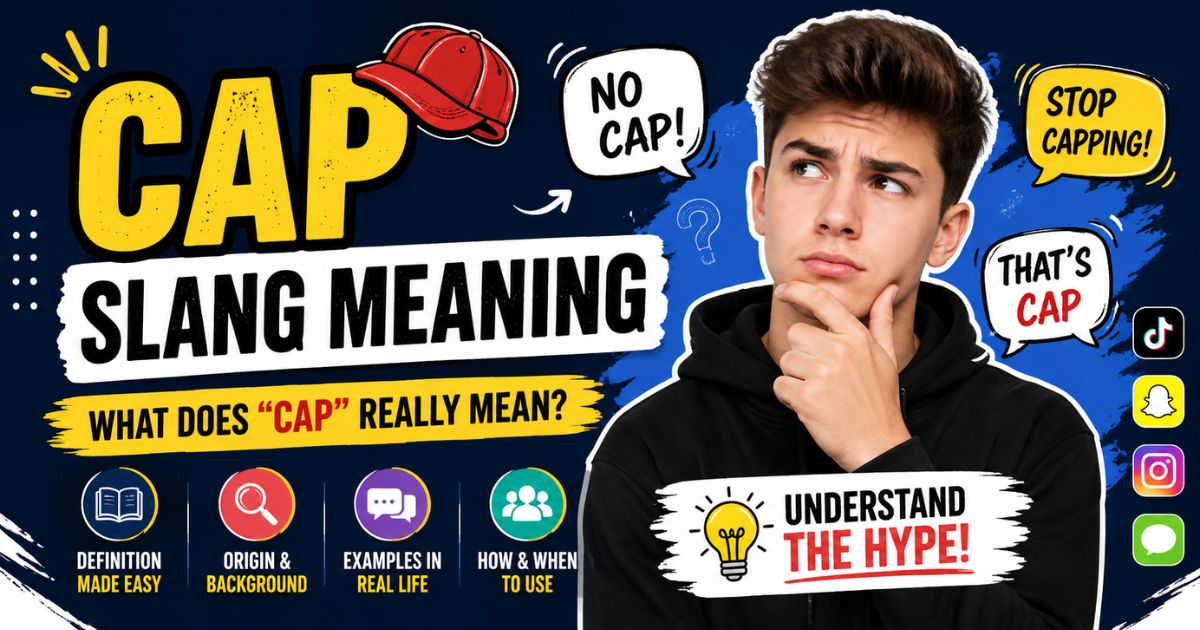
Have you ever seen someone reply with “Cap!” or “Stop the cap” in a comment section and wondered what they meant?
You’re not alone. The word cap has become one of the most popular slang terms on TikTok, Instagram, Snapchat, X (formerly Twitter), and even in everyday text messages. It’s part of modern internet culture and is used by millions of people, especially Gen Z and Gen Alpha, to call out lies, exaggerations, or unbelievable claims.
In simple terms, cap slang meaning usually refers to a lie, fake statement, or exaggeration, while no cap means someone is telling the truth. Although the phrase sounds simple, it has evolved into a flexible expression with different meanings depending on the conversation.
In this guide, you’ll learn exactly what does cap mean, where it came from, how to use it correctly, platform-specific meanings, real-life examples, common mistakes, and much more.
Meaning & Definition of Cap Slang
The cap slang meaning is simple:
Cap = A lie, false statement, exaggeration, or something that isn’t true.
If someone says something unbelievable, another person may simply reply:
“Cap.”
That single word means:
- You’re lying.
- I don’t believe you.
- That’s fake.
- That’s an exaggeration.
For example:
Alex: I finished a 500-page book in one hour.
Jordan: Cap.
Jordan clearly doesn’t believe Alex’s claim.
Simple Definition Table
| Term | Meaning | Example |
|---|---|---|
| Cap | Lie or false claim | “That’s cap.” |
| No Cap | Truth; honestly | “No cap, it was amazing.” |
| Capping | Lying or exaggerating | “Stop capping.” |
| Stop the Cap | Stop lying | “Be honest. Stop the cap.” |
Unlike many internet slang terms, cap is understood across different social media platforms and even in spoken conversations.
Secondary Meanings
Although lying is the primary definition, cap can carry several slightly different meanings depending on context.
Exaggeration
Sometimes a person isn’t completely lying—they’re simply making something sound bigger than it really is.
Example:
“I can beat anyone in this game.”
Someone may respond:
“That’s cap.”
Fake Confidence
Friends sometimes use cap when someone pretends to be extremely confident.
Example:
“I never get nervous before exams.”
Reply:
“Cap.”
Unrealistic Claims
If someone makes impossible promises, people may call it cap.
Example:
“I’ll become a millionaire next week.”
Response:
“Big cap.”
Friendly Joke
Among close friends, calling something cap isn’t always serious.
Example:
Friend:
“I’m the funniest person alive.”
Reply:
“Cap 😂”
Everyone understands it’s playful teasing rather than an accusation.
Background & Origin of Cap Slang
Understanding where cap slang came from makes the expression even more interesting.
The phrase originated from African American Vernacular English (AAVE), where cap was used to describe lying or boasting. Over time, the term became common in hip-hop culture, especially in rap lyrics.
Long before TikTok existed, artists used words like:
- cap
- capping
- no cap
to describe honesty and dishonesty.
As hip-hop influenced mainstream culture, these expressions spread beyond music.
By the late 2010s, social media accelerated their popularity.
Platforms like:
- TikTok
- Snapchat
- X (formerly Twitter)
helped introduce cap to millions of users worldwide.
Today, it has become part of everyday internet slang, even among people who aren’t familiar with its cultural roots.
Why “No Cap” Became Popular
The phrase no cap gained even more attention because celebrities and rappers frequently used it to emphasize honesty.
Instead of saying:
“Honestly…”
they simply said:
“No cap.”
For example:
“No cap, that’s the best pizza I’ve ever eaten.”
The phrase sounds casual, modern, and authentic.
Usage in Different Contexts
The beauty of cap is that it fits into many kinds of conversations.
Let’s explore the most common situations.
Read More: Cooked Meaning: What It Really Means in Slang, Text, TikTok & Social Media
1. Chat Conversations
Text messaging is where you’ll see cap the most.
Examples:
Friend:
“I slept only one hour and still got 100%.”
Reply:
“Cap.”
Friend:
“I’ve never lost a video game.”
Reply:
“Stop capping.”
Friend:
“No cap, that movie was incredible.”
Meaning:
“I’m being completely honest.”
Because texting is fast, people often use just one word:
Cap.
or
No cap.
2. Social Media Posts
Instagram, TikTok, Facebook, Reddit, and X are full of people using cap.
Example comment:
“This influencer definitely made $20 million this month.”
Replies:
- Cap.
- Big cap.
- Stop the cap.
Users often challenge exaggerated claims without writing long explanations.
Memes also use the word heavily.
Example meme:
“When your friend says they weren’t hungry but eats half your fries.”
Caption:
Cap.
The joke instantly becomes relatable.
3. Arguments or Debates
People use cap to disagree without typing long messages.
Instead of writing:
“I don’t think that’s accurate.”
They simply write:
Cap.
Example:
Person A:
“This is the greatest movie ever made.”
Person B:
“Cap.”
Although short, the response clearly communicates disagreement.
4. Friendly Teasing
Friends often accuse each other of capping for fun.
Example:
Friend:
“I can dunk a basketball.”
Reply:
“Cap 😂”
Nobody is offended because everyone understands the playful tone.
This casual use has made cap one of the most recognizable Gen Z expressions.
Meanings Across Platforms
Although the basic meaning stays the same, different platforms encourage different styles of using cap.
On WhatsApp, cap usually appears in personal conversations between friends and family.
Examples:
“I finished all my homework already.”
Reply:
“Cap.”
or
“No cap, I’m outside.”
Because WhatsApp is designed for direct messaging, people often use cap naturally in everyday conversations.
Instagram users commonly use cap in comments, Stories, and Reels.
Examples:
“This is the best burger in America.”
Comments:
- Cap.
- Big cap.
- No cap though.
Influencers also use no cap in captions to sound more genuine.
Example:
“No cap, this was the hardest workout I’ve ever done.”
Here, they’re emphasizing honesty.
TikTok
TikTok helped make cap a viral slang term.
Creators often include phrases like:
- No cap
- Stop the cap
- Big cap
- That’s cap
You’ll hear the word in videos, voiceovers, comedy sketches, and reaction clips.
For example, a creator may exaggerate something for humor, and viewers flood the comments with:
“Cap 😂”
TikTok’s fast-moving meme culture helped spread the phrase worldwide.
Snapchat
On Snapchat, cap is commonly used in quick chats, private messages, and story replies. Because conversations disappear after they’re viewed, people often use short slang instead of typing long responses.
For example:
Friend: “I woke up at 5 AM to study.”
Reply: “Cap.”
Or:
Friend: “No cap, I actually enjoyed doing homework.”
Here, no cap tells the other person they’re being completely honest.
Snapchat users also combine the phrase with emojis to add emotion:
- 🧢 = Cap (you’re lying)
- 😂🧢 = That’s obviously false
- 💯 = No cap (for real)
Since Snapchat conversations are casual, cap feels natural and fits perfectly with the platform’s fast-paced communication style.
TikTok
TikTok played a huge role in making cap slang a global trend. You’ll hear creators say “no cap” in videos, see “stop the cap” in comments, and even find memes built around the phrase.
Typical TikTok examples include:
- “This life hack works every time. No cap.”
- “Bro said he can run a marathon tomorrow. Cap.”
- “Big cap 😂”
Creators often use no cap to make their stories sound more believable or dramatic.
On Instagram, cap appears in:
- Reel comments
- Story replies
- Direct Messages (DMs)
- Caption discussions
Suppose an influencer writes:
“I never edit my photos.”
Many followers might comment:
“Cap.”
That single word suggests they don’t believe the statement.
You’ll also see captions like:
“Best vacation ever, no cap.”
The creator is emphasizing that they genuinely loved the experience.
X (formerly Twitter)
On X, where people often react to news, sports, entertainment, and trending topics, cap has become a quick way to disagree.
Example:
“This player is the greatest of all time.”
Replies:
- Cap.
- That’s cap.
- Huge cap.
Because posts on X are short, cap works as an efficient way to express disbelief without writing a long explanation.
Other Fields & Technical Meanings
One reason people get confused about cap meaning is that the word has several meanings outside internet slang. Context is everything.
Cap as a Physical Object
Traditionally, cap refers to something that covers or closes another object.
Examples include:
- A bottle cap
- A baseball cap
- A pen cap
- A lens cap
These meanings have nothing to do with slang.
Cap in Business and Finance
In finance, market cap means market capitalization, which is the total value of a publicly traded company’s shares.
Example:
“The company has a market cap of $500 billion.”
Again, this is unrelated to slang.
Cap as a Limit
In many situations, cap means a maximum limit.
Examples:
- Spending cap
- Salary cap
- Data cap
- Price cap
If someone says there’s a salary cap, they mean there’s a maximum amount that can be paid.
CAP as an Abbreviation
The letters CAP can also stand for different phrases depending on the industry, such as:
- Civil Air Patrol
- Corrective Action Plan
- College of American Pathologists
- Certified Administrative Professional
These abbreviations shouldn’t be confused with cap meaning in slang.
Common Misconceptions & Mistakes
Although cap seems easy to understand, many people misuse it. Here are the most common mistakes.
Thinking Cap Means “Hat” in Every Conversation
Someone might text:
“Bro, that’s cap.”
A beginner could think they’re talking about a baseball cap.
In reality, they’re saying:
“You’re lying.”
Always read the surrounding conversation before deciding what cap means.
Using “Cap” in Formal Writing
While cap is extremely common in online communication, it’s not appropriate in professional emails, school essays, legal documents, or business reports.
Instead of writing:
“The report is cap.”
Write:
“The report contains inaccurate information.”
Formal language is still the better choice in professional settings.
Assuming Every Exaggeration Is a Lie
Sometimes people exaggerate for humor rather than trying to deceive anyone.
For example:
“I’m literally dying after leg day.”
Friends might jokingly reply:
“Cap.”
The speaker wasn’t trying to fool anyone—they were simply being dramatic.
Overusing the Word
Because cap became so popular, some people started using it in almost every sentence.
Example:
- That’s cap.
- You’re capping.
- Big cap.
- Stop the cap.
- Cap.
Overusing any slang makes conversations sound repetitive. It’s best used naturally and only when it fits the situation.
Similar Terms & Alternatives
Modern internet slang offers several expressions that carry a similar meaning to cap. Some are direct alternatives, while others have slightly different tones.
| Slang Term | Meaning | Example |
|---|---|---|
| Cap | Lie or exaggeration | “That’s cap.” |
| No Cap | Honestly; telling the truth | “No cap, I loved it.” |
| Capping | Lying or exaggerating | “Stop capping.” |
| Big Cap | Huge lie | “That’s big cap.” |
| Stop the Cap | Stop lying | “Be honest—stop the cap.” |
| Fake | Not genuine | “That’s fake.” |
| BS | Nonsense or unbelievable claim | “That’s BS.” |
| Sus | Suspicious or questionable | “That sounds sus.” |
| Delulu | Delusional thinking (playful) | “You’re delulu if you believe that.” |
Each term has its own nuance, but cap remains one of the most widely recognized expressions in modern internet slang.
How to Respond to “Cap” in Chat
If someone replies “Cap” to your message, don’t panic. Most of the time, they’re simply saying they don’t believe you or think you’re exaggerating.
Your response depends on whether you were joking, serious, or intentionally exaggerating.
If You Were Telling the Truth
You can calmly back up your claim.
Example:
You: “I met my favorite singer yesterday.”
Friend: “Cap.”
You: “Seriously! I even took a picture.”
If You Were Joking
Lean into the joke.
Example:
You: “I’m richer than Elon Musk.”
Friend: “Cap.”
You: “Okay, maybe just in Monopoly. 😂”
If They Misunderstood You
Clarify what you meant.
Example:
You: “I meant it as an exaggeration.”
or
“I wasn’t being literal.”
If They’re Teasing You
Sometimes the best response is to laugh along.
Example:
Friend:
“Cap.”
You:
“Believe what you want 😂”
Keeping the conversation light often makes for better interactions among friends.
Examples:
Example 1
Alex: “I can solve a Rubik’s Cube in 20 seconds.”
Chris: “Cap.”
Alex: “Watch me next time.”
Example 2
Taylor: “No cap, that pizza was amazing.”
Jordan: “Now I need to try it.”
Example 3
Emma: “I ran five miles before breakfast.”
Liam: “Big cap.”
Emma: “Check my fitness app!”
Example 4
Noah: “Stop capping—you never watched that movie.”
Olivia: “Fine, you caught me.”
Differences From Similar Words
The word cap often gets grouped with other internet slang, but each expression has its own meaning. Knowing the differences helps you use them correctly and avoid confusion.
| Term | Meaning | Example |
|---|---|---|
| Cap | A lie, exaggeration, or false claim | “That’s cap.” |
| No Cap | I’m telling the truth; honestly | “No cap, it was amazing.” |
| Capping | Lying or exaggerating | “Stop capping.” |
| Big Cap | A major or obvious lie | “That’s big cap.” |
| Sus | Suspicious or questionable | “That sounds sus.” |
| Fake | Not genuine or authentic | “Those shoes are fake.” |
| BS | Nonsense or something unbelievable | “That’s BS.” |
Although these words sometimes overlap, they aren’t interchangeable.
For example:
- Someone can sound sus without actually lying.
- Something can be fake without anyone making a false claim.
- Cap specifically points to a statement that the speaker believes is untrue or exaggerated.
Cap vs. No Cap
This is one of the most searched questions online.
| Cap | No Cap |
|---|---|
| Means a lie | Means the truth |
| Questions someone’s honesty | Emphasizes honesty |
| Often used as criticism | Often used for reassurance |
| Example: “That’s cap.” | Example: “No cap, I loved it.” |
Think of them as opposites.
- Cap = False
- No cap = True
Cap vs. Capping
These words are closely related but used differently.
Cap is usually a noun.
Example:
“That’s cap.”
Capping is a verb.
Example:
“Stop capping.”
One describes the lie, while the other describes the act of lying.
Relevance in Online Conversations & Dating Apps
Slang changes quickly, and dating apps are one place where modern expressions spread fast. You’ll often see cap, no cap, and stop capping in conversations on apps like Tinder, Bumble, Hinge, and other messaging platforms.
Why People Use Cap in Dating Chats
People use cap because it’s:
- Quick
- Casual
- Funny
- Less confrontational than saying “You’re lying.”
Imagine this conversation:
Person A: “Everyone says I’m the best cook.”
Person B: “Cap 😂”
The reply isn’t necessarily accusing the other person of lying. It may simply be playful flirting.
Building Trust
Interestingly, no cap is often used to make compliments sound more sincere.
Examples:
- “No cap, you have a great smile.”
- “No cap, I enjoyed talking with you.”
- “You’re really funny, no cap.”
Adding no cap signals genuine honesty, which can help build trust in casual online conversations.
Group Chats and Gaming
The expression also appears frequently in:
- Discord servers
- Gaming chats
- WhatsApp groups
- Messenger conversations
For example:
Player: “I carried the whole team.”
Teammate: “Cap.”
Gamers use it constantly to challenge exaggerated claims or boastful comments.
Popularity & Trends Over Time
The cap slang meaning has grown from a niche expression in AAVE (African American Vernacular English) and hip-hop culture into one of the most recognizable slang terms on the internet.
Early Years
Before social media made it mainstream, cap was already used in spoken conversations within African American communities to refer to lying or bragging.
Artists and rappers helped introduce the expression to larger audiences through song lyrics and interviews.
Rise of No Cap
Around the late 2010s, the phrase no cap exploded in popularity.
As musicians, athletes, influencers, and streamers began using it regularly, millions of fans adopted the expression in everyday speech.
Soon, people weren’t just saying:
“Honestly…”
They were saying:
“No cap.”
TikTok and Meme Culture
The arrival of TikTok accelerated the trend.
Comedy videos, reaction clips, lip-syncs, and memes made cap one of the platform’s most recognizable words.
Comments like:
- “Cap.”
- “Big cap.”
- “Stop the cap.”
became incredibly common.
The simplicity of the expression helped it spread across different age groups and countries.
Still Popular in 2026?
Yes. Even though internet slang evolves quickly, cap remains widely understood in 2026.
While newer slang terms continue to appear, cap has become part of everyday online vocabulary, much like words such as sus, ghosting, and DM.
Its lasting popularity comes from how easy it is to use and understand.
FAQs
1. What does cap mean in slang?
In slang, cap means a lie, false statement, or exaggeration. If someone says “That’s cap,” they mean they don’t believe what was said.
2. What does no cap mean?
No cap means I’m telling the truth, honestly, or I’m being completely serious. It’s used to emphasize sincerity.
Example:
“No cap, that was the best concert I’ve ever attended.”
3. Is cap a bad word?
No. Cap isn’t considered a swear word or offensive language. It’s informal slang that’s commonly used among friends, on social media, and in text messages.
However, because it implies someone is lying, it can come across as rude if used in a serious conversation.
4. Where did cap slang come from?
The slang meaning of cap originated in African American Vernacular English (AAVE) and became widely known through hip-hop culture, rap music, and later social media platforms like TikTok, Instagram, Snapchat, and X.
5. Can I use cap in formal writing?
No. Cap is best suited for casual conversations, texting, and social media. In professional or academic writing, it’s better to use words like false, incorrect, inaccurate, or misleading.
6. What does stop capping mean?
Stop capping means stop lying, stop exaggerating, or be honest.
Example:
Friend: “I can bench press 500 pounds.”
You: “Stop capping.”
Conclusion
The cap slang meaning is straightforward once you understand the context. In modern internet slang, cap refers to a lie, exaggeration, or false claim, while no cap means someone is being truthful or completely honest.
From its roots in AAVE and hip-hop culture to its widespread use on TikTok, Instagram, Snapchat, X, and text messaging, cap has become one of the defining expressions of online communication. Whether you’re commenting on a viral video, chatting with friends, gaming online, or scrolling through memes, you’ll likely encounter phrases like “That’s cap,” “No cap,” and “Stop the cap.”
The key is to use the term naturally and in the right setting. It’s perfect for casual conversations but isn’t appropriate for formal writing or professional communication.
Now that you know what cap means, where it came from, and how people use it across different platforms, you’ll be able to understand—and use—this popular slang with confidence.
