
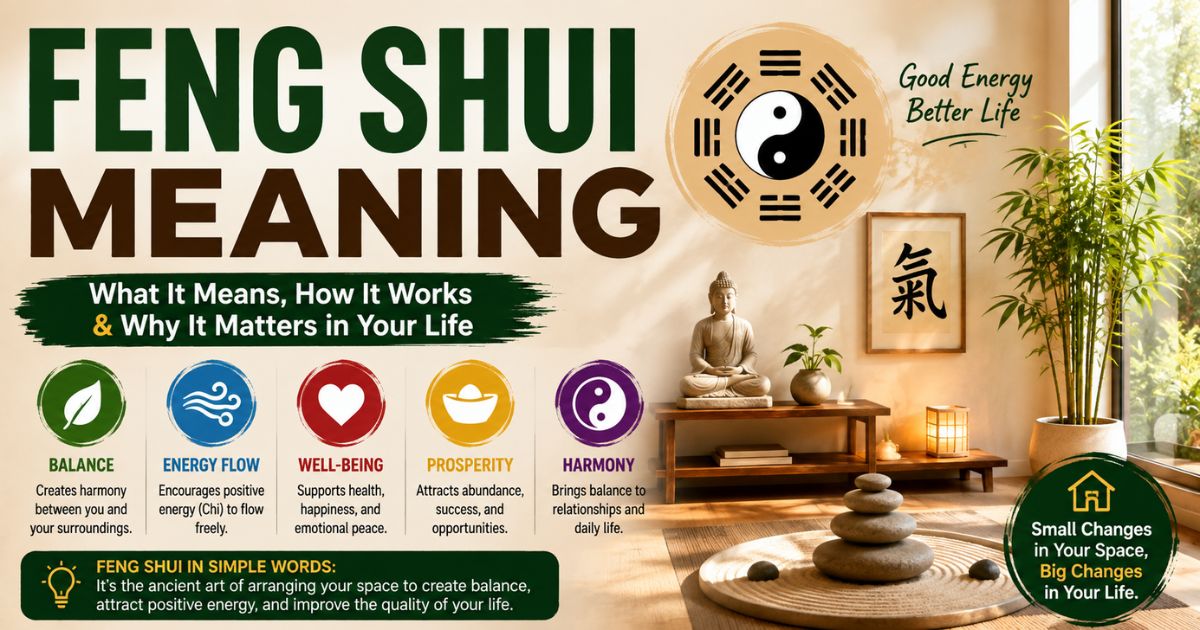
Have you ever walked into a room and immediately felt calm, comfortable, or energized? Feng shui is based on the idea that the way you arrange your surroundings can influence how energy moves through a space and how you experience it.
The feng shui meaning goes beyond simply placing furniture in certain positions. It refers to an ancient Chinese practice focused on creating harmony between people and their environment. It considers factors such as space, direction, natural elements, colors, light, and the arrangement of objects.
Today, people use feng shui in homes, bedrooms, offices, gardens, and other spaces. Some approach it as a traditional cultural practice, while others use its principles as a way to create more balanced, organized, and peaceful surroundings.
But what does feng shui actually mean? Where did it come from, what do its elements represent, and how can you apply its ideas in everyday life? Let’s break it down.
What Does It Mean?
The term feng shui comes from two Chinese words: feng, meaning “wind,” and shui, meaning “water.”
Together, the words reflect an ancient Chinese understanding of how natural forces move through the environment.
In simple terms, feng shui is about creating harmony between people and the spaces they occupy. Traditional feng shui considers the flow of qi (also spelled chi), a concept often translated as vital energy or life force.
The goal isn’t simply to make a room look attractive. Instead, feng shui encourages thoughtful placement and balance so a space feels supportive and harmonious.
For example, keeping a pathway open rather than blocking it with furniture can make a room feel easier to move through. From a feng shui perspective, that also allows energy to flow more freely.
Feng Shui Meaning in Simple Words
In simple words, feng shui means arranging your surroundings in a balanced and intentional way to create harmony and support well-being.
It can involve furniture placement, natural light, colors, plants, materials, and the relationship between different areas of a room.
Feng Shui Origin
Feng shui originated in ancient China and developed over many centuries.
Its early roots are connected with observing landscapes, environmental conditions, climate, water, mountains, and the relationship between human settlements and nature. Ancient practitioners paid attention to how landforms and natural forces could affect where people lived and worked.
Over time, feng shui developed into different schools and systems. Some approaches place greater emphasis on physical landscapes and directions, while others focus more heavily on interiors, symbolic arrangements, or specific tools.
One well-known concept is the bagua, an octagonal map used in some feng shui traditions to understand different areas of life and their relationship to spaces.
It’s important to remember that feng shui isn’t one single fixed system. Different schools may interpret its principles differently.
Spiritual Meaning
The spiritual meaning of feng shui is closely connected with harmony, balance, intention, and the relationship between humans and their surroundings.
Rather than treating your environment as separate from your life, feng shui encourages you to consider how your surroundings affect your sense of comfort and connection.
For some people, this becomes a spiritual practice. They may use intentional placement of objects, natural elements, meditation spaces, or decluttering rituals to create an environment that feels peaceful.
However, feng shui itself isn’t necessarily a spiritual practice for everyone. Someone may use its principles simply because they enjoy having an organized and harmonious home.
Feng Shui Meaning in Home
Your home is one of the most common places to apply feng shui.
The basic idea is to create a space where you feel comfortable, supported, and able to move easily.
One traditional principle is to avoid unnecessary clutter. A crowded environment can make a room feel stressful or difficult to navigate. Removing items you no longer use can create a greater sense of openness.
Furniture placement also matters.
For example, feng shui often emphasizes having a strong or stable position for important furniture. In a bedroom, this might mean placing the bed where you can see the entrance without being directly aligned with the doorway.
Natural light, ventilation, plants, and appropriate use of colors can also contribute to a balanced environment.
You don’t have to completely redesign your home. Small changes can make the space feel noticeably different.
Read More: Slow Burn Meaning: What It Means in Love, Texting, Dating, Spirituality & Social Media
Feng Shui Meaning in Bedroom
The bedroom is particularly important because it’s associated with rest, privacy, and personal relationships.
A feng shui-inspired bedroom generally aims to feel calm rather than busy.
A few commonly recommended ideas include:
- Keep the area around the bed relatively clear.
- Choose comfortable and calming colors.
- Reduce unnecessary electronics and distractions.
- Use balanced furniture arrangements when possible.
- Keep the bedroom clean and organized.
- Make sure the bed feels secure and comfortable.
The bed is often considered the most important piece of furniture in the room.
In traditional feng shui, placing the bed in a position where you can see the bedroom entrance while resting is often considered favorable. The exact recommendations can vary depending on the feng shui school being followed.
The broader practical lesson is simple: your bedroom should make it easy for you to relax.
Feng Shui Meaning in Love
Feng shui is sometimes associated with love, romance, and relationships.
The basic idea is to create an environment that feels welcoming to connection rather than chaotic or emotionally closed off.
For example, some feng shui practitioners recommend using pairs of objects in a bedroom to symbolize partnership. Two matching bedside tables or two lamps can create visual balance.
People may also remove objects strongly associated with past relationships when they’re ready to move forward.
However, feng shui shouldn’t be treated as a guarantee that a particular arrangement will attract a romantic partner.
Healthy relationships still depend on communication, compatibility, trust, respect, and mutual effort.
Feng shui can be used as a symbolic way to make your environment reflect the kind of relationship and emotional atmosphere you want.
Feng Shui Meaning in Office
Feng shui can also be applied to workplaces and home offices.
The goal is often to create an environment that feels organized, focused, and supportive of productivity.
Your desk placement can make a noticeable difference in how comfortable you feel while working. Many feng shui approaches favor positioning the desk so you have a clear view of the room or entrance rather than sitting with your back directly toward the doorway.
Keeping your workspace free of unnecessary clutter can also help you stay focused.
Plants, natural light, comfortable furniture, and thoughtful organization can make an office feel more inviting.
Even if you don’t follow feng shui spiritually, these practices can have practical benefits because an organized workspace can reduce visual distractions.
The Five Elements of Feng Shui
One of the central ideas in traditional feng shui is the five elements.
They are:
| Element | Common Associations |
|---|---|
| Wood | Growth, vitality, flexibility |
| Fire | Energy, passion, transformation |
| Earth | Stability, grounding, nourishment |
| Metal | Clarity, precision, structure |
| Water | Flow, wisdom, adaptability |
These elements aren’t simply physical materials. They can also be represented symbolically through shapes, colors, objects, and textures.
Wood
Wood is commonly associated with growth, renewal, creativity, and upward movement.
Plants and wooden furniture can represent this element.
Fire
Fire represents warmth, energy, passion, and transformation.
Candles, lighting, triangular shapes, and certain warm colors can symbolically represent fire.
Earth
Earth is associated with stability, grounding, nourishment, and reliability.
Ceramics, stone, square shapes, and earthy colors can represent this element.
Metal
Metal is connected with structure, clarity, focus, and organization.
Metal objects, rounded shapes, and metallic tones can represent it.
Water
Water symbolizes flow, adaptability, wisdom, and movement.
The element may be represented through water features, reflective surfaces, dark colors, or flowing forms.
The five elements are traditionally understood as interconnected rather than completely separate. Feng shui practices may seek balance among them rather than simply adding as much of one element as possible.
Yin and Yang in Feng Shui
Yin and yang are another important concept associated with Chinese philosophy and traditional feng shui.
They represent complementary forces rather than absolute opposites.
Yin is commonly associated with qualities such as:
- Quiet
- Darkness
- Rest
- Softness
- Stillness
Yang is often associated with:
- Brightness
- Activity
- Warmth
- Movement
- Energy
A balanced room might contain both.
For example, a bedroom may benefit from softer lighting and comfortable textures, which create a more yin atmosphere. A workspace may need brighter lighting and greater activity, bringing in more yang qualities.
The goal isn’t to eliminate one side. It’s to create an appropriate balance for the purpose of the space.
Feng Shui Colors Meaning
Colors can have symbolic associations in feng shui, particularly in systems that connect colors with the five elements.
| Color | Common Feng Shui Association |
|---|---|
| Green | Growth, renewal, Wood |
| Red | Energy, passion, Fire |
| Yellow | Stability, nourishment, Earth |
| White | Clarity, simplicity, Metal |
| Black | Depth, wisdom, Water |
| Blue | Calm, flow, Water |
| Brown | Grounding, stability, Earth |
These meanings shouldn’t be treated as universal rules.
For example, using red doesn’t automatically create passion, and painting a room blue doesn’t guarantee peace. Your personal response to a color, along with lighting and the room’s purpose, matters too.
A good feng shui approach considers the entire environment rather than relying on a single color.
Is Feng Shui a Religion?
Feng shui is not generally considered a religion.
It is better understood as a traditional Chinese practice and system of environmental arrangement. Its historical development is connected with Chinese philosophy, cosmology, and traditional beliefs, but feng shui itself doesn’t function as a religion in the same way as Christianity, Islam, Buddhism, Judaism, or Hinduism.
Some people practice feng shui as part of a broader spiritual worldview, while others use it as a cultural tradition or interior-design philosophy.
This distinction matters because feng shui can mean different things to different people.
If you’re interested in using feng shui, you don’t necessarily need to adopt a particular religious belief system.
Examples in Everyday Life
You can find feng shui-inspired ideas in ordinary activities without making your entire home follow a traditional system.
Keeping Entryways Clear
An uncluttered entrance can make your home feel more welcoming and easier to navigate.
Positioning Your Bed Thoughtfully
A stable bed position can create a greater sense of comfort and security.
Organizing Your Desk
Removing unnecessary objects from your workspace can reduce visual distractions.
Adding Plants
Plants can introduce natural shapes, color, and a sense of vitality into an interior.
Using Natural Light
Opening curtains and allowing daylight into a room can make the environment feel brighter and more energetic.
Creating Balance
Using pairs of objects, balanced furniture, and complementary textures can create visual harmony.
Removing Unnecessary Clutter
Decluttering is one of the easiest practical ways to make a space feel more open and intentional.
Why Is Feng Shui Important?
The importance of feng shui depends on how you view it.
For people who follow it traditionally, feng shui provides a framework for understanding the relationship between people, nature, energy, and their surroundings.
For others, its value is more practical. Decluttering, improving lighting, arranging furniture thoughtfully, and creating comfortable spaces can make everyday environments more pleasant regardless of whether you believe in qi.
In that sense, feng shui encourages an idea that most people can relate to: your environment can influence how you feel and behave.
A room can’t solve every problem in your life, but a thoughtfully designed environment can make it easier to relax, focus, sleep, or connect with others.
Conclusion
The feng shui meaning is rooted in the idea of creating harmony between people and their environment.
Originating in ancient China, feng shui developed into a range of traditions concerned with natural forces, spatial arrangement, balance, and the flow of qi. Today, people apply feng shui principles to homes, bedrooms, offices, relationships, and everyday spaces.
The five elements—Wood, Fire, Earth, Metal, and Water—along with yin and yang, provide important concepts within traditional feng shui.
You don’t have to completely redesign your life to explore these ideas. Start small. Clear a cluttered area, improve the lighting, reposition your desk, or make your bedroom more peaceful.
The most useful takeaway is simple: create a space that supports the way you want to live and feel.
FAQs
What does feng shui mean?
Feng shui is a traditional Chinese practice concerned with arranging environments to create harmony and balance. The words literally mean “wind” and “water.”
What is the spiritual meaning of feng shui?
Spiritually, feng shui can represent harmony, balance, intention, and the relationship between people and their surroundings. Some people use it as part of a broader spiritual practice.
What does feng shui mean in a home?
In a home, feng shui focuses on creating balanced, comfortable spaces through thoughtful furniture placement, organization, natural elements, colors, and other environmental features.
What does feng shui mean in a bedroom?
Feng shui in a bedroom emphasizes rest, security, balance, and peaceful surroundings. Bed placement, clutter, lighting, and colors are commonly considered.
What does feng shui mean in love?
Feng shui in love is often associated with creating an environment that supports partnership, connection, openness, and emotional balance. It doesn’t guarantee a relationship.
What are the five elements of feng shui?
The five elements are Wood, Fire, Earth, Metal, and Water. Each represents different qualities and can be symbolically represented in a space.
What do yin and yang mean in feng shui?
Yin and yang represent complementary qualities such as rest and activity, darkness and brightness, or stillness and movement. Feng shui often seeks an appropriate balance between them.
What do colors mean in feng shui?
Different colors can symbolize different qualities and elements. For example, green is commonly associated with Wood, red with Fire, yellow with Earth, white with Metal, and black with Water.
Is feng shui a religion?
No. Feng shui is generally regarded as a traditional Chinese practice rather than a religion. Some people incorporate it into spiritual practices, while others use it culturally or aesthetically.
Does feng shui really work?
The answer depends on what you mean by “work.” Traditional feng shui makes claims about environmental energy that aren’t established by modern scientific evidence. However, practical changes such as decluttering, improving lighting, and creating comfortable spaces can affect how an environment feels and functions.
