
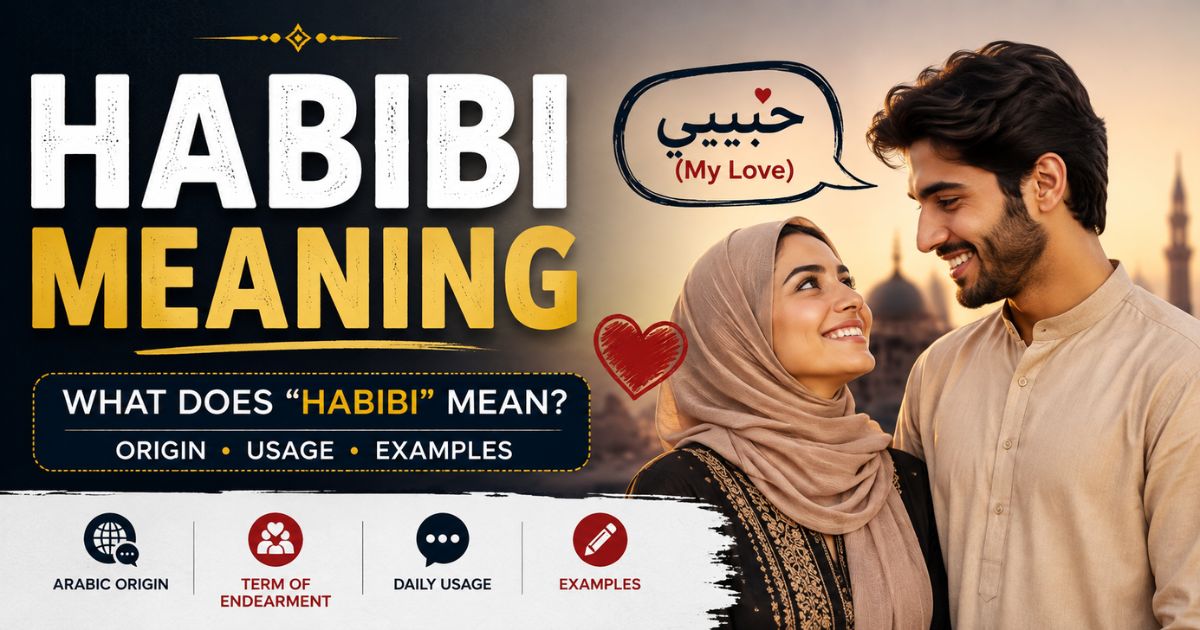
Have you ever heard someone say “habibi” and wondered whether they’re flirting, being friendly, or simply using an Arabic word they’ve picked up online?
The answer isn’t always obvious.
Habibi (حبيبي) is an Arabic word that literally relates to “my beloved” or “my dear.” In everyday Arabic, however, its meaning is much more flexible. Depending on the speaker, listener, relationship, country, and tone, habibi can express affection, friendship, warmth, familiarity, or romantic love.
You might hear a husband call his wife habibi, but you can also hear friends use it with each other. A shopkeeper might say it warmly to a customer, and someone online might use it jokingly in a meme.
That’s why understanding habibi meaning requires more than a simple dictionary translation.
In this guide, we’ll look at what habibi means in Arabic, how people use it in texts and social media, how it differs from habibti, and what someone may mean when they call you habibi.
Meaning & Definition of Habibi
Habibi (حبيبي) is an Arabic term of affection that can be translated as “my dear,” “my beloved,” or “my darling.”
The word comes from the Arabic root associated with love and affection. In Arabic, grammatical gender matters, which is why the form used for a male and female can differ.
Primary Meaning
The most direct translation of habibi is:
“My beloved” or “my dear.”
The word is traditionally used when addressing a male.
For example:
“Shukran, habibi.”
This can mean:
“Thank you, my dear.”
The exact emotional strength depends on context.
Between romantic partners, habibi can sound deeply affectionate. Between friends, it can simply communicate warmth.
Secondary Meaning
In everyday conversation, habibi can function much like terms such as:
- My friend
- My dear
- Buddy
- Mate
- My man
- Dear
- Darling
The closest English equivalent changes depending on the situation.
For example, a close friend might say:
“Yalla, habibi!”
This could mean:
“Come on, buddy!”
It doesn’t necessarily mean:
“Come on, my romantic partner.”
That distinction is essential when interpreting habibi meaning in text.
Tone Changes Meaning
Tone is one of the biggest factors.
Consider:
“Habibi ❤️”
This could sound romantic.
Now consider:
“Yalla habibi!”
That may simply be friendly or encouraging.
And:
“Habibi, what are you doing? 😂”
could be playful.
The same word can carry different emotions depending on voice, facial expression, emojis, relationship, and surrounding words.
Background & Origin
Habibi comes from Arabic حبيبي (ḥabībī).
It is related to ḥabīb, meaning someone beloved or dear, and the ending -ī indicates possession, giving the sense of “my beloved” or “my dear.”
The feminine form is generally habibti (حبيبتي), meaning “my beloved” when addressing a woman.
Historical Use
Terms derived from the Arabic root connected with love have a long history in Arabic language and literature.
Expressions of affection appear throughout Arabic poetry, songs, religious and cultural texts, and everyday speech.
Habibi has therefore never been exclusively an internet word.
It existed in spoken and written Arabic long before social media, texting, or viral videos.
Read More: HB Meaning Explained: What Does HB Mean in Text & Social Media?
Spread Beyond Arabic
Over time, habibi became familiar to people outside Arabic-speaking communities through:
- Music
- Film and television
- Travel
- Immigration and multicultural communities
- Sports
- Pop culture
- Social media
- Memes
- Online creators
Today, people who don’t speak Arabic may recognize phrases such as “yalla habibi” or use habibi casually in messages.
However, its meaning can become simplified when it moves into another language or online community.
Usage in Different Contexts
In Text Messages
In text messages, habibi can be affectionate, friendly, romantic, or playful.
For example:
“Good morning habibi ❤️”
This is likely romantic or deeply affectionate.
But:
“Thanks habibi 😂”
could simply be friendly.
Emojis provide useful clues, but they don’t completely determine the meaning.
In Social Media Captions
Habibi appears frequently in captions, particularly when users want to add an Arabic or Middle Eastern flavor to a post.
Examples include:
“Dubai nights, habibi ✨”
“Good vibes only, habibi.”
“Yalla habibi, let’s go!”
In these cases, the word may function more as a cultural expression or stylistic phrase than as a literal declaration of affection.
In Friend Groups
Friends may use habibi as a warm nickname.
For example:
“Where are you, habibi?”
or:
“Come on, habibi, we’re late!”
Among close friends, the word can communicate familiarity without romantic interest.
This is especially important for English speakers who encounter habibi online and assume it always means “boyfriend” or “lover.”
In Professional Settings
Habibi can appear in professional or customer-service interactions in some Arabic-speaking cultures, but its appropriateness depends heavily on the relationship and local communication norms.
Someone might use an affectionate form casually with a customer or colleague, particularly in an informal environment.
However, if you’re not familiar with the culture, it’s safer to use someone’s name or a standard professional form of address.
Using habibi in a formal business email to someone you barely know could sound overly familiar.
Meanings Across Platforms
The basic meaning of habibi doesn’t fundamentally change from one social platform to another. What changes is the context.
WhatsApp conversations often include habibi between friends, relatives, and romantic partners.
Examples:
“Good night habibi ❤️”
“Where are you habibi?”
“Yalla habibi, let’s go.”
The first may be romantic. The second and third can easily be friendly.
On Instagram, habibi often appears in captions and comments.
For example:
“Looking good, habibi!”
or:
“Yalla habibi! 🔥”
It may also appear under travel photos, especially posts connected with Middle Eastern destinations.
TikTok
TikTok has helped spread many Arabic expressions into global internet culture.
Habibi may appear in:
- Memes
- Comments
- Funny videos
- Travel content
- Music clips
- Relationship videos
- Arabic-language content
Someone may use “habibi” simply because it fits the joke or sounds expressive.
Snapchat
Snapchat users may use habibi in direct messages and Stories.
For example:
“Habibi 😂 what was that?”
or:
“Goodnight habibi ❤️”
Again, the surrounding conversation determines whether the expression is romantic or friendly.
Other Fields: Does Habibi Have Technical Meanings?
Habibi isn’t a technical term in the way abbreviations such as PMO or NGL can be.
However, the word appears in several other cultural and commercial contexts.
As a Name
Habibi can appear in business names, usernames, titles, brands, restaurants, and creative projects.
Because the word has a positive association with affection, businesses may use it to create a warm or welcoming identity.
In Music and Entertainment
Habibi appears frequently in Arabic and international music.
Artists may use the word because it fits themes of:
- Love
- Romance
- Friendship
- Longing
- Cultural identity
- Affection
It also appears in song titles and lyrics across different genres.
Its popularity in entertainment has helped introduce the word to audiences who don’t speak Arabic.
In Slang-Like Technical Communities
There isn’t a standardized technical meaning of habibi.
In online communities, however, users sometimes turn ordinary words into memes, usernames, inside jokes, or community-specific expressions.
So if you encounter “habibi” in a gaming server, Discord community, or meme group, the meaning may be influenced by that group’s culture.
Common Misconceptions & Mistakes
Mistake 1: It Always Means Romantic Love
This is probably the biggest misconception.
Habibi can certainly be romantic, but it isn’t automatically romantic.
Friends, family members, and acquaintances may use it affectionately.
The relationship matters.
Mistake 2: Everyone Uses It Flirtatiously
No.
Someone saying “habibi” doesn’t automatically mean they’re flirting with you.
For example:
“Thanks, habibi!”
could simply be a warm response from a friend.
Don’t interpret the word in isolation.
Mistake 3: Habibi and Habibti Are the Same
They’re closely related, but they differ grammatically.
Habibi (حبيبي) is generally used when addressing a male.
Habibti (حبيبتي) is generally used when addressing a female.
Both convey affection, but the form changes according to the person being addressed.
Mistake 4: It Is Only Used in Arabic
Habibi is an Arabic word, but it has spread into many multilingual communities.
You may hear it in English conversations, social media posts, music, memes, and international pop culture.
That doesn’t make it an English word in origin. It simply shows how languages influence each other.
Mistake 5: Saying It Is Always Cultural Appropriation
Using a word from another language isn’t automatically cultural appropriation.
People learn and borrow words across languages all the time.
The more important questions are:
- Are you using the word respectfully?
- Do you understand roughly what it means?
- Are you mocking the culture or language?
- Are you using it appropriately for the situation?
Using habibi affectionately or playfully doesn’t inherently make the usage disrespectful.
Similar Terms & Alternatives
There are several Arabic and English expressions that can overlap with habibi.
Depending on the situation, alternatives may include:
- My dear
- Darling
- Sweetheart
- Babe
- Dear
- My friend
- Buddy
- Bro
- Mate
Arabic also has other affectionate expressions, and the exact choice can vary by region and dialect.
Close alternatives in chat
If you’re trying to convey the same general warmth in English, you might use:
“Babe”
“Dear”
“Bestie”
“My friend”
“Buddy”
But none of these perfectly matches habibi in every situation.
How to Respond to “Habibi”
Your response should depend on the relationship and tone.
Friendly Replies
If a friend says:
“Habibi, where are you?”
you could respond:
“I’m almost there!”
or:
“On my way, habibi 😂.”
Flirty Replies
If the conversation is clearly romantic, you might reply:
“Hey, habibi ❤️”
or:
“Missed you too ❤️.”
The important thing is to match the existing tone rather than assuming romance.
Playful Replies
For a joking conversation:
“Yalla, habibi 😂.”
or:
“Anything for you, habibi!”
Chat Examples
Friend: “Habibi, we’re waiting for you!”
You: “I’m coming! 😂”
Partner: “Good morning, habibi ❤️”
You: “Good morning, love ❤️.”
Friend: “Thanks for helping me, habibi!”
You: “Anytime!”
These examples show why context matters more than the word itself.
Differences From Similar Words
Habibi vs Babe
Habibi is an Arabic term of affection.
Babe is an English term commonly used between romantic partners, although friends may sometimes use it too.
Habibi can be more culturally flexible depending on the Arabic-speaking community and context.
Habibi vs Bro
Bro usually suggests friendship or informal familiarity.
Habibi carries a stronger sense of affection, although it can still be used casually between friends.
Habibi vs Dear
“Dear” is one of the closer English translations.
However, English speakers often use “dear” in formal letters or polite conversation, while habibi can sound more personal and culturally specific.
Habibi vs Habibti
The main difference is grammatical gender.
Habibi is generally used when addressing a male.
Habibti is generally used when addressing a female.
Both come from the same Arabic root and express affection.
Relevance in Online Conversations & Dating Apps
Habibi has become especially visible in international dating conversations.
Someone may use it as a genuine term of affection, while another person may use it casually because they’ve become familiar with Arabic expressions through friends, travel, music, or social media.
In Dating Chats
A message such as:
“Good night, habibi ❤️”
is likely affectionate and may be romantic.
Likewise:
“I miss you, habibi.”
usually communicates emotional closeness.
But:
“Yalla habibi, tell me what happened 😂”
could simply be playful.
But Be Careful
Don’t assume that being called habibi automatically means someone wants a romantic relationship.
Look at the complete conversation.
Consider:
- How well you know each other
- The person’s communication style
- The words around habibi
- Emojis
- Whether they’ve used the term with other friends
- Cultural background
A single word rarely provides enough information to determine someone’s intentions.
Popularity & Trends Over Time
Habibi has become increasingly recognizable around the world, partly because Arabic words have traveled through music, entertainment, migration, tourism, sports, and social media.
The word also has a memorable sound, which makes it easy for non-Arabic speakers to recognize.
Google Trends Pattern
Search interest in words such as habibi can rise around viral songs, celebrity content, travel trends, cultural events, and social-media memes.
Search behavior also changes when a phrase becomes popular in a song or video.
Because online trends move quickly, interest can spike without changing the underlying meaning of the word.
Social Media Growth Drivers
Several factors have helped spread habibi internationally.
Music
Arabic and global artists frequently use habibi in songs, introducing the word to listeners around the world.
Travel
Travel content featuring places such as Dubai, Abu Dhabi, Beirut, Cairo, and other destinations has exposed international audiences to Arabic expressions.
TikTok and Instagram
Short-form videos make it easy for words and phrases to cross language boundaries.
Memes
Memes often use habibi humorously, which can make the word familiar even to people who don’t speak Arabic.
FAQs
1. Does habibi mean boyfriend?
No.
Habibi does not literally mean “boyfriend.” It means something closer to “my beloved,” “my dear,” or “my darling.”
A boyfriend might be called habibi, but so might a friend or family member.
2. Is habibi romantic?
It can be.
Habibi is often romantic between partners, but it can also be friendly, affectionate, playful, or familiar.
Context determines the tone.
3. Can a girl say habibi?
Yes.
A woman can say habibi when addressing a male. The word refers to the person being addressed, not the gender of the speaker.
4. What is the female version of habibi?
The common feminine form is habibti (حبيبتي).
It is generally used when addressing a woman.
5. What does “Yalla habibi” mean?
“Yalla habibi” roughly means “Come on, my dear,” “Let’s go, my dear,” or simply “Come on, buddy.”
The exact tone depends on the situation.
“Yalla” itself means “come on” or “let’s go” in common Arabic usage.
6. Is calling someone habibi flirting?
Not necessarily.
Calling someone habibi can be flirtatious, especially in a romantic conversation, but it can also be completely friendly.
You need to consider the larger context.
7. Why do people say “come to Dubai habibi”?
This phrase is often used online as a playful imitation of a warm, welcoming Middle Eastern style.
It can appear in travel content, memes, and jokes about visiting Dubai.
It doesn’t necessarily represent how every person in Dubai actually speaks. Often, it’s simply an internet catchphrase or humorous stereotype.
Related Search Queries
People searching for habibi meaning may also encounter related questions such as:
- What does habibi mean in Arabic?
- What does habibi mean in text?
- What does habibi mean on Instagram?
- What does habibi mean on TikTok?
- What does habibi mean from a guy?
- What does habibi mean from a girl?
- Is habibi a romantic word?
- What is the difference between habibi and habibti?
- What does yalla habibi mean?
- Can friends call each other habibi?
- Does habibi mean my love?
- What does habibi mean in English?
- Is habibi a nickname?
- Is habibi flirting?
These searches all point toward the same central issue: context matters more than a single fixed translation.
Quick Examples for Fast Understanding
| Phrase | Likely Meaning |
|---|---|
| “Good morning, habibi ❤️” | Affectionate or romantic |
| “Thanks, habibi!” | Friendly or affectionate |
| “Yalla habibi!” | Come on / Let’s go |
| “Habibi, what’s wrong?” | Caring or concerned |
| “Habibi 😂” | Playful |
| “Miss you, habibi ❤️” | Likely romantic |
| “Come on, habibi, we’re late!” | Friendly or familiar |
| “Habibti ❤️” | Affectionate term addressed to a woman |
The safest interpretation always comes from the surrounding conversation.
Conclusion
The habibi meaning is broader than simply “boyfriend” or “lover.”
In Arabic, habibi (حبيبي) is an affectionate term that can mean “my dear,” “my beloved,” or “my darling.” Its tone can be romantic, friendly, playful, familial, or simply warm.
That’s why someone calling you habibi doesn’t automatically mean they’re flirting.
A romantic partner might say:
“I miss you, habibi ❤️.”
A friend might say:
“Yalla, habibi, we’re late!”
Both sentences use the same word, but the emotional meaning is different.
It’s also useful to remember the distinction between habibi and habibti. Habibi is generally used when addressing a male, while habibti is generally used when addressing a female.
As Arabic expressions continue to appear in music, movies, travel content, memes, TikTok videos, and international conversations, habibi has become familiar far beyond Arabic-speaking communities.
If you want to understand what someone means when they call you habibi, don’t focus on the word alone. Look at who said it, how they said it, what came before it, and the relationship you share.
