
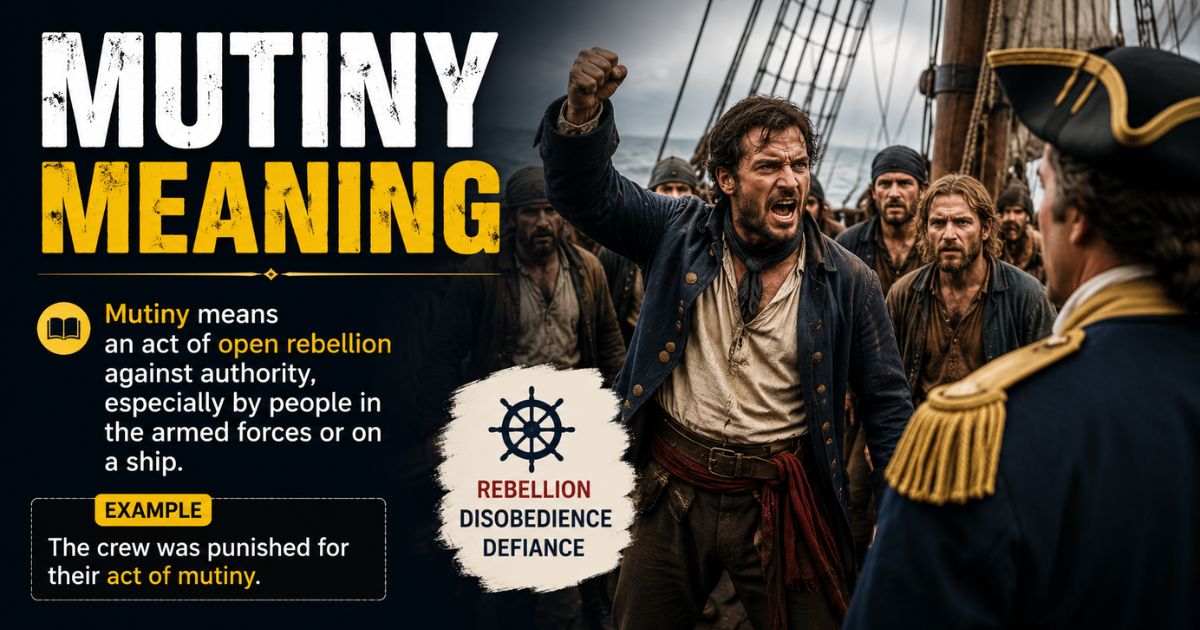
Have you ever heard someone say, “The team staged a mutiny,” or seen the word mutiny in a movie about pirates or soldiers? At first glance, it may sound like just another word for rebellion. However, its meaning is much more specific.
Understanding the mutiny meaning helps you use the word correctly in conversations, writing, history lessons, and even social media. While the term originally referred to military and naval situations, people now use it both literally and figuratively to describe groups standing up against authority.
In this guide, you’ll learn what mutiny means, where it came from, how it’s used today, common examples, and the difference between mutiny and similar words like rebellion or coup.
What Does Mutiny Mean?
The mutiny meaning is the organized refusal of a group of people—usually soldiers or sailors—to obey the authority of their leaders. In many cases, the group actively tries to remove or replace those leaders.
In simple terms, mutiny means a collective act of disobedience against someone in command.
Unlike one person refusing an order, mutiny involves multiple people acting together.
Mutiny Definition
Most major English dictionaries define mutiny as:
An organized rebellion by soldiers, sailors, or other people under authority against their commanding officers.
The word can be used as both:
- A noun: “The crew started a mutiny.”
- A verb: “The sailors mutinied against the captain.”
Mutiny Pronunciation
Pronunciation: MYOO-tuh-nee
Phonetic spelling: /ˈmjuː.tɪ.ni/
Origin and Background of the Term
The history of the word explains why it is still closely connected to military discipline.
The word mutiny comes from the Old French word mutin, meaning rebellious or defiant. It later entered Middle English and became widely associated with military and naval forces.
Historically, strict chains of command were essential aboard ships and in armies. If an entire crew refused to obey orders, lives could be lost. Because of this, mutiny became one of the most serious offenses in military law.
Famous Historical Mutinies
Several famous events shaped the modern understanding of mutiny.
HMS Bounty (1789)
Perhaps the best-known example is the Mutiny on the Bounty.
The crew of HMS Bounty, led by Fletcher Christian, rebelled against Captain William Bligh after months at sea. Bligh and several loyal crew members were forced into a small boat and set adrift.
This event has inspired countless books, documentaries, and movies.
Indian Rebellion of 1857
Often called the Sepoy Mutiny, this major uprising involved Indian soldiers serving under the British East India Company.
Although historians now commonly refer to it as the Indian Rebellion or the First War of Independence, the event shows how the word mutiny has been used throughout history.
How Mutiny Is Used in Daily Life
Although the original meaning relates to military forces, people now use mutiny in everyday conversations as a metaphor.
In the Workplace
Someone might jokingly say:
“The employees are planning a mutiny because management canceled remote work.”
No one is actually overthrowing the boss. Instead, the phrase describes a group protesting leadership.
At School
Students may jokingly say:
“There was a mutiny after the teacher announced a surprise test.”
Again, this simply means many students opposed the decision together.
In Families
Parents sometimes laugh by saying:
“The kids started a mutiny when bedtime came.”
The children aren’t committing a crime—they’re simply refusing to cooperate.
In Gaming
Gamers may use the word when teammates reject the leader’s strategy.
Example:
“The squad mutinied and followed another player instead.”
Emotional or Practical Meaning of Mutiny
Beyond its dictionary definition, mutiny often represents frustration with authority.
People usually use the word when:
- A group feels ignored
- Leadership loses trust
- Orders seem unfair
- People unite against decisions
- Cooperation breaks down
In modern conversation, the word often carries humor, exaggeration, or drama rather than its strict historical meaning.
For example:
“The office practically had a mutiny when free coffee disappeared.”
Nobody actually rebelled. The speaker simply emphasizes how unhappy everyone became.
Read More: YK Meaning: What It Really Means in Text, TikTok, Snapchat & Social Media (2026)
Similar or Related Terms
Many people confuse mutiny with other words related to conflict. While they are connected, they are not identical.
| Word | Meaning | Difference from Mutiny |
|---|---|---|
| Rebellion | General resistance against authority | Much broader than mutiny |
| Revolt | Organized uprising | Can involve civilians or governments |
| Insurrection | Violent uprising against authority | Usually larger in scale |
| Uprising | Collective protest or revolt | Not limited to military |
| Coup | Sudden seizure of government power | Usually political leadership |
| Defiance | Open resistance | Can involve one person |
| Insubordination | Refusal to obey orders | Often individual rather than collective |
Mutiny vs. Rebellion
This is one of the most searched questions.
A rebellion can happen anywhere—among citizens, workers, students, or political groups.
A mutiny specifically involves people rebelling against their own leaders while under an established chain of command.
Think of it this way:
- Every mutiny is a rebellion.
- Not every rebellion is a mutiny.
Common Misunderstandings About Mutiny
The word is often misunderstood, especially online.
Myth 1: Mutiny Always Means Violence
Not necessarily.
Although many historical mutinies became violent, the word itself simply means refusing authority as a group.
Myth 2: One Person Can Commit Mutiny
Usually not.
Mutiny almost always involves multiple people acting together.
Myth 3: Mutiny Only Happens on Ships
Historically, ships made mutiny famous.
Today, the word also applies to armies, prisons, workplaces, fictional stories, and metaphorical situations.
Myth 4: Mutiny Is the Same as a Coup
A coup attempts to seize political power from a government.
A mutiny challenges immediate leadership within an organization or military unit.
Mutiny Meaning in Text and Social Media
One reason people search “Mutiny meaning in text” is because they see the word online.
Unlike many internet abbreviations, mutiny is not a texting acronym.
Instead, people use it humorously.
Examples include:
- “The group chat is planning a mutiny.”
- “My followers started a mutiny after I changed my profile picture.”
- “The gamers mutinied against the team leader.”
Mutiny Meaning on TikTok
Creators often use mutiny when joking about followers rejecting a challenge or disagreeing with a creator’s decision.
Example:
“My subscribers staged a mutiny after I canceled the giveaway.”
Mutiny Meaning on Instagram
On Instagram, the word often appears in captions describing playful group disagreement.
Example:
“The family had a mutiny over vacation plans.”
Mutiny Meaning on Snapchat
Friends may use it jokingly when everyone refuses someone’s suggestion.
Example:
“Complete mutiny in the group chat tonight.”
Mutiny Meaning in WhatsApp
The meaning stays the same.
It usually describes a group refusing to cooperate with the person making decisions.
Mutiny in Memes
Internet memes often exaggerate small disagreements.
For example:
“When the teacher assigns homework on Friday and the class starts a mutiny.”
Examples of Mutiny in Sentences
Here are practical examples showing how to use the word correctly.
Historical Examples
- The sailors planned a mutiny against their captain.
- The soldiers were punished after the mutiny.
- The crew mutinied during the long voyage.
Everyday Examples
- The office threatened a mutiny after losing free snacks.
- The kids launched a mutiny at bedtime.
- The gaming team mutinied against its leader.
- The students joked about staging a mutiny after the exam schedule changed.
- Fans declared a mutiny online after the show’s ending.
Why Understanding Mutiny Matters Today
Even though most people will never witness a real military mutiny, the word appears regularly in:
- News reports
- History books
- Movies
- Television shows
- Political discussions
- Social media posts
- Video games
- Everyday jokes
Knowing the correct mutiny meaning helps you understand these contexts without confusing it with other forms of rebellion.
It also improves your vocabulary and makes your communication more precise.
Frequently Asked Questions
What does mutiny mean in simple words?
In simple words, mutiny means a group refusing to obey the person in charge, especially in the military or on a ship. Today, it can also describe any organized challenge to authority in a humorous or figurative way.
Is mutiny positive or negative?
Traditionally, mutiny has a negative meaning because it involves breaking discipline and refusing lawful authority. However, in casual conversation, people often use the word humorously without implying serious wrongdoing.
Where is mutiny commonly used?
The word commonly appears in military history, naval history, politics, literature, movies, video games, workplaces, classrooms, and social media discussions where groups oppose leadership.
Is mutiny formal or informal?
The word itself is standard English and suitable for both formal and informal writing. Its figurative use in everyday conversations is generally informal.
Why do people search for mutiny?
People search for mutiny to understand its historical meaning, dictionary definition, pronunciation, differences from rebellion, and modern usage in texts, memes, TikTok, Instagram, WhatsApp, and other online conversations.
Conclusion
The mutiny meaning goes far beyond pirate stories and naval history. At its core, it describes a group refusing to obey those in authority, especially within military or organized settings. Over time, the word has evolved into a popular expression for any coordinated challenge to leadership, whether it’s in the workplace, a classroom, a gaming team, or even a family discussion.
By understanding the history, definition, pronunciation, and modern usage of mutiny, you’ll be able to recognize the word in books, movies, news reports, and social media—and use it accurately in your own conversations. While it’s closely related to terms like rebellion, revolt, and insurrection, mutiny has a more specific meaning tied to organized groups challenging their own leaders.
