
Have you ever tried something again and again, only to get absolutely no result? You might describe the situation by saying “I tried to call him, but to no avail.”
But what exactly does no avail mean?
The phrase “to no avail” means without success or without producing the desired result. When you do something “to no avail,” you make an effort, but it doesn’t work. In everyday English, it often describes repeated attempts that fail to achieve what you wanted.
For example, if you keep restarting your internet connection but it still doesn’t work, you could say, “I restarted the router several times, but to no avail.”
Let’s look at the no avail meaning, its origin, common uses, examples, synonyms, and the difference between “to no avail,” “in vain,” and “unsuccessful.”
No Avail Meaning
The basic no avail meaning is without success, without benefit, or without achieving the intended result.
The word avail means to help, benefit, or produce a useful result. When something is done “to no avail,” it produces no useful outcome.
In simple terms:
To no avail = without success = with no result
For example:
“She searched everywhere for her keys, but to no avail.”
This means she searched everywhere, but she didn’t find her keys.
The phrase usually focuses on the contrast between effort and outcome. Someone tried to accomplish something, but the attempt didn’t work.
What Does “No Avail” Mean in Simple Words?
If you’re looking for a very simple explanation:
“To no avail” means you tried to do something, but it didn’t work.
You can think of it as:
Effort + no desired result = to no avail
The expression can describe small everyday frustrations or much more serious situations.
What Does To No Avail Mean?
“To no avail” means unsuccessfully or without achieving the desired result.
The phrase is usually used after describing an action or effort.
For example:
“I asked him several times to explain what happened, but to no avail.”
The speaker made several attempts to get an explanation, but none of those attempts worked.
Another example:
“They looked for a solution to the problem, but to no avail.”
They tried to solve the problem, but they couldn’t find a solution.
Is “No Avail” Correct English?
The standard expression is “to no avail.”
You may hear or see people shorten it to “no avail,” especially in informal writing, but “to no avail” is the established idiom.
For example:
Correct: “We tried to fix the car, but to no avail.”
Less natural: “We tried to fix the car, but no avail.”
If you’re writing formally, stick with “to no avail.”
No Avail Origin
The expression “to no avail” comes from the older use of the word avail, which means benefit, help, or advantage.
The word traces back through Anglo-French and Old French forms related to the idea of being useful or beneficial. Over time, avail developed into both a verb and a noun in English.
The phrase “to no avail” essentially means “with no benefit” or “without producing a useful result.”
Its meaning has remained remarkably consistent.
When someone says:
“He tried to convince her, but to no avail.”
They’re saying his efforts had no effect.
Because the phrase has a somewhat traditional or formal sound, you’ll often find “to no avail” in books, news articles, essays, and formal writing. However, people also use it in everyday conversation.
Read More: Secondary Education Meaning: Definition, Levels, Examples & More
How Is No Avail Used?
The phrase “to no avail” usually appears when someone makes an attempt but fails to achieve the intended outcome.
A common sentence structure is:
[Person] + [action/attempt] + but + to no avail.
For example:
“I called customer service several times, but to no avail.”
Another common structure is:
[Attempt] + to no avail.
For example:
“They searched the building to no avail.”
The phrase can follow many types of actions:
- Tried
- Asked
- Searched
- Called
- Looked
- Waited
- Negotiated
- Explained
- Requested
- Attempted
Why Do People Use “To No Avail”?
The expression is useful because it communicates more than simply saying “it failed.”
Compare:
“I tried to contact her, but it was unsuccessful.”
with:
“I tried to contact her, but to no avail.”
The second sentence emphasizes the effort and frustration involved.
It suggests that someone genuinely tried to achieve something, but the attempt produced no result.
Examples of To No Avail in Sentences
Here are some natural examples of “to no avail” in sentences:
“I searched my entire room for my phone, but to no avail.”
“She called her brother several times, but to no avail.”
“We tried to repair the computer, but to no avail.”
“He asked for an explanation, but to no avail.”
“The doctors tried several treatments, but to no avail.”
“They looked everywhere for the missing document, but to no avail.”
“I restarted the app three times, but to no avail.”
“She tried to convince her parents, but to no avail.”
“The team made several attempts to score, but to no avail.”
“He waited for a response all afternoon, but to no avail.”
Notice the pattern: someone makes an effort, but the desired result doesn’t happen.
More Casual Examples
In everyday conversation, you might say:
“I tried texting him, but to no avail.”
“I asked her to stop, but to no avail.”
“We tried everything, but to no avail.”
These sound natural and are easy to understand.
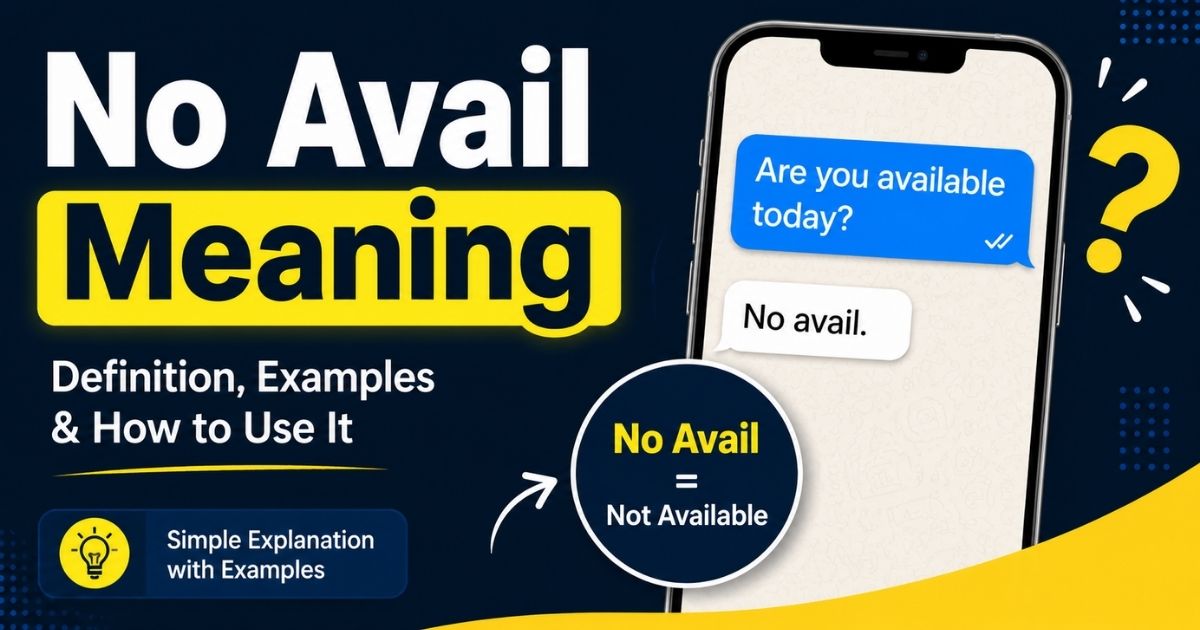
No Avail Meaning in Text
The no avail meaning in text messages is basically the same as its standard English meaning: an attempt didn’t work or produced no result.
For example:
Person A: “Did you manage to get the tickets?”
Person B: “I tried calling the box office, but to no avail.”
Person B means they tried calling, but they couldn’t get the desired result.
Because “to no avail” sounds slightly more formal than typical texting language, friends might use simpler expressions such as:
- “It didn’t work.”
- “No luck.”
- “I tried, but nothing happened.”
- “Didn’t work at all.”
- “I couldn’t get it done.”
However, “to no avail” can add a little emphasis or humor to a text.
For example:
“I begged my cat to move off my laptop. To no avail. 😂”
The phrase makes the situation sound slightly dramatic, even though the problem is trivial.
No Avail Meaning in Relationships
In relationships, “to no avail” usually describes an attempt to communicate, repair a problem, change a situation, or get a response that doesn’t succeed.
For example:
“I tried talking to him about our problems, but to no avail.”
This means the person tried to have a conversation, but it didn’t resolve anything.
Another example:
“She apologized several times, but to no avail.”
Here, her apologies didn’t produce the desired response.
The phrase doesn’t automatically mean that a relationship has ended. It simply tells you that an attempt didn’t produce the intended outcome.
Relationship Examples
“I tried explaining how I felt, but to no avail.”
“He tried to rebuild her trust, but to no avail.”
“They tried counseling, but to no avail.”
“She kept asking him to communicate more openly, but to no avail.”
In these examples, the important idea is effort without the expected result.
When Should You Use To No Avail?
Use “to no avail” when you want to explain that an effort or attempt failed to produce the result you wanted.
It’s especially useful when:
- You made multiple attempts.
- You expected a particular outcome.
- Your efforts didn’t change the situation.
- You want to emphasize frustration or disappointment.
- You’re writing in a slightly formal or polished style.
For example:
“I tried several passwords to no avail.”
This tells the reader that you made several attempts, but none worked.
When Should You Avoid It?
You probably don’t need “to no avail” when you’re simply stating a fact with no failed effort involved.
For example:
“The store was closed.”
There’s no attempted action here, so “to no avail” doesn’t fit.
But:
“I drove to the store twice, but to no avail.”
Now it makes sense because the person made an effort but didn’t achieve the desired result.
No Avail vs In Vain
“To no avail” and “in vain” are very similar. Both can describe an unsuccessful effort.
| To No Avail | In Vain |
|---|---|
| Means without success or result | Means unsuccessfully or without achieving the desired result |
| Often emphasizes the outcome | Can emphasize wasted or unsuccessful effort |
| Slightly formal | Can sound more literary or dramatic |
| Common in “tried X, but to no avail” | Common in “tried X in vain” |
For example:
“She tried to open the door, but to no avail.”
and:
“She tried in vain to open the door.”
Both mean that she tried but couldn’t open the door.
However, “in vain” can sometimes carry a stronger sense that the effort was wasted or futile.
No Avail vs Unsuccessful
“To no avail” and “unsuccessful” also have similar meanings, but they’re used differently.
Unsuccessful is an adjective.
“His attempt was unsuccessful.”
To no avail is an idiomatic expression.
“He tried to fix it, but to no avail.”
The difference is mainly grammatical and stylistic.
“To no avail” often sounds more natural when you’re describing an action followed by a failed outcome.
Compare:
“She made several attempts, but they were unsuccessful.”
“She made several attempts, but to no avail.”
Both are correct. The second has a stronger idiomatic and expressive quality.
No Avail Synonyms
There are several no avail synonyms you can use depending on the context.
Common Synonyms
- Without success
- Without result
- Unsuccessfully
- In vain
- Without effect
- Futilely
- With no success
- With no result
- Pointlessly
- Ineffectively
Casual Alternatives
If you’re texting or talking with friends, you might say:
- No luck
- It didn’t work
- Nothing worked
- No results
- It was useless
- I tried, but nothing happened
For example:
Formal:
“I tried contacting the company, but to no avail.”
Casual:
“I tried contacting the company, but no luck.”
Both communicate the same basic idea.
Common Mistakes With No Avail
Although “to no avail” is a simple phrase, people sometimes use it incorrectly.
Mistake 1: Forgetting “To”
The standard idiom is:
“I tried to help, but to no avail.”
Not:
“I tried to help, but no avail.”
Mistake 2: Using It Without an Attempt
“To no avail” normally connects to an action or effort.
Instead of:
“The answer was to no avail.”
Say:
“He searched for the answer, but to no avail.”
Mistake 3: Thinking It Means “Unavailable”
The word avail in this expression doesn’t mean “available.”
“To no avail” means without success or benefit.
It has nothing to do with something being unavailable.
Mistake 4: Using It for a Successful Action
You shouldn’t say:
“I studied for the exam, but to no avail, and I got an A.”
That creates a contradiction because getting an A means the effort produced the desired result.
Mistake 5: Assuming It Always Means Something Was Completely Pointless
“To no avail” means the intended result wasn’t achieved. It doesn’t necessarily mean the effort had absolutely no value.
For example, someone might try to repair a computer and fail, but learn something useful during the process.
The attempt was unsuccessful, but not necessarily meaningless.
How to Respond to “To No Avail”
If someone says “to no avail” in a conversation, your response depends on what they’re talking about.
If they’re describing a frustrating situation, you can respond with empathy:
“That’s frustrating. Did you try anything else?”
Or:
“Oh no, hopefully you find a solution soon.”
If the statement is casual or humorous:
“Sounds like you’ve tried everything!”
Or:
“Well, at least you gave it a shot!”
For example:
Friend: “I tried getting my dog to come inside, but to no avail.”
You: “Sounds like your dog had other plans!”
The phrase doesn’t require a special response. Simply respond to the situation being described.
FAQ’s About No Avail Meaning
What does “to no avail” mean?
“To no avail” means without success or without achieving the desired result.
What does “no avail” mean in simple English?
It means you tried something, but it didn’t work.
Is “to no avail” positive or negative?
It’s generally used in a negative or disappointing context because it describes an unsuccessful attempt.
Is “to no avail” formal?
It is somewhat formal or polished, but it’s perfectly normal English and can also appear in everyday conversation.
Is “to no avail” the same as “in vain”?
They are very similar. Both describe unsuccessful efforts, although “in vain” can sometimes emphasize that an effort was futile or wasted.
What is another word for “to no avail”?
Common alternatives include unsuccessfully, in vain, without success, without result, and without effect.
Can I use “to no avail” in a text message?
Yes. It works in text messages, although casual alternatives such as “no luck” or “it didn’t work” may sound more conversational.
Does “to no avail” mean “unavailable”?
No. “To no avail” means without success or benefit. It doesn’t mean that something is unavailable.
Can “to no avail” describe one attempt?
Yes. It can describe one unsuccessful attempt, although it’s especially natural when someone has made repeated efforts.
What is an example of “to no avail”?
“I tried calling her, but to no avail.”
This means I tried calling her, but I couldn’t reach her or get the desired result.
Conclusion
The no avail meaning is straightforward: without success, benefit, or the desired result. The standard expression is “to no avail,” and it’s used when someone makes an effort but doesn’t accomplish what they intended.
For example, “I tried fixing my phone, but to no avail” means the person attempted to fix it but wasn’t successful.
You can use the phrase in everyday conversations, texts, essays, and formal writing. It’s closely related to “in vain” and “unsuccessfully,” although each expression has its own style and grammatical role.
The easiest way to remember it is:
To no avail = You tried, but it didn’t work.
