
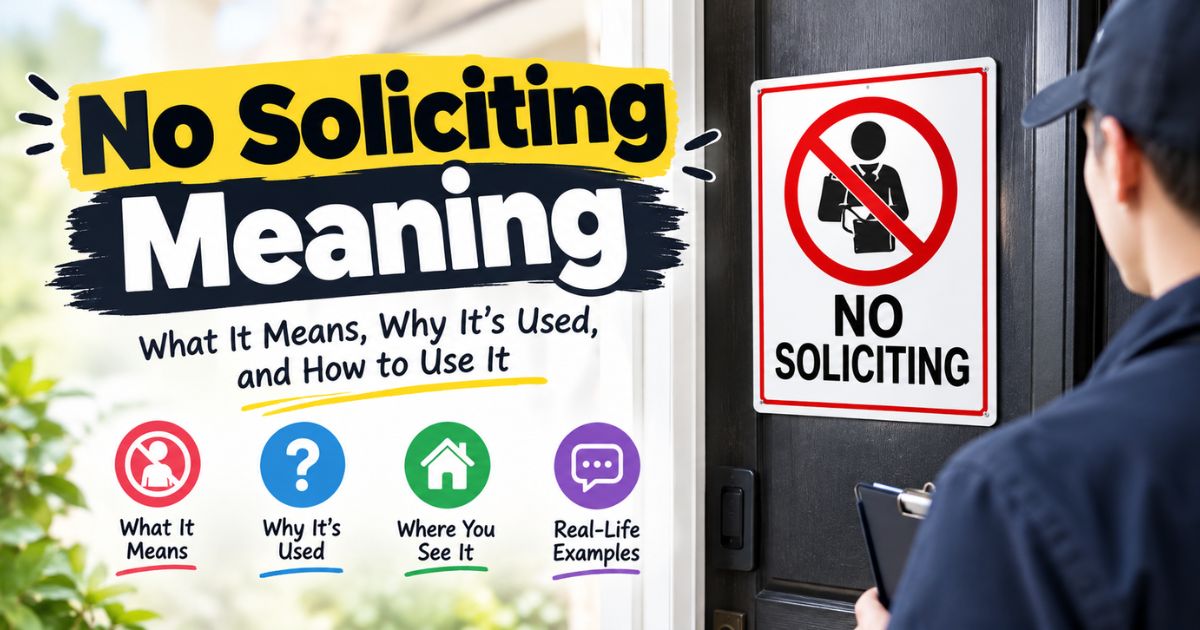
Have you ever seen a No Soliciting sign on someone’s front door, house, office, or business and wondered exactly what it means? Does it mean you can’t knock on the door at all? Does it only apply to salespeople? What about delivery drivers, charity workers, political campaigners, or religious visitors?
The no soliciting meaning is actually quite simple, but the situations covered by the sign can sometimes be confusing. In general, a no soliciting sign tells people not to approach someone for an unwanted sales pitch, business promotion, donation request, fundraising effort, or similar purpose.
However, a No Soliciting sign doesn’t automatically mean that nobody can ever visit or knock on the door. The exact meaning can depend on why someone is visiting and, in some cases, local regulations.
Let’s break down everything you need to know.
What Does No Soliciting Mean?
No soliciting means that a property owner does not want people approaching them to sell products, promote services, ask for donations, recruit customers, or make another unwanted business-related request.
A person who does these activities may be called a solicitor, while the activity itself is called soliciting or solicitation.
For example, someone knocking on your door to sell home security systems is soliciting. A fundraiser asking for donations may also be soliciting. A salesperson promoting a new internet service could also fall into this category.
In simple terms, when you see a no soliciting sign, the message is usually:
Please don’t knock on my door to sell me something or ask me for money, support, or business.
The sign is mainly designed to protect privacy and prevent unwanted interaction.
No Soliciting Meaning in Simple Words
The no soliciting meaning in simple words is:
Don’t come here to sell, advertise, promote, or ask for something.
Imagine you’re relaxing at home after a long day. Someone knocks on your door, and you expect an important visitor. Instead, it’s a door-to-door salesperson giving you a sales pitch.
A no soliciting sign tells that person the homeowner doesn’t want those types of visits.
It can apply to activities such as:
- Selling products or services
- Promoting a business
- Asking for charity donations
- Fundraising
- Distributing promotional material
- Recruiting customers or members
- Making unwanted sales pitches
The main idea is simple: the property owner doesn’t want unsolicited business or fundraising contact.
No Soliciting Meaning on a Sign
The no soliciting meaning on a sign is a clear request from the property owner asking solicitors not to approach them for commercial, promotional, or fundraising purposes.
You might see wording such as:
No Soliciting
Please No Soliciting
No Salespeople or Solicitors
No Solicitors
Although the wording may differ, the purpose is generally the same.
The sign tells salespeople, marketers, canvassers, and other solicitors that their visit isn’t welcome.
A no solicitation sign is especially common in neighborhoods where residents receive frequent door-to-door sales visits.
No Soliciting Meaning on a Door
The no soliciting meaning on a door usually applies to people who are about to knock or ring the doorbell for a sales or promotional purpose.
For example, a door-to-door salesperson might want to introduce a product. Before knocking, they see a sign that says No Soliciting.
The appropriate response is usually not to make the sales visit.
The sign is placed directly on the door because that’s where visitors are most likely to see it before contacting the homeowner.
However, the sign doesn’t necessarily mean that absolutely nobody can knock.
For example, an invited guest, neighbor, friend, emergency worker, or delivery person generally isn’t visiting to make a sales solicitation.
That’s why does no soliciting mean no knocking doesn’t always have a simple yes-or-no answer.
No Soliciting Meaning at a Home
The no soliciting meaning at home is mainly about protecting a homeowner’s privacy.
Your home is a private residence, and many people don’t want unexpected visitors trying to sell products or services.
A homeowner may put up a no soliciting sign because they:
- Don’t want unwanted sales pitches
- Value their privacy
- Work from home
- Have young children
- Have pets that react to door knocking
- Receive frequent unwanted visitors
- Don’t want to be interrupted
For many homeowners, the sign acts as a simple boundary.
It says, in effect: Please respect my privacy and don’t contact me for sales or promotional purposes.
A no soliciting sign doesn’t necessarily prevent invited guests from visiting. Your friends, family members, neighbors, and other expected visitors aren’t usually considered solicitors.
No Soliciting Meaning in a Business
The no soliciting meaning in a business works similarly, but the setting is different.
Businesses often display no solicitation signs to prevent interruptions during working hours.
For example, an office may not want salespeople walking in and trying to sell advertising, equipment, software, cleaning services, or other products.
A business owner may want employees to focus on customers and work rather than dealing with unexpected sales representatives.
A no solicitation sign at a business can communicate:
Do not enter or contact employees for unsolicited sales, promotions, fundraising, or business requests.
However, businesses may have their own policies about who is allowed to enter.
A supplier with an appointment, a scheduled service technician, or another authorized visitor may still be welcome.
The key difference is whether the person has a legitimate reason or permission to be there.
Read More: Hanged Man Tarot Card Meaning: Love, Career, Spirituality & More
Does No Soliciting Mean No Selling?
In most cases, yes. One of the main purposes of a no soliciting sign is to stop unwanted selling.
If someone is visiting your property to sell a product or service, that activity is commonly considered solicitation.
For example:
A salesperson selling solar panels may be soliciting.
A person promoting a cleaning service may be soliciting.
Someone selling internet packages door to door may be soliciting.
So, when people ask, does no soliciting mean no selling, the answer is generally yes.
However, solicitation can include more than selling.
That’s an important distinction.
Someone doesn’t necessarily need to be selling a physical product to be considered a solicitor. Asking for donations, promoting an organization, or recruiting customers may also count as solicitation depending on the situation.
Does No Soliciting Mean No Knocking?
No soliciting does not always mean no knocking.
This is one of the biggest misunderstandings about no soliciting signs.
The sign usually prohibits knocking for a solicitation-related purpose. It doesn’t automatically ban every person from knocking on the door.
For example, these people may not normally be considered solicitors:
An invited guest visiting you.
A friend stopping by.
A neighbor with an important message.
A delivery person delivering a package.
An emergency worker responding to a situation.
However, a person knocking specifically to give a sales pitch may be violating the request expressed by the sign.
So the better way to understand it is:
No soliciting means no unwanted knocking for sales, promotions, donations, or similar requests.
If a property owner wants absolutely no visitors or interruptions, they may use a sign such as Do Not Disturb or another more specific message.
Examples of Solicitation
Understanding examples of solicitation makes the meaning of the sign much easier.
Solicitation can involve many different activities.
Sales Solicitation
A door-to-door salesperson promoting products or services is one of the most common examples.
Examples include selling:
- Internet services
- Home security systems
- Cleaning services
- Solar energy products
- Magazine subscriptions
- Home improvement services
These activities usually involve a sales pitch designed to convince someone to become a customer.
Donation Solicitation
Solicitation isn’t always about selling.
Someone asking for money for a charity, organization, or fundraising campaign may also be soliciting.
For example, a person may knock on doors asking residents to support a charity donation campaign.
Whether a specific no soliciting sign applies to charities can sometimes depend on the wording of the sign and local rules.
Fundraising Solicitation
Schools, organizations, clubs, and community groups may sometimes conduct fundraising activities.
Examples can include selling items to raise money or asking for financial support.
Again, the exact situation can vary. Some property owners may welcome these activities, while others may expect everyone to respect a general no solicitation request.
Business Solicitation
Business solicitation happens when someone contacts another person to promote a business opportunity, product, or service.
For example, a marketing representative entering an office without an appointment and trying to sell advertising services could be engaged in business solicitation.
Political Canvassing
Political canvassing can involve knocking on doors to discuss candidates, campaigns, or issues.
Whether political visitors are covered by a no soliciting sign can depend on local laws and the nature of the activity.
Political communication may be treated differently from ordinary commercial sales solicitation.
Religious Visitors
Religious visitors may also knock on doors to discuss beliefs or invite people to religious events.
Whether a general No Soliciting sign applies to religious visitors can be interpreted differently depending on local laws and the specific circumstances.
The safest approach for visitors is to respect clearly expressed property boundaries and applicable local regulations.
Who Is Considered a Solicitor?
A solicitor is generally a person who approaches someone to request, promote, sell, recruit, or seek something.
Depending on the situation, a solicitor could be:
- A salesperson
- A marketer
- A fundraiser
- A business representative
- A charity worker asking for donations
- A canvasser
- Someone recruiting customers or members
The word solicitor doesn’t always mean the same thing in every context.
For example, in some countries, the word can also refer to a type of legal professional. That’s completely different from the meaning used on a No Soliciting sign.
On a property sign, the term usually refers to someone making an unsolicited request or promotion.
What Does Soliciting Mean?
Soliciting means actively approaching someone to ask for, promote, request, sell, or seek something.
The exact meaning depends on the context.
For example:
A salesperson solicits customers.
A fundraiser solicits donations.
A business may solicit clients.
An organization may solicit support.
In everyday conversations about property signs, soliciting usually refers to unwanted door-to-door contact involving sales, promotions, or requests.
What Does Solicitation Mean?
Solicitation is the act of making a request, appeal, offer, or attempt to obtain something from another person.
For example:
Sales solicitation means trying to gain customers or make sales.
Donation solicitation means asking people to contribute money.
Business solicitation can involve trying to gain clients or promote services.
So, the no solicitation meaning is essentially a request to stop these unwanted approaches on the property.
No Solicitation vs No Trespassing
No Solicitation and No Trespassing are not the same thing.
A no soliciting sign focuses mainly on the purpose of someone’s visit.
A no trespassing sign focuses on entering or remaining on private property without permission.
Here’s a simple comparison:
| No Soliciting | No Trespassing |
|---|---|
| Mainly targets unwanted sales and requests | Focuses on unauthorized entry |
| Often applies to salespeople and promoters | Can apply more broadly to unauthorized visitors |
| Doesn’t necessarily ban every visitor | May prohibit entering private property |
| Protects against unwanted solicitation | Protects property boundaries |
A person may be allowed to approach a property for some legitimate reason while still not being allowed to solicit.
Likewise, a property owner may use both signs if they want to communicate stronger boundaries.
The legal effect of either sign can depend on local regulations and jurisdiction.
No Solicitation vs Do Not Disturb
No Solicitation and Do Not Disturb also have different meanings.
A no soliciting sign mainly targets people who want to sell, promote, or request something.
A Do Not Disturb sign has a broader meaning. It tells people not to interrupt or bother the person.
For example, someone might use a Do Not Disturb sign in a hotel room.
A homeowner could also use similar wording if they don’t want unexpected visitors.
Here’s the difference:
No Soliciting: Don’t contact me for sales, promotions, or requests.
Do Not Disturb: Please don’t interrupt or bother me.
If your goal is specifically to stop door-to-door salespeople, a No Soliciting sign is more direct.
If you want fewer interruptions from almost everyone, different wording may better communicate your preference.
Does No Soliciting Mean No Visitors?
Generally, no. A no soliciting sign doesn’t automatically mean that all visitors are prohibited.
The sign is mainly directed toward people who are visiting to solicit.
Your friends, family members, invited guests, neighbors, and other legitimate visitors usually aren’t visiting for that purpose.
However, property owners can create their own rules about visitors.
Some signs use more detailed language, such as:
No Soliciting. No Salespeople. No Fundraising. No Uninvited Visitors.
The specific wording matters.
If you’re unsure whether your visit is welcome, it’s best to respect the property owner’s wishes.
Does No Soliciting Apply to Delivery Drivers?
A delivery person generally isn’t making a sales solicitation when delivering something that has already been ordered.
For example, someone delivering:
- A package
- Food
- Groceries
- A scheduled order
is usually performing a delivery service rather than trying to sell something.
So, does no soliciting apply to delivery drivers? Usually, not in the ordinary sense.
However, delivery drivers should still follow any specific delivery instructions provided by the property owner.
Can a Friend Knock on a No Soliciting Door?
Yes, a friend can generally knock on a door displaying a no soliciting sign because a friend isn’t normally there to sell, promote, or request something.
The same is generally true for invited guests and many ordinary personal visitors.
Remember, the purpose of the visit matters.
If you’re visiting socially, you’re not usually considered a solicitor.
Why Do People Put Up No Soliciting Signs?
People put up no soliciting signs for many practical reasons.
The biggest reason is usually privacy.
Unexpected door knocking can interrupt work, family time, sleep, meetings, or relaxation.
Some homeowners also dislike feeling pressured by salespeople.
Others simply don’t want strangers approaching their private residence with unsolicited offers.
For businesses, the reason may be productivity.
An office manager doesn’t want employees repeatedly interrupted by marketers and sales representatives.
A simple sign can communicate the policy before an unwanted interaction begins.
How Does a No Soliciting Sign Work?
A no soliciting sign works mainly by clearly communicating the property owner’s wishes.
Instead of waiting until a salesperson knocks and starts talking, the sign gives advance notice.
It tells potential solicitors:
This property does not welcome unsolicited sales or promotional visits.
Most legitimate businesses and sales representatives should respect that request.
However, the exact legal effect of a sign can vary depending on local laws.
A sign isn’t automatically identical to a court order or criminal prohibition in every location.
Local rules may determine issues such as permits, door-to-door sales, trespassing, and enforcement.
Is a No Soliciting Sign Legally Binding?
The answer depends on where you live and the specific circumstances.
A No Soliciting sign can clearly show that a property owner does not want solicitation. However, whether violating the sign creates a legal violation depends on local laws and regulations.
Some cities or jurisdictions have specific rules about door-to-door salespeople and solicitation permits.
Other legal issues may involve:
- Local solicitation laws
- Property rights
- Trespassing rules
- Business licensing requirements
- Consumer protection regulations
- Constitutional protections for certain types of speech
For example, commercial door-to-door sales may be treated differently from political or religious communication.
Because laws vary by jurisdiction, you shouldn’t assume that every no soliciting sign has exactly the same legal effect everywhere.
If you need advice about a specific legal situation, check the regulations in your local area or speak with a qualified legal professional.
No Soliciting Meaning in an Apartment
The no soliciting meaning in an apartment is similar to its meaning at a house.
The sign generally tells salespeople, marketers, and fundraisers not to approach residents with unsolicited requests.
However, apartment buildings may also have additional security and access rules.
A solicitor may not be allowed to enter the building without permission.
Property managers can create rules for common areas, visitor access, and business solicitation.
If you live in an apartment, check your building’s policies as well as any posted signs.
No Soliciting Meaning at an Office
An office may display a no solicitation sign to prevent unwanted business promotions and interruptions.
For example, a salesperson may walk into an office and try to promote a new service.
If the business has a No Soliciting policy, employees may be instructed not to accept unsolicited sales visits.
The sign helps protect working time and keeps unexpected promotions from disrupting the workplace.
Legitimate visitors with appointments, deliveries, or scheduled business are different from uninvited salespeople.
What Should You Do If You See a No Solicitation Sign?
If you see a no solicitation sign, the respectful thing to do is first consider why you’re visiting.
Ask yourself:
Am I here to sell something?
Am I promoting a service?
Am I asking for donations or support?
Am I trying to recruit someone?
If the answer is yes, you should generally respect the sign and avoid making the unsolicited approach.
If you’re a delivery person, invited guest, neighbor, or someone with another legitimate reason for visiting, the sign may not apply in the same way.
When in doubt, respect the property owner’s privacy.
That’s usually the safest and most considerate approach.
A Simple Real-Life Example
Imagine a salesperson walking through a neighborhood promoting a new home security service.
They approach a house and see a sign saying:
PLEASE NO SOLICITING
That salesperson should understand that the homeowner doesn’t want an unsolicited sales pitch.
Now imagine a package delivery driver arriving at the same house with an order the homeowner placed online.
The driver isn’t trying to make a sales pitch or recruit a customer. They’re delivering an existing order.
The situations are different because the purpose of each visit is different.
That’s the easiest way to understand the no soliciting meaning.
Conclusion
The no soliciting meaning is simple: the property owner does not want unwanted approaches involving sales, promotions, fundraising, donations, or similar requests.
A No Soliciting sign is commonly used on homes, doors, offices, apartments, and businesses to protect privacy and reduce unwanted interruptions.
It generally means no door-to-door sales pitches and no unsolicited promotional requests, but it doesn’t automatically mean that nobody can ever knock on the door.
Friends, invited guests, neighbors, and delivery drivers usually aren’t considered solicitors because they aren’t visiting to sell or promote something.
The exact legal effect of a no soliciting sign can vary by location, so local regulations may matter in specific situations. Still, the basic message is clear: respect the property owner’s wishes and don’t make unwanted sales or solicitation visits.
FAQs
What does no soliciting mean?
No soliciting means the property owner does not want people approaching them to sell products, promote services, ask for donations, or make unsolicited requests.
What does no soliciting mean in simple words?
In simple words, it means: Don’t come here to sell, advertise, promote, or ask for something.
What does a no soliciting sign mean?
A no soliciting sign tells salespeople, marketers, fundraisers, and other solicitors that unsolicited approaches are not welcome on the property.
Does no soliciting mean no knocking?
Not always. It mainly means no knocking for sales, promotions, fundraising, or solicitation. Friends, delivery drivers, and invited guests may still have legitimate reasons to knock.
Does no soliciting mean no selling?
Yes, in most cases. Preventing unwanted door-to-door selling is one of the main purposes of a no soliciting sign.
Does no soliciting mean no visitors?
No. A no soliciting sign usually applies to people visiting for sales, promotions, or requests. It doesn’t automatically ban all visitors.
What is an example of soliciting?
A door-to-door salesperson trying to sell home security systems is a common example of soliciting.
Who does a no soliciting sign apply to?
It generally applies to salespeople, marketers, fundraisers, business promoters, and others making unsolicited requests.
Does no soliciting apply to delivery drivers?
Usually, delivery drivers aren’t considered solicitors when delivering an order or package that has already been requested.
Can a friend knock on a no soliciting door?
Yes, generally. A friend isn’t normally considered a solicitor because they aren’t visiting to sell, promote, or request something.
Is no soliciting the same as no trespassing?
No. No soliciting focuses on unwanted sales and requests, while no trespassing focuses on unauthorized entry onto private property.
Is a no soliciting sign legally enforceable?
Its legal effect depends on local laws and jurisdiction. A sign clearly communicates the property owner’s wishes, but enforcement rules can vary.
Does no soliciting include charities?
It may, depending on the wording of the sign and local regulations. Asking for donations can be considered solicitation.
Does no soliciting include political campaigns?
Political canvassing may be treated differently from commercial solicitation under local laws, so the answer can vary by jurisdiction.
What should you do if you see a no solicitation sign?
Respect the sign. If you’re visiting to sell, promote, fundraise, or make an unsolicited request, don’t approach the property.
