Someone comments “NPC behavior” under a video, and suddenly you’re wondering if that’s about video games or something else entirely. You’re not wrong to be confused. NPC started as a gaming term, but it’s since taken on a whole second life across TikTok, Instagram, and everyday texting.
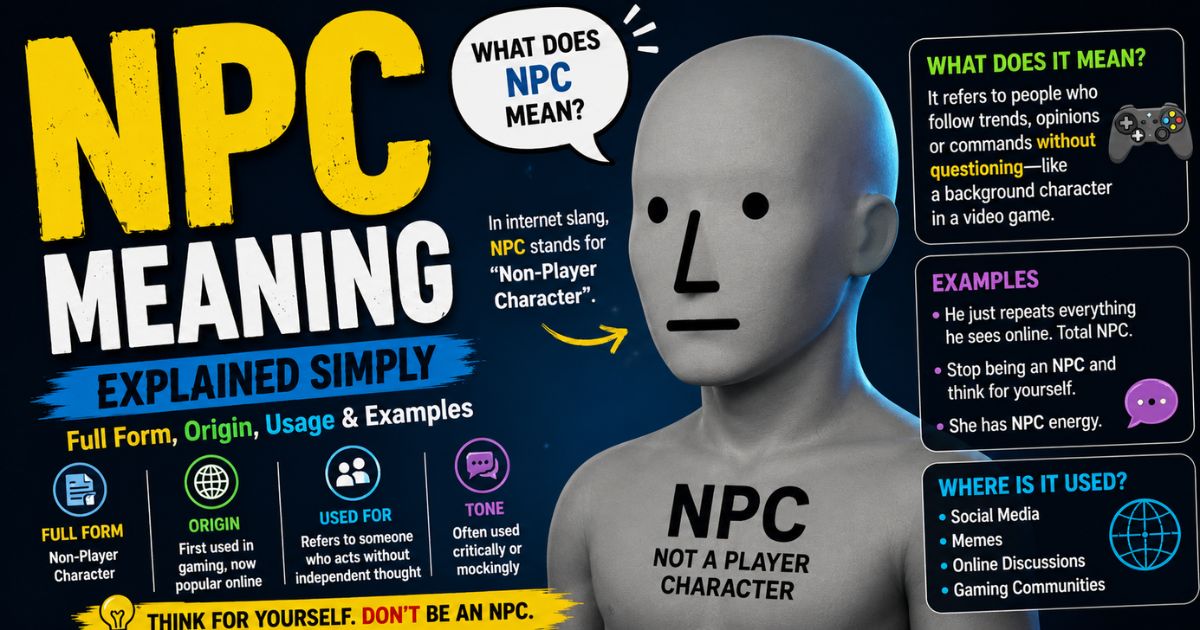
At its core, NPC stands for “non-player character,” a term borrowed directly from video games. Online, though, it’s morphed into slang for someone who seems to act on autopilot, repeating the same reactions or opinions without much original thought behind them. It’s a sharp little insult wrapped in gaming language, and once you understand where it came from, the modern usage makes a lot more sense.
This guide walks through everything: the original meaning of NPC, how it evolved into internet slang, where it shows up across different platforms, and how to respond if someone drops it in your direction.
Meaning & Definition of NPC
NPC carries two very different meanings depending on where you encounter it. One is technical and neutral. The other is sharp, sarcastic, and very much a product of internet culture.
Primary Meaning:
In its original and most literal sense, NPC stands for “non-player character.” In video games, this refers to any character controlled by the game itself rather than a human player. Shopkeepers, quest-givers, background townsfolk, they’re all NPCs. They follow scripted behavior, repeat the same lines, and exist to support the player’s experience rather than act independently.
Secondary Meaning (Internet Slang):
Online, NPC took that gaming concept and turned it into a pointed insult. When someone calls a person an NPC, they’re suggesting that person lacks independent thought, follows the crowd, or reacts to situations in a predictable, scripted way, just like a background character in a game. It’s often aimed at people seen as going along with popular opinions without questioning them, or reacting to everything with the same generic responses.
Background & Origin of NPC
The term NPC has been part of gaming vocabulary for decades, dating back to tabletop role-playing games long before video games existed. Dungeon Masters used it to describe any character in the story who wasn’t controlled by a player at the table. Once video games adopted role-playing mechanics, the term carried over naturally and became standard gaming language.
Evolution into Internet Culture:
The slang version of NPC really took off around 2018, when it started spreading through Twitter and meme culture as a way to mock people seen as unoriginal or overly conformist in their opinions, especially in political and social discussions. From there, it moved into broader internet slang, losing some of its original political edge and becoming a general-purpose jab at anyone acting predictable or robotic. TikTok gave it a second wind more recently through “NPC streaming,” where creators act out exaggerated, repetitive gestures and phrases live on camera, deliberately leaning into the joke rather than avoiding it.
Usage in Different Contexts
NPC shows up differently depending on the setting, and reading that context correctly makes a big difference in how the term should be understood.
1. Gaming Context
Here, NPC stays close to its original, neutral definition. Players use it constantly and without any insult attached, simply referring to any non-playable character in a game. A quest-giver, a merchant, a background pedestrian in an open-world game, they’re all NPCs, full stop.
2. Social Media Context
This is where the slang version dominates. People use NPC to describe someone who seems to repeat popular opinions without thinking them through, or who reacts to trends in a robotic, predictable way. It’s become a common insult in comment sections, often aimed at people seen as followers rather than independent thinkers.
3. Professional/Neutral Context
Outside of gaming and social slang, NPC rarely comes up in professional settings. When it does, it’s almost always tied back to game design, software development, or discussions about artificial intelligence and simulated behavior, not as commentary on real people.
Read More: YNS Meaning Explained: What It Really Means in Text, Snapchat & Social Media
Meanings Across Platforms
While the core idea behind slang NPC stays fairly consistent, each platform has its own flavor of how the term gets used.
| Platform | How “NPC” Is Typically Used |
|---|---|
| Casual jokes between friends, often gaming-related | |
| Comment sections, sometimes tagged to viral “basic” behavior | |
| TikTok | NPC streaming trend and reaction comments on repetitive behavior |
| Snapchat | Quick jokes in chats, usually gaming references among friends |
On WhatsApp, NPC tends to stay closer to its gaming roots, showing up in casual jokes between friends who play games together. It’s less common as a pointed insult here since conversations are more private and personal.
Instagram comments use NPC to call out behavior seen as unoriginal or overly trend-driven, often under posts showing someone copying a popular look, opinion, or reaction.
TikTok
TikTok is where NPC really exploded thanks to the “NPC streaming” trend, where creators mimic repetitive, scripted gestures and phrases for entertainment. Beyond that trend, it’s also a common comment used to mock predictable reactions in videos.
Snapchat
On Snapchat, NPC usually shows up in more private, joking exchanges between friends, often tied to gaming references rather than the sharper social media insult version.
Other Fields Where NPC Appears
Outside of gaming and slang, “NPC” shows up in a few completely unrelated fields, and it’s worth knowing these so the acronym doesn’t get mixed up out of context.
1. Biology (Niemann-Pick Disease – NPC)
In medicine, NPC refers to Niemann-Pick disease type C, a rare genetic disorder that affects how the body processes cholesterol and other lipids. This usage has nothing to do with gaming or slang and predates the internet meaning by decades.
2. Aviation/Navigation
In aviation and navigation contexts, NPC can appear as shorthand in technical documentation, though its usage here is far less standardized than in gaming or medicine.
3. AI & Simulation
In discussions about artificial intelligence and simulated environments, NPC often describes any automated agent that behaves according to programmed rules rather than real-time human input, extending the original gaming definition into broader tech conversations about bots and automated behavior.
Common Misconceptions & Mistakes
A common misconception is that NPC is always a harsh personal attack. In reality, it ranges from lighthearted teasing among friends to a genuinely dismissive insult, depending entirely on tone and relationship. Another mistake people make is assuming the term always relates to intelligence. It’s really more about perceived originality and independent thought than raw intelligence, someone can be sharp and still get called an NPC if they’re seen as following the crowd on a specific topic. It’s also worth remembering that the gaming definition and the slang definition are two separate things entirely, so context always matters before assuming which one applies.
Similar Terms & Alternatives
If you want variety instead of repeating NPC constantly, plenty of similar terms carry a comparable meaning. “Sheep” and “follower” both point toward the same idea of going along with the crowd. “Basic” leans more toward predictable taste than predictable behavior. “Bot” carries a very similar robotic connotation, often used interchangeably with NPC in comment sections. “Copy-paste” works well too, especially when describing someone whose opinions all sound identical to whatever’s currently trending.
How to Respond to NPC Comments
Getting called an NPC can land differently depending on who said it and how seriously you take internet comments in general. Here are a few common ways people respond.
Neutral Response:
Something simple like “okay, sure” defuses the comment without giving it much weight, which usually works best in situations where engaging further isn’t worth the effort.
Playful Response:
Leaning into the joke with something like “beep boop, quest accepted” turns the insult into a bit rather than letting it land as a real jab.
Confident Response:
A reply like “I just don’t feel the need to overreact to everything” pushes back calmly without escalating things into an argument.
Humorous Response:
Some people go all in and start acting like an actual NPC in the replies, repeating a scripted-sounding line a few times for comedic effect. It usually gets a good laugh and takes all the sting out of the original comment.
Differences From Similar Words
It’s worth separating NPC from other words people mix it up with. “Bot” usually implies something is fake or automated entirely, often used for suspicious accounts rather than real people acting predictably. “Sheep” focuses specifically on blind conformity rather than general predictability. “Basic” is softer and usually about taste or aesthetic choices rather than behavior or thought patterns. NPC, by comparison, hits hardest when it’s aimed at someone’s reasoning or reactions, suggesting they’re running on a script rather than thinking for themselves.
Relevance in Online Conversations & Dating Apps
NPC occasionally shows up in dating app conversations too, usually as a joke about a match giving generic, copy-paste responses that feel more like a template than a real conversation. Someone might joke that a match “is giving NPC energy” if every reply feels rehearsed or interchangeable with any other match. It’s a playful way to call out a lack of originality without being outright rude about it, fitting the same fast, low-effort communication style that defines a lot of modern dating app culture.
Popularity & Trends Over Time
NPC slang saw its biggest spike around 2018 during its political meme phase, cooled off slightly, and then surged again with the rise of NPC streaming trends on TikTok. Unlike some slang that fades fast, NPC has held on because it ties back to something people already understand from gaming, which gives it more staying power than terms invented purely for internet use. It’s settled into steady, everyday use rather than disappearing after its viral peaks, and it shows no real signs of dropping out of common vocabulary anytime soon.
FAQs
1. What does NPC mean in slang?
In slang, NPC describes someone seen as unoriginal or predictable, reacting to situations like a scripted background character rather than thinking independently.
2. Is NPC an insult?
It can be, though tone matters a lot. Among friends it’s often lighthearted teasing, while in more serious contexts it can feel like a genuine put-down.
3. What is NPC in gaming?
In gaming, NPC stands for “non-player character,” referring to any character controlled by the game rather than a human player.
4. Why do people say NPC on TikTok?
TikTok popularized NPC through the “NPC streaming” trend, where creators mimic repetitive, scripted behavior for entertainment, alongside general comment section use as an insult for predictable reactions.
5. Is calling someone NPC rude?
It can come across as rude depending on the context and relationship. It’s usually more playful among friends but can feel dismissive in unfamiliar or serious conversations.
Conclusion
NPC is a good reminder of how gaming language keeps bleeding into everyday internet culture. What started as a simple term for background game characters has turned into shorthand for calling out predictable, unoriginal behavior online. Whether you’re hearing it in a gaming Discord or a TikTok comment section, the meaning usually comes down to the same idea: someone acting on autopilot instead of thinking for themselves.
Now that you know both sides of NPC, the technical gaming definition and the sharper internet slang version, you’ll be able to tell exactly which one’s in play the next time it shows up in your feed.
