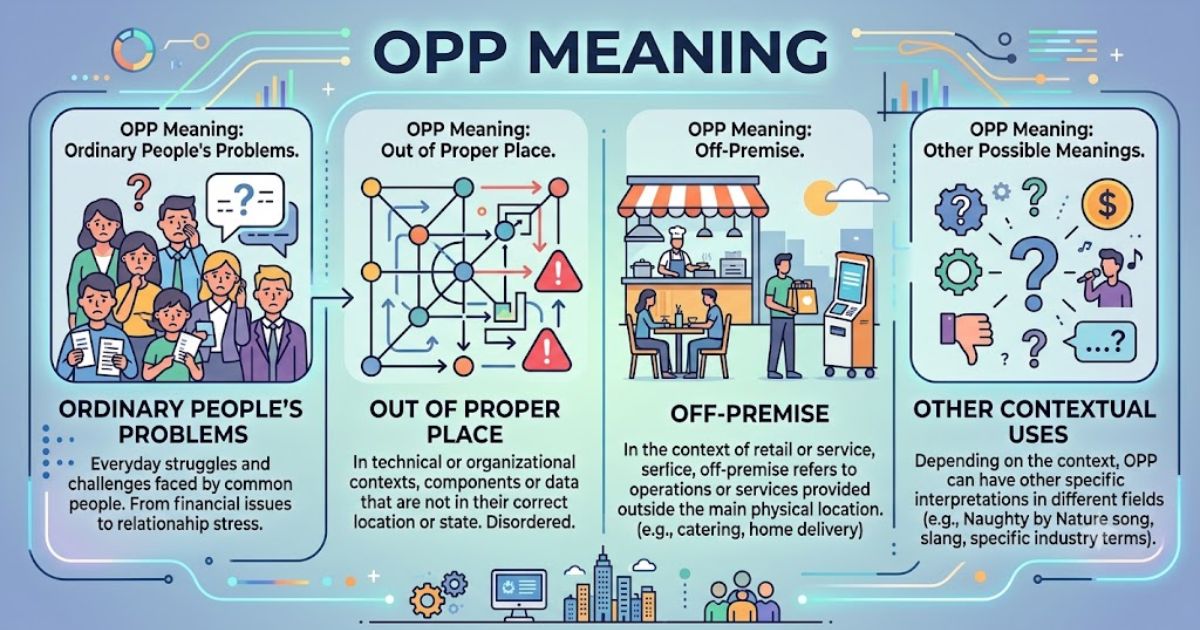
You see “OPP” in a TikTok comment, Snapchat message, song lyric, or group chat. Now you are wondering whether it means a rival, someone’s partner, or something completely different. The short answer is that OPP meaning depends on context. In modern slang, it usually means an opponent, rival, or someone seen as being against you. However, in older hip-hop language, O.P.P. can refer to someone else’s romantic partner or “other people’s property.”
That is why the word can feel confusing. A gamer might call another player an “opp” after losing a match. A friend might jokingly call a strict teacher an “opp.” Meanwhile, a song lyric may use O.P.P. in the older relationship-based sense. Once you look at the sentence, tone, and platform, the meaning usually becomes clear.
Meaning & Definition of OPP
The most common OPP meaning in texting, social media, and online conversations is “opposition,” “opponent,” or “rival.” People often write “opp” for one person and “opps” for several people. Merriam-Webster defines “opps” as opposition or opponents and notes that the singular form can be “opp.”
In simple terms, an opp is someone you do not support, trust, or get along with. The tone can be serious, playful, sarcastic, or dramatic. For example, saying “My alarm is my biggest opp” does not mean you have a real enemy. It simply means you hate waking up early.
1. Slang Meaning (Most Popular)
In current slang, “opp” usually means an enemy, rival, opponent, or person on the other side of a conflict. The conflict does not have to be serious. Someone can jokingly call a sibling, ex, classmate, sports rival, annoying coworker, or even a slow internet connection an opp.
For example, “That group project is full of opps” means the speaker feels their teammates are working against them. “My opp beat me in Fortnite again” means the speaker lost to a rival player. The word often carries more drama than the situation deserves. That is part of the joke.
In some music and street-related contexts, “opp” can refer to a real rival or opposing group. Because the term may carry a serious meaning in that setting, it is smart not to copy it casually when you do not understand the conversation. Context is everything.
2. Other Common Meanings
OPP has more than one meaning. The older pop-culture meaning came from Naughty by Nature’s 1991 song “O.P.P.,” where the phrase referred to involvement with another person’s partner. Dictionary.com explains that O.P.P. referred to sexual infidelity in that song context, while “opposition” or “enemy” became another common slang meaning over time.
You may also see “opp” used as a short form for “opportunity” in casual work, business, or gaming conversations. For example, “That job opp looks good” means “That job opportunity looks good.” This use is much less dramatic and usually easy to understand from the sentence.
| Meaning of OPP | Typical Context | Example |
|---|---|---|
| Opponent or rival | Texting, TikTok, gaming, music | “He is my opp in this tournament.” |
| Someone against you | Jokes, arguments, group chats | “My Wi-Fi is my opp today.” |
| Other people’s partner or property | Older hip-hop and song references | “That lyric is using the old O.P.P. meaning.” |
| Opportunity | Work, business, casual shorthand | “I found a great freelance opp.” |
Background & Origin of OPP
The word “opp” became widely known through hip-hop culture. The older O.P.P. meaning gained mainstream attention through Naughty by Nature’s 1991 hit “O.P.P.” The group used “other people’s property” as the cleaner version of a phrase about becoming involved with someone else’s partner. The song made the phrase memorable and helped it move beyond local slang into popular culture.
Later, “opp” developed into a shorter slang word for opposition, opponent, enemy, or rival. That newer meaning became especially common in rap lyrics, online culture, gaming chats, and social-media comments. Today, many younger users know “opp” only as “rival” and may not connect it with the older song meaning at all.
Language often works this way. A word starts in one community, changes through music and internet culture, then becomes part of everyday jokes. “Opp” is a good example. It has traveled from hip-hop history to TikTok captions, gaming streams, memes, and private messages.
Read More: Ultimate Guide to WYD Meaning in Text 2026!
Usage in Different Contexts
Before replying to “opp,” look at what happened before the message. Did someone lose a game? Did a friend complain about school? Are people talking about dating? The answer will usually tell you which meaning fits.
The word can sound playful in one situation and aggressive in another. That is why you should not assume every “opp” comment means serious conflict. Sometimes people are just being dramatic for laughs.
1. Chat & Texting
In texting, “opp” often means someone or something frustrating the sender. Friends may use it jokingly when talking about parents, teachers, work, public transport, homework, or an ex.
For example, “My manager is acting like an opp today” means the manager is making the day difficult. “My phone battery is my opp” means the battery keeps dying at the worst time. The speaker is not describing a real battle. They are using exaggeration to make a complaint funnier.
When the message says “He is an opp,” the tone may be more serious. It can suggest that the person is disliked, untrustworthy, competitive, or openly against the speaker.
2. Social Media
On social media, “opp” is often used for jokes, captions, reaction posts, and comments. TikTok users may call school, Monday mornings, bad weather, strict parents, or awkward dating situations “their opp.” Instagram users may use it under photos after a sports win, breakup, or playful argument.
A caption such as “Me vs. my opps” can mean almost anything. It might show someone competing in the gym, overcoming a hard week, or joking about a tiny inconvenience. The image and comments usually provide the missing clue.
However, when the post includes references to real conflicts, rival groups, or threats, take the wording more seriously. Do not jump into a comment thread or copy the language just because it is trending.
3. Gaming
In gaming, “opp” usually means an opponent. It is often harmless shorthand. Players may say, “The opps were camping,” “I beat my opp,” or “Watch out for that opp.”
This use is close to the standard meaning of “opponent.” It may refer to the other team, a rival player, or someone who keeps defeating you. In competitive games, it can also describe a player you meet repeatedly and want to beat next time.
For example, “That player is my opp now” simply means, “I want a rematch.” It is competitive talk, not necessarily personal drama.
4. Professional Use (rare)
In professional settings, avoid using “opp” to mean a rival or enemy. It can sound too casual, unclear, or confrontational. A work email saying “Our opp is delaying the project” may confuse people or sound unprofessional.
In business chat, “opp” is more likely to mean “opportunity.” Sales teams sometimes use it as quick shorthand, such as “new client opp,” “partnership opp,” or “growth opp.” Even then, use the full word in formal documents. Clear writing saves everyone time.
Meanings Across Platforms
The OPP meaning on TikTok, Snapchat, Instagram, and WhatsApp stays broadly similar, but the tone can shift depending on how people use the platform. TikTok leans toward jokes and trends. Snapchat often feels more personal. Instagram can mix humor, music culture, and public reactions. WhatsApp usually depends heavily on the relationship between the people chatting.
On WhatsApp, “opp” usually appears in private chats or group messages. It can mean a rival, someone annoying, or a person who seems to be against the group. Friends may also use it jokingly when one person cancels plans or refuses to share food.
For example, “You did not save me a slice? You are an opp.” Here, the meaning is playful. Nobody is accusing anyone of serious wrongdoing. It is just a dramatic way to say, “You let me down.”
On Instagram, “opp” often appears in captions, reels, song lyrics, and comment sections. A sports fan may call a rival team “the opps.” Someone posting a gym video may write, “Working while my opps sleep.” A friend may comment, “You really beat the opps with this outfit.”
The platform’s visual style makes exaggeration common. People use “opp” to create confidence, humor, or a little friendly rivalry. Read the caption alongside the image before deciding what it means.
TikTok
On TikTok, “opp” is often part of meme language. Users may call an everyday problem an opp, such as laundry, exams, cravings, traffic, or a bad haircut. A video saying “POV: your opp gets exposed” may be about an ex, a classmate, a fictional character, or a completely silly situation.
TikTok also spreads slang quickly. A word can become popular because a sound, dance, lyric, or creator uses it. That does not mean every user knows its full history. In most casual TikTok content, “opp” means someone or something working against the creator.
Snapchat
On Snapchat, “opp” can feel more personal because messages often involve close friends, crushes, classmates, or dating situations. Someone may say, “Do not reply to him, he is an opp,” meaning they do not trust that person or think he will cause drama.
It can also be lighthearted. “My mom is my opp because she took my phone” means the sender feels annoyed, not threatened. Tone matters a lot on Snapchat because the same phrase can be playful between friends and serious in a conflict.
Other Fields & Technical Meanings
Outside slang, OPP can stand for several unrelated terms. The best-known example in Canada is the Ontario Provincial Police, commonly shortened to OPP. The organization describes itself as Ontario’s largest police service and one of the largest deployed police services in North America.
In offices, companies may use OPP as an internal abbreviation for phrases such as “operational planning process,” “opportunity,” or another department-specific term. There is no single universal professional definition. That is why you should ask for clarification when the acronym appears in a report, meeting, or email.
You may also see “opp.” used in dictionaries as an abbreviation for “opposite.” Merriam-Webster lists “opp.” as an abbreviation for “opposite.”
Common Misconceptions & Mistakes
The biggest mistake is assuming OPP always means the same thing. It does not. Someone saying “My ex is an opp” probably means they see the ex as a problem or rival. Someone quoting the Naughty by Nature song may be using the older relationship-based meaning. Someone at work may simply mean “opportunity.”
Another mistake is confusing “opp” with “OP.” In gaming, OP usually means “overpowered,” not opponent. For example, “That weapon is OP” means the weapon is too strong. “That player is my opp” means the player is an opponent.
You should also avoid using “opp” in serious situations without understanding the social setting. In some communities, the term can refer to real rivalries and may carry more weight than it does in a funny TikTok caption.
Similar Terms & Alternatives
Several words can replace “opp,” depending on the situation. If you mean someone you are competing against, “opponent,” “rival,” or “competitor” works well. If you mean someone you dislike or distrust, “enemy,” “hater,” “nemesis,” or “rival” may fit better.
In a joke, you can say “my biggest enemy” instead of “my opp.” For example, “My biggest enemy is my snooze button” carries the same playful energy. In professional writing, use “competitor,” “opposing party,” “challenge,” or “obstacle” instead.
| Word | Best Use |
|---|---|
| Opp | Casual slang, texts, games, social media |
| Opponent | Sports, gaming, formal competition |
| Rival | Ongoing competition between people or teams |
| Enemy | Serious conflict or dramatic language |
| Hater | Someone who criticizes or dislikes you |
| Competitor | Business, sports, and professional settings |
| OP | Gaming slang for “overpowered,” not “opponent” |
How to Respond to OPP
The easiest response is to mirror the tone. If a friend says, “My alarm is my opp,” you can reply with a joke. If someone says a person is an opp during a serious argument, it is better to ask what happened before taking sides.
A safe reply can be simple: “What did they do?” or “Are you joking, or is there real drama?” This gives the other person space to explain without making assumptions.
Friendly Chat Examples:
| Message | Friendly Reply |
|---|---|
| “My homework is my opp.” | “Honestly, homework has been everyone’s opp this week.” |
| “She is acting like an opp.” | “What happened? I thought you two were cool.” |
| “That team is our opp tonight.” | “Then let’s beat them.” |
| “My phone battery is my opp.” | “Charge it before it ruins your whole day.” |
| “Do not trust him, he is an opp.” | “Got it. I’ll stay out of that drama.” |
Differences From Similar Words
“Opp,” “enemy,” “rival,” and “hater” overlap, but they are not identical. An enemy sounds serious and personal. A rival is someone you compete against. A hater is someone who criticizes you or wants you to fail. An opp can include all of these meanings, but it is usually broader and more casual.
For example, your sports opponent is not automatically your enemy. Your rival school may be an opp during a game but not outside it. Your friend can jokingly become your opp for eating the last slice of pizza. The word is flexible, which is why it became so popular online.
Relevance in Online Conversations & Dating Apps
In online conversations, “opp” can help people make a point quickly. It adds attitude and humor without needing a long explanation. Saying “My situationship is an opp” tells readers that the relationship feels frustrating, confusing, or emotionally exhausting.
On dating apps, users may call an ex, a bad date, or a confusing match an opp. That does not always mean the other person is dangerous. Often, it means, “This person is not good for my peace.” Still, do not use the term to dismiss serious behavior. If someone feels unsafe, it is better to use clear language, block the person, save evidence, and seek support when needed.
Popularity & Trends Over Time
The popularity of “opp” shows how slang moves through culture. The older O.P.P. reference became famous through 1990s hip-hop, especially Naughty by Nature’s hit song. Over time, “opp” shifted toward the simpler meaning of opponent or opposition.
Social media, gaming, rap culture, and short-form video have kept the term alive. It works well in captions because it is short, expressive, and flexible. You can use it seriously, sarcastically, or as a joke about a toaster that burns your bread every morning.
The trend will probably keep changing. Slang rarely stays frozen. Some people may keep using “opp” as a regular part of online language, while others may replace it with the next viral word. That is how internet culture moves: fast, messy, and usually with a meme attached.
FAQs
The quick answers below clear up the most common questions about the OPP meaning in slang, messages, music, and social media.
1. What does OPP mean in slang?
In slang, OPP usually means an opponent, rival, enemy, or person who is against you. “Opps” is the plural form and means multiple rivals or opponents.
2. Is OPP a bad word?
No, “opp” is not automatically a bad word. It can be playful, especially when someone calls homework, traffic, or a friend an opp. However, it can sound serious in discussions about real conflict, rivalry, or threats.
3. What does OPP mean in texting?
In texting, OPP usually means someone or something causing problems, acting against you, or competing with you. For example, “My boss is my opp today” means the sender feels frustrated with their boss.
4. What does OPP mean in songs?
In songs, OPP may refer to an opponent or rival. In the famous Naughty by Nature song, O.P.P. refers to involvement with someone else’s partner, framed as “other people’s property.”
5. Is OPP the same as OP?
No. “Opp” means opponent, opposition, or rival in slang. “OP” usually means overpowered in gaming, or original poster on some forums. They are different terms.
Conclusion
The OPP meaning is simple once you understand context. In most TikTok comments, Snapchat messages, gaming chats, and everyday texts, it means a rival, opponent, or someone making life harder. In older hip-hop references, it can point to someone else’s partner. In work conversations, it may even mean opportunity.
The next time someone says, “That person is an opp,” do not rush to assume the worst. Look at the conversation. They may be talking about a real rivalry, a joking complaint, a gaming match, an ex, or even a dead phone battery. One small word can carry a lot of attitude, but context tells you the real story.
