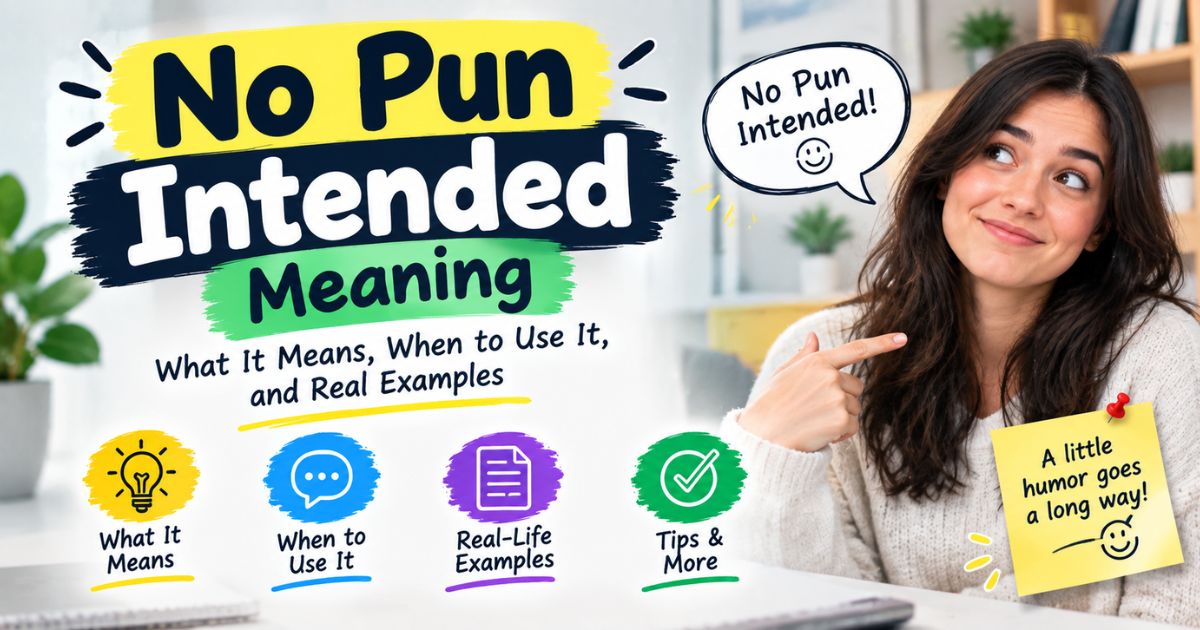
Have you ever heard someone say something funny and then quickly add, “no pun intended”? You may have seen the phrase in a text message, social media post, meme, or everyday conversation and wondered what they actually meant.
The no pun intended meaning is simple: someone is saying that they did not deliberately make a joke or play on words, even though their words may accidentally sound like one. However, people sometimes use the expression humorously, sarcastically, or even when the pun seems very obviously intentional.
Let’s break down exactly what “no pun intended” means, how people use it in text and social media, and how you can recognize the difference between an accidental pun and intentional wordplay.
What Does No Pun Intended Mean?
No pun intended means that a person claims they did not purposely make a pun, even though the words they used can sound funny or have a double meaning.
A pun is a type of wordplay that uses words with multiple meanings or words that sound alike to create humor. Sometimes a person creates this wordplay by accident.
For example:
“The baker said his business was rising quickly—no pun intended.”
The word “rising” relates to business growth, but it also connects directly to bread rising. The speaker may add “no pun intended” to say that the double meaning wasn’t planned.
In simple terms, the phrase acts like a small disclaimer:
“I realize what I just said sounds like a pun, but I didn’t mean to make a joke.”
That’s the basic no pun intended definition.
No Pun Intended Meaning in Easy Words
The easiest way to understand the no pun intended meaning is this:
You accidentally say something that sounds like a joke or play on words, so you say “no pun intended” to explain that the joke wasn’t deliberate.
Imagine you say:
“The fisherman had a great catch at work today.”
The word “catch” could refer to catching fish, but it can also mean finding or getting something valuable. If the person works as a fisherman, the sentence may create accidental wordplay.
You might then say:
“No pun intended.”
It tells the listener that the funny connection happened naturally.
Of course, English speakers also use this expression as a joke. Sometimes the pun is clearly intentional, but saying “no pun intended” makes the sentence even funnier.
What Is a Pun?
To fully understand the no pun intended phrase, you first need to know what a pun is.
A pun is a form of humorous wordplay. It happens when someone uses a word or phrase in a clever way because it has multiple meanings or sounds similar to another word.
For example:
“I used to be a banker, but I lost interest.”
The word “interest” has two meanings here. It can mean curiosity or enthusiasm, but it also refers to money earned or charged by banks.
That double meaning creates the joke.
Common Types of Puns
English has several common types of wordplay.
Homophone puns use words that sound alike but have different meanings. For example, “I scream” and “ice cream” sound similar.
Double-meaning puns use a word with multiple meanings.
Visual or contextual puns become funny because of the situation in which the words are used.
A pun can be intentional or accidental. That difference is important when understanding no pun intended vs pun intended.
What Does No Pun Intended Mean In Text?
The no pun intended meaning in text is almost the same as it is in spoken conversation.
When someone writes “no pun intended” in texting or chat, they usually want to point out that something they said has an accidental double meaning.
For example:
Friend: “I hope your new job works out.”
Friend: “No pun intended.”
If the person is talking to someone who works at a gym, the phrase “works out” suddenly has another meaning. The sender may notice that connection and add “no pun intended.”
In texting, people may also write:
- NPI
- No pun intended lol
- No pun intended 😂
- Pun not intended
- Totally no pun intended
The abbreviation NPI is less common than writing the full expression, but you may occasionally see it in casual online conversations.
The phrase is generally informal and works best in friendly chats rather than formal business writing.
Read More: No Soliciting Meaning: Everything You Need to Know About the Sign
What Does No Pun Intended Mean On Social Media?
The no pun intended meaning on social media can be slightly more playful.
On platforms like Instagram, X, TikTok, Facebook, and Reddit, people often use the expression after captions, jokes, comments, or clever statements.
For example:
“This coffee shop is brewing up some serious competition. No pun intended.”
The word “brewing” relates to coffee, while the sentence also talks about competition growing.
On social media, however, people often write “no pun intended” even when everyone knows the pun was intentional.
That creates an extra layer of humor.
For example:
“The math teacher has a lot of problems. No pun intended.”
Clearly, the connection between a math teacher and “problems” is probably intentional. Saying “no pun intended” becomes part of the joke.
This is why the phrase can sometimes feel sarcastic or ironic.
Why Do People Say No Pun Intended?
People use “no pun intended” for several reasons.
The most obvious reason is to explain accidental wordplay. English contains many words with multiple meanings, so accidental puns happen naturally during conversation.
Another reason is to make listeners notice the double meaning.
Interestingly, saying “no pun intended” often draws more attention to the pun. The listener might not have noticed the wordplay until the speaker mentioned it.
That’s why the expression has become a popular humorous disclaimer.
People may also use it to:
- Clarify that a joke wasn’t planned
- Acknowledge an accidental double meaning
- Add humor to a sentence
- Make a conversation sound more playful
- Create irony or sarcasm
In everyday English, context usually tells you which meaning the speaker intends.
Is “No Pun Intended” Always Literal?
No. “No pun intended” is not always meant literally.
Sometimes a person genuinely means that the wordplay was accidental. Other times, they use the phrase jokingly after making a very obvious pun.
For example:
“The broken pencil was pointless—no pun intended.”
Most people would assume the pun was intentional because “pointless” directly connects to a pencil.
The speaker says “no pun intended” because pretending the joke was accidental makes it more amusing.
This is one reason the expression can be sarcastic.
Is No Pun Intended Sarcastic?
It can be.
If someone makes a very obvious pun and then says “no pun intended,” they may be using irony. They know the pun was intentional, and the listener probably knows it too.
For example:
“The gardener really grew on me. No pun intended.”
The word “grew” makes the connection obvious. The phrase is likely being used humorously rather than as a serious disclaimer.
So, whether no pun intended is literal or sarcastic depends on the situation.
No Pun Intended vs Pun Intended
The difference between these two expressions is straightforward.
| Phrase | Meaning |
|---|---|
| No pun intended | The speaker says the wordplay was accidental or jokingly pretends it was accidental |
| Pun intended | The speaker openly admits that the wordplay was deliberate |
For example:
“That joke was electric. Pun intended.”
Here, the person openly acknowledges that they deliberately used a word connected to electricity.
Now compare it with:
“The electrician had a shocking experience. No pun intended.”
If the speaker truly didn’t plan the connection between “shocking” and electricity, the phrase is literal. But if the joke was clearly planned, “no pun intended” may be ironic.
What Is the Opposite of No Pun Intended?
The closest opposite is:
“Pun intended.”
When someone says “pun intended,” they are telling you directly that the wordplay was intentional.
The contrast is simple:
- No pun intended = supposedly accidental wordplay
- Pun intended = deliberate wordplay
Both expressions are commonly used in casual conversation and humorous writing.
No Pun Intended Examples In Sentences
The best way to understand the no pun intended usage is to see it in real sentences.
Here are some clear examples:
“The photographer developed a great career—no pun intended.”
The word “developed” can relate to both career growth and developing photographs.
“The chef’s ideas were delicious, no pun intended.”
“Delicious” connects naturally with food, even though the sentence describes ideas.
“The gym trainer said the workout would be tough. No pun intended.”
The phrase may be funny depending on the surrounding context.
“Our relationship is on thin ice, no pun intended.”
If the discussion involves hockey, skating, or winter, the phrase can create a double meaning.
“The computer repair shop crashed last week—no pun intended.”
The word “crashed” can describe a business failure or a computer problem.
“The gardener planted the idea in my mind—no pun intended.”
“Planted” creates wordplay because it relates to gardening and introducing an idea.
“The music teacher said the students were hitting all the right notes. No pun intended.”
The phrase connects musical notes with making good decisions.
These examples show why English is full of opportunities for accidental and intentional wordplay.
Similar Phrases To “No Pun Intended”
There isn’t one perfect synonym for “no pun intended,” but several phrases can express a similar idea depending on the situation.
“Pun Intended”
This is the direct opposite and openly admits that the joke was deliberate.
“That Wasn’t Meant as a Joke”
This works when you want to clarify that something funny was said seriously.
“I Didn’t Mean It That Way”
This phrase can help explain an accidental double meaning, although it doesn’t specifically refer to puns.
“Unintended Wordplay”
This is more descriptive than conversational. You might use it when explaining language rather than speaking casually.
“Accidentally Funny”
This can describe a statement that became humorous without the speaker planning it.
In everyday conversation, though, “no pun intended” remains the most natural and recognizable expression.
How To Use No Pun Intended
You usually place “no pun intended” immediately after a sentence containing possible wordplay.
For example:
“The actor really nailed that role, no pun intended.”
You can use it in spoken conversation, texts, captions, comments, and informal writing.
The phrase often appears:
- At the end of a sentence
- After a comma
- In parentheses
- As a short follow-up sentence
For example:
“The business is growing fast. No pun intended.”
Or:
“The business is growing fast (no pun intended).”
Both are understandable, although the first style often feels more natural in casual writing.
When Should You Say No Pun Intended?
You can say “no pun intended” when your words accidentally create a connection that sounds humorous.
For example, imagine you’re talking about a bakery and say:
“Their business is really rising.”
Because bread rises, the sentence contains an accidental pun.
You might add:
“No pun intended.”
You can also use the phrase when deliberately making a joke but pretending that you didn’t.
That playful use is especially common in memes, captions, and social media comments.
However, you don’t need to add the phrase every time a sentence contains a double meaning. Sometimes explaining the pun can make a conversation less natural.
Use it when the wordplay is noticeable or when pointing it out adds humor.
How To Respond To “No Pun Intended”
How you respond depends on the tone of the conversation.
If the person made a funny accidental pun, you might simply laugh and say:
- “Sure, no pun intended! 😂”
- “That’s actually pretty funny.”
- “I see what you did there.”
- “Nice one!”
- “That pun definitely counts.”
If the pun was clearly intentional, a playful response works well:
“Yeah, right. Totally accidental! 😂”
Or:
“I don’t believe you. That was definitely intentional.”
You can also respond with another pun if you want to continue the joke.
For example:
Person: “The bakery business is rising, no pun intended.”
You: “Well, that joke really takes the cake.”
That kind of response fits naturally in casual conversation.
Is No Pun Intended a Joke?
Sometimes, yes.
The phrase itself isn’t necessarily a joke. Its original purpose is to explain that wordplay was accidental.
However, modern English speakers often use “no pun intended” as part of the joke.
This happens because the phrase creates a funny contradiction when the pun is clearly deliberate.
Imagine someone saying:
“I’m reading a book about anti-gravity. It’s impossible to put down—no pun intended.”
The joke is obvious. Adding “no pun intended” makes the statement even more playful.
So, the phrase can be serious, accidental, sarcastic, ironic, or humorous.
Context matters.
Does No Pun Intended Mean the Pun Was Accidental?
Usually, yes—but not always.
The literal meaning suggests that the pun was unintentional. The speaker is saying they didn’t deliberately create the wordplay.
However, language changes depending on how people use it. Today, many people deliberately say “no pun intended” after an intentional pun because the contradiction itself is funny.
This means you shouldn’t always take the phrase literally.
Look at the sentence, the speaker’s tone, and the situation.
If the wordplay seems natural and unexpected, it may truly be accidental.
If the pun is extremely obvious and clever, there’s a good chance the speaker intended it.
No Pun Intended Meaning in Conversation
In real conversation, “no pun intended” usually works as a quick side comment.
You say something, notice the possible double meaning, and immediately acknowledge it.
For example:
“Let’s tackle this problem one step at a time—no pun intended.”
If the conversation involves football, the word “tackle” suddenly creates another meaning.
The phrase keeps the conversation light and shows that you recognize how the words sound.
This makes no pun intended a useful expression in conversational English, especially when talking casually with friends, coworkers, or people online.
The Difference Between Literal and Figurative Meaning
Understanding literal and figurative meaning can also help you recognize puns.
A literal meaning is the direct meaning of a word.
A figurative meaning uses words in a non-literal way to create an idea or comparison.
For example:
“He’s on fire.”
Literally, this means someone is burning.
Figuratively, it can mean someone is performing extremely well.
Puns often become possible because words and phrases can carry more than one meaning. A speaker may use one meaning while listeners notice another.
That overlap creates the double meaning that makes wordplay funny.
Conclusion
The no pun intended meaning is simple: it means someone claims they didn’t deliberately make a pun or play on words.
People often use the phrase after accidentally saying something with a double meaning. However, it has also become a popular humorous expression. Sometimes the pun is clearly intentional, and saying “no pun intended” adds irony to the joke.
The easiest way to remember it is this:
No pun intended = “I didn’t mean to make that wordplay.”
But in casual conversation and social media, don’t always take it literally. Sometimes the speaker absolutely intended the pun—and that’s exactly why the phrase is funny.
FAQs
What does “no pun intended” mean?
“No pun intended” means the speaker says they didn’t deliberately make a joke or play on words, even though their words may contain a double meaning.
What does no pun intended mean in text?
In text messages and chat, it usually means the same thing: the sender is pointing out accidental wordplay or joking about an obvious pun.
Is no pun intended slang?
It isn’t exactly slang. It’s a common English expression used in informal conversation, texting, social media, and humorous writing.
What is the difference between pun intended and no pun intended?
Pun intended means the wordplay was deliberate. No pun intended means the speaker claims the wordplay was accidental.
Is no pun intended sarcastic?
It can be. People often use it sarcastically after making an obviously intentional pun.
How do you use no pun intended in a sentence?
You usually add it after a sentence containing possible wordplay. For example: “The bakery business is rising fast—no pun intended.”
Why do people say no pun intended?
People say it to acknowledge accidental wordplay, clarify their meaning, or add humor to a conversation.
Can no pun intended be used jokingly?
Yes. In fact, people often use it jokingly when the pun was clearly intentional.
What is the opposite of no pun intended?
The opposite is “pun intended,” which openly admits that the wordplay was deliberate.
Does no pun intended always mean the pun was accidental?
No. While that is the literal meaning, people often use the phrase ironically after an intentional pun.
