
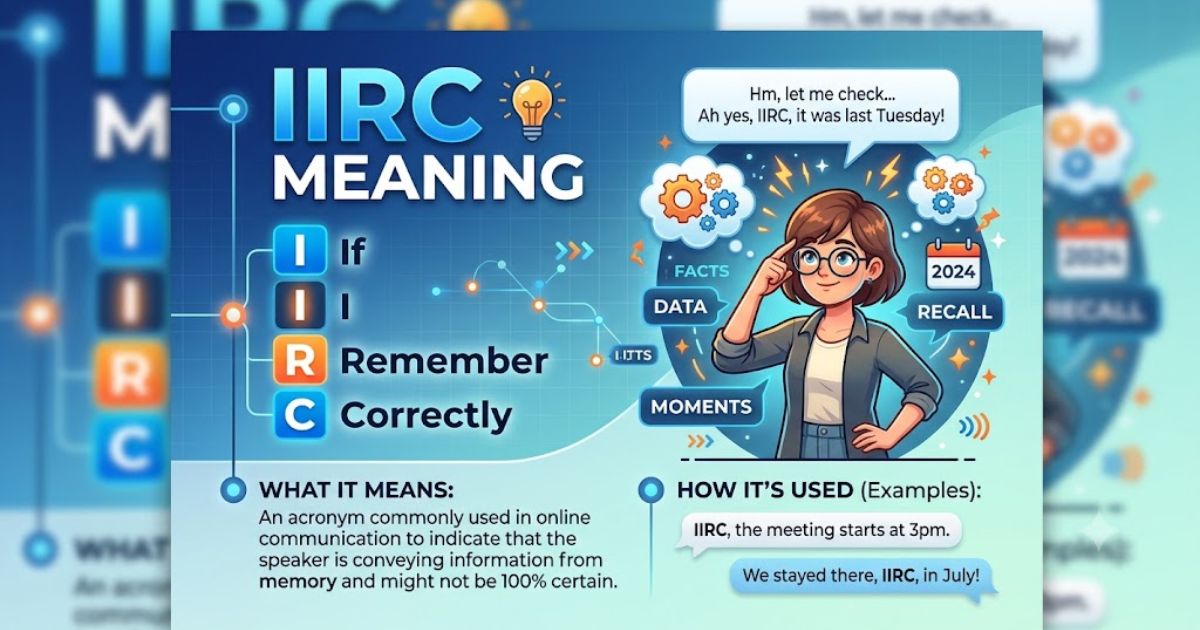
You receive a message that says, “IIRC, the meeting starts at 10,” and suddenly you are staring at four letters that seem more complicated than they should be. Don’t worry. The IIRC meaning is simple once you know it. It stands for “if I recall correctly” or “if I remember correctly.”
People use IIRC when they believe something is true but do not want to claim complete certainty. It works like a small verbal safety net. Instead of saying, “The movie came out in 2019,” someone may say, “IIRC, the movie came out in 2019.” That tells you they are fairly confident, but they may not have checked the exact detail recently.
You will see IIRC in messages, Reddit threads, gaming chats, social-media comments, informal emails, and online discussions. Major dictionaries list it as a written abbreviation used in emails, texts, and online communication.
Meaning & Definition of IIRC
The IIRC meaning is “if I recall correctly” or “if I remember correctly.” You use it when you are sharing information from memory rather than quoting a verified source, checking a document, or looking up the exact fact.
It is useful because it sounds less forceful than a direct statement. You are not saying, “This is definitely true.” You are saying, “This is what I remember, but I could be mistaken.” That small difference can make an online conversation feel more honest and less argumentative.
Simple Definition:
IIRC means “if I recall correctly.” It tells the reader that you are relying on memory and that your statement may need checking.
For example, you might say, “IIRC, the deadline is Friday.” You are helping the conversation move forward, but you are also leaving room for correction if the deadline is actually Thursday.
Oxford Learner’s Dictionaries explains that IIRC is used in social media, text messages, and emails to show that you believe something is correct.
Example:
Here is a simple example:
“IIRC, Sarah said she would send the file this afternoon.”
This message does not mean the sender is unsure about everything. It means they remember Sarah saying that, but they are not completely certain. Maybe the sender heard it during a busy meeting. Maybe they are remembering a message from yesterday. Either way, IIRC keeps the tone careful.
Another example could be:
“IIRC, this game has a hidden level after stage five.”
In this case, the speaker is sharing a useful memory. They are not pretending to have checked the game guide five minutes ago.
Key Purpose:
The key purpose of IIRC is to show reasonable uncertainty. It helps you share useful information without overstating how sure you are.
Think of it like saying, “I may be right, but let’s not bet the house on it.” That makes IIRC helpful in conversations where facts matter but nobody wants to stop everything just to search for one detail.
It can also make your tone sound more polite. Saying “You are wrong” can start an argument. Saying “IIRC, the rule changed last year” gives the other person room to check without feeling attacked.
Background & Origin of IIRC
IIRC grew out of early internet communication, where people regularly shortened long phrases to type faster. Online chat rooms, discussion boards, email chains, forums, and text messaging all encouraged people to use quick abbreviations such as LOL, BRB, IMO, and IIRC.
The exact first use of IIRC is difficult to prove because online slang often spreads informally before dictionaries record it. Still, language references consistently classify it as an internet, messaging, email, and social-media abbreviation. Merriam-Webster includes IIRC in its list of common texting abbreviations, while Cambridge lists it as a written abbreviation used in emails and other digital communication.
IIRC also became common because it solves a very human problem: memory is helpful, but memory is not perfect. Online conversations move quickly. Instead of spending ten minutes checking whether a show had six or seven seasons, someone can say, “IIRC, it had seven seasons,” and keep the discussion moving.
Usage in Different Contexts
You can use IIRC in many casual digital settings. However, the best choice depends on the audience, topic, and tone. It works well when the stakes are low or when you clearly signal that the other person should verify the information.
For example, IIRC fits naturally in a group chat about movies, games, travel plans, or old school memories. It is less suitable when you are discussing medical instructions, legal deadlines, payment details, or anything where accuracy matters a lot. In those situations, checking the source is better than relying on memory.
1. Casual Conversations
In casual conversations, IIRC feels natural and friendly. You can use it with friends, family members, classmates, or coworkers you know well.
A few examples show how it works:
| Casual Message | What It Means |
|---|---|
| “IIRC, we met at Ali’s birthday party.” | “I think we met there, but I am not fully certain.” |
| “IIRC, the café closes at 8.” | “That is what I remember, but you may want to check.” |
| “IIRC, your sister likes horror movies.” | “I remember that detail, but I could be mixing it up.” |
The phrase works best when you are adding helpful information, not trying to win an argument. It sounds relaxed, practical, and honest.
2. Online Discussions
In online discussions, IIRC is especially useful when people are debating facts from memory. You may see it on Reddit, Quora, forums, YouTube comments, Discord servers, or fan communities.
For example:
“IIRC, the author confirmed that theory in an old interview.”
This sentence is better than presenting the claim as absolute fact. It tells readers that the information may be correct, but they should still look for the interview if the detail matters.
IIRC can also reduce unnecessary arguments. Online debates often get heated because people state uncertain facts too strongly. Adding IIRC shows that you are open to being corrected. That is a small habit, but it can make discussions feel less combative.
3. Professional Informal Emails
IIRC can appear in informal work emails, internal chat messages, or relaxed team conversations. Cambridge specifically lists IIRC as an abbreviation used in emails.
For example, you might write:
“IIRC, the client approved the first design direction last week.”
That works in a message to a teammate who understands the casual tone. However, do not use IIRC in a formal contract, legal notice, client proposal, performance review, or important financial email. In those situations, vague memory is not enough.
A safer professional alternative is:
“Based on my notes, the client approved the first design direction last week.”
That sounds more polished and shows that you have something to refer back to.
4. Gaming & Forums
Gaming communities use IIRC when players remember maps, quests, game mechanics, updates, character abilities, or old patch notes.
For example:
“IIRC, you unlock that weapon after level 20.”
Or:
“IIRC, that boss has a weak spot on the back.”
The acronym works well in gaming because players often help one another from memory. Nobody expects every person to open a guide before replying. Still, if you are giving advice that could affect a major game decision, it is smart to mention that the player should double-check the latest patch notes.
Read More: ABT Meaning Powerful Guide for Chat Users 2026!
Meanings Across Platforms
The IIRC meaning stays the same across most platforms. It still means “if I recall correctly.” What changes is the tone. A WhatsApp message may feel personal. A TikTok comment may feel playful. An Instagram reply may be short and casual. A Snapchat message may feel immediate and conversational.
The platform does not change the definition. The context changes how formal, serious, or playful the message sounds.
On WhatsApp, people often use IIRC in family chats, friend groups, school groups, and work messages. It is useful when someone asks about plans, dates, locations, or previous conversations.
For example:
“IIRC, we agreed to meet near the station.”
This sounds natural because it helps the group remember what was discussed without sounding too strict. It is especially useful in busy group chats where messages disappear quickly.
On Instagram, IIRC often appears in comments, captions, and direct messages. People may use it while talking about celebrities, fashion trends, movies, events, or old posts.
For example:
“IIRC, she wore this outfit at last year’s event too.”
The phrase gives the comment a casual, conversational feel. It also prevents the writer from sounding overly confident about a small detail.
TikTok
On TikTok, IIRC may appear in comments when users discuss a creator’s old video, a song lyric, a trend, a television scene, or a viral story.
For example:
“IIRC, this sound first went viral last summer.”
TikTok moves fast, and people often share information from memory. IIRC helps users contribute without presenting every remembered detail as proven fact. It is especially helpful in comment sections where one wrong statement can spread quickly.
Snapchat
On Snapchat, IIRC is most likely to appear in private messages or group snaps. People may use it when discussing school schedules, weekend plans, mutual friends, or old conversations.
For example:
“IIRC, he said he was not coming tonight.”
The phrase sounds casual and direct. However, because Snapchat messages can feel personal, make sure you are not spreading rumors. IIRC is not a free pass to repeat something uncertain about another person.
Other Fields & Technical Meanings
In most cases, IIRC only means “if I recall correctly.” It does not usually have a technical meaning in business, medicine, law, science, or computer programming.
However, people sometimes confuse IIRC with IRC, which stands for Internet Relay Chat. IRC is a real-time online chat system that was created in 1988. It is a completely different term from IIRC.
Here is the difference:
| Term | Meaning | Example |
|---|---|---|
| IIRC | If I recall correctly | “IIRC, the event begins at 6.” |
| IRC | Internet Relay Chat | “They still use IRC for community chat.” |
| IMO | In my opinion | “IMO, the first movie was better.” |
| IMHO | In my humble opinion | “IMHO, the update needs more testing.” |
The easiest way to remember it is this: IIRC is about memory. IRC is about online chat technology.
Common Misconceptions & Mistakes
People often understand the basic IIRC meaning but misuse the tone. The biggest problem happens when someone treats IIRC as a way to sound confident while avoiding responsibility. It should not be used to spread uncertain information, make serious claims, or dodge the need to verify important facts.
Used well, IIRC makes you sound thoughtful. Used badly, it can make your message sound careless.
Mistake 1: Thinking it means certainty
IIRC does not mean “I know this for sure.” It means the opposite. It tells the reader that the information comes from memory and might need checking.
For example, do not write:
“IIRC, your payment is overdue, so we will charge a fee.”
That is risky because payment information should be checked before you send it. A better message would be:
“Please let me confirm the payment status and get back to you.”
Use IIRC for low-stakes memory, not for high-stakes decisions.
Mistake 2: Using it formally
IIRC is fine in casual emails and internal messages. Still, it can feel too informal in legal documents, academic research papers, job applications, client proposals, or formal business reports.
For formal writing, use a clearer phrase such as:
“Based on the available records…”
Or:
“According to the meeting notes…”
Those options sound more professional and show that you are relying on something more solid than memory.
Mistake 3: Confusing it with IRC
IIRC and IRC look similar, but they mean very different things. IIRC means “if I recall correctly.” IRC means Internet Relay Chat, a type of online chat system.
This mistake is easy to make when you read quickly. However, the sentence usually gives away the meaning. If someone says, “IIRC, the update came out last week,” they are talking about memory. If they say, “Join the IRC channel,” they are talking about chat software.
Similar Terms & Alternatives
IIRC belongs to a family of short phrases that help you explain how certain you are, what you think, or where your information comes from.
Here are some useful alternatives:
| Term | Full Meaning | Best Use |
|---|---|---|
| IIRC | If I recall correctly | You remember something but are not fully certain |
| AFAIK | As far as I know | You are sharing your current knowledge |
| IMO | In my opinion | You are sharing a personal view |
| IMHO | In my humble opinion | You are giving a softer or more polite opinion |
| FWIW | For what it’s worth | You are offering information that may or may not help |
| TBH | To be honest | You are giving a frank opinion or admission |
| ICYMI | In case you missed it | You are sharing something previously posted |
Cambridge defines IMO as “in my opinion,” while FWIW means “for what it’s worth.” These phrases may look similar, but they serve different jobs in a conversation.
For example, “IIRC, the concert is on Saturday” talks about memory. “IMO, Saturday is the best day for the concert” shares an opinion. One points to remembered information. The other gives a personal view.
How to Respond to IIRC
When someone uses IIRC, you usually do not need a complicated reply. You can agree, correct them politely, ask for more detail, or confirm the information.
The best response depends on whether the remembered fact matters. If it is a casual topic, a simple reply is enough. If it affects plans, money, work, or safety, it is better to verify it.
Example 1:
“IIRC, the restaurant does not take reservations.”
You could reply:
“I think you are right, but I will check before we go.”
This response keeps the tone friendly while making sure the plan does not fall apart later.
Example 2:
“IIRC, the assignment is due tomorrow.”
You could reply:
“Thanks. I will check the course page to be safe.”
That response is practical. You are not accusing the person of being wrong. You are simply confirming an important detail.
Example 3:
“IIRC, that actor was in the first season.”
You could reply:
“Yes, I think so too. I remember seeing them in the early episodes.”
This works when the topic is casual and no one needs proof right away.
Example 4:
“IIRC, you said you do not like spicy food.”
You could reply:
“That is right, but mild spice is okay.”
This is a good example of how IIRC can help people remember personal preferences without sounding stiff.
Differences From Similar Words
The main difference between IIRC and similar abbreviations is the type of uncertainty involved.
IIRC means you are relying on memory. AFAIK means you are sharing what you currently know. IMO means you are sharing an opinion. FWIW means you are offering information that may or may not be useful.
Here is a simple comparison:
| Phrase | What It Signals |
|---|---|
| “IIRC, the shop closes at 9.” | “This is what I remember.” |
| “AFAIK, the shop closes at 9.” | “This is what I know right now.” |
| “IMO, the shop should stay open later.” | “This is my personal opinion.” |
| “FWIW, the shop was quiet last time I went.” | “This may or may not help, but here is some extra information.” |
The difference between IIRC and IMO is especially important. IIRC is about facts from memory. IMO is about personal opinions. Cambridge defines IMO as “in my opinion,” which makes that distinction clear.
Relevance in Online Conversations & Dating Apps
IIRC is useful in online conversations because it makes your message sound less rigid. Online communication lacks facial expressions, voice tone, and body language. A sentence that sounds neutral in person can seem harsh in text.
For example, instead of saying:
“You told me you were free this weekend.”
You could say:
“IIRC, you said you were free this weekend?”
The second version sounds softer. It gives the other person a chance to correct you without feeling blamed.
On dating apps, IIRC can be useful when you refer back to something from someone’s profile or an earlier chat. You might write:
“IIRC, you said you are into hiking. Do you have a favorite trail?”
That shows you paid attention without pretending you remember every detail perfectly. It feels natural and can make a conversation warmer.
Still, do not overuse it. Saying IIRC in every message can make you sound unsure of everything. Use it when memory truly matters.
Popularity & Trends Over Time
IIRC has stayed useful because it fills a communication gap that never disappears. People still forget dates, names, details, plot points, game mechanics, and old conversations. As long as people talk online, they will need a quick way to say, “This is what I remember.”
Merriam-Webster continues to list IIRC among common texting abbreviations, showing that it remains recognizable in modern digital communication.
Unlike some slang words that disappear after one viral trend, IIRC has lasted because it is practical. It is short, easy to understand, and useful in many settings. You can use it in a gaming forum, a class group chat, a casual office message, or a TikTok comment without needing to explain it.
FAQs
1. What does IIRC mean in text?
IIRC means “if I recall correctly” or “if I remember correctly.” People use it when they think something is true but are not completely certain.
2. Is IIRC formal or informal?
IIRC is mainly informal. It works well in texts, chats, social media, forums, gaming, and relaxed emails. Avoid it in formal legal, academic, or business documents.
3. Can I use IIRC in emails?
Yes, you can use IIRC in informal emails or internal workplace messages. Cambridge lists it as a written abbreviation used in emails. However, use full wording or verified records in formal communication.
4. Is IIRC still used today?
Yes. IIRC is still widely recognized in texts, online discussions, social media, emails, and gaming communities. Merriam-Webster includes it in its current list of common texting abbreviations.
5. What is the difference between IIRC and IMO?
IIRC means “if I recall correctly,” so it refers to a fact you remember. IMO means “in my opinion,” so it introduces your personal view.
Conclusion
The IIRC meaning is simple: “if I recall correctly.” It is a useful phrase for sharing something from memory without claiming total certainty. You will see it in texts, gaming chats, social media, emails, forums, and casual online conversations.
The key is to use it at the right time. IIRC is great for remembering a movie release date, an old conversation, a game tip, or a weekend plan. It is not the right choice for legal facts, medical advice, invoices, deadlines, or serious claims that need proof.
Used naturally, IIRC makes your writing sound honest, relaxed, and thoughtful. It tells the other person, “This is what I remember, but let’s check if it really matters.”
