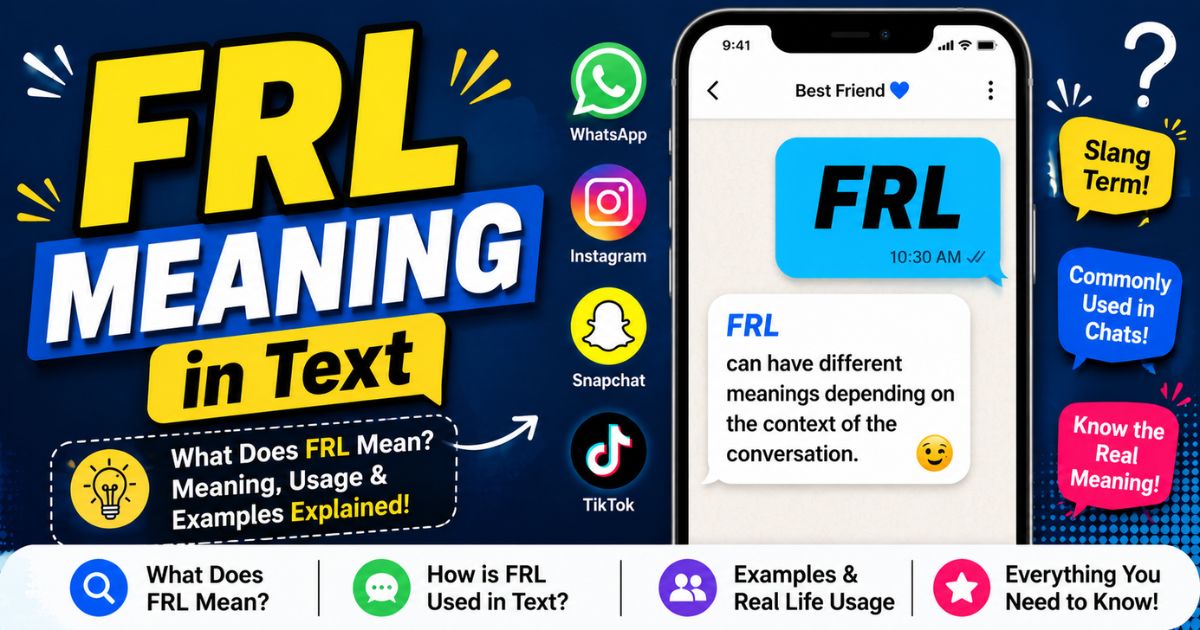
Have you ever received a message that simply says “FRL?” or “That was crazy FRL” and wondered what the person meant? If so, you’re not alone. FRL meaning in text is a common question because online conversations are filled with short abbreviations that can change meaning depending on context.
In texting, FRL usually means “for real.” People use it to show that they’re being serious, agreeing with someone, confirming something, or reacting strongly to what was said. It can also appear in social media comments, direct messages, gaming chats, and group conversations.
For example, someone might text, “You’re moving to New York? FRL?” Here, FRL means “for real?” and shows surprise or disbelief. In another conversation, someone could say, “That movie was amazing FRL,” meaning “That movie was amazing, for real.”
Let’s break down the FRL text meaning, how people use this abbreviation, and how it compares with similar expressions such as FR, FRFR, TBH, and NGL.
What Does FRL Meaning in Text?
The most common FRL meaning in text is “for real.” It’s an informal abbreviation used in digital communication to make a message shorter while keeping its meaning clear.
When someone writes FRL, they’re generally emphasizing sincerity or agreement. Depending on the sentence, it can mean:
- For real
- Seriously
- Honestly
- Truly
- Really
- No joke
- I’m being serious
For example:
“FRL, you did a great job.”
This means:
“For real, you did a great job.”
The abbreviation can also appear at the end of a statement:
“That restaurant is expensive FRL.”
Here, the speaker is emphasizing that they genuinely believe the restaurant is expensive.
The meaning becomes even clearer when you look at the surrounding words. FRL isn’t normally a complicated acronym. Its purpose is to add emphasis, sincerity, agreement, or surprise to casual communication.
The Origin of FRL
The exact point when FRL became popular is difficult to identify because internet slang tends to develop gradually across different online communities.
The abbreviation comes directly from the phrase “for real.” As texting and online messaging became more popular, users began shortening common expressions to save time and make conversations faster.
This follows the same pattern as many other online abbreviations. People shortened phrases such as:
- “for real” → FR
- “for real, for real” → FRFR
- “to be honest” → TBH
- “not gonna lie” → NGL
- “I don’t know” → IDK
- “right now” → RN
- “I know, right?” → IKR
FRL fits naturally into this broader culture of texting slang, internet abbreviations, and digital communication.
Although people may use different versions of the abbreviation, the underlying idea remains the same: communicate the phrase “for real” quickly.
FRL Meaning in Text Messages
In text messages, FRL usually expresses seriousness, agreement, confirmation, or disbelief.
Consider these examples:
Person A: “I’ve been working all day.”
Person B: “FRL? You need a break.”
Here, FRL means “For real?” and shows that Person B wants confirmation.
Another example:
“FRL, that was the funniest thing I’ve seen today.”
In this case, FRL reinforces the speaker’s opinion. They aren’t joking about how funny they found the situation.
It can also express agreement:
Person A: “This weather is terrible.”
Person B: “FRL.”
The second person is essentially saying, “For real. I completely agree.”
Because the abbreviation is so short, punctuation and context can change its tone. “FRL?” often sounds like a question or expression of disbelief, while “FRL.” can sound like strong agreement.
How FRL Is Used on Social Media
The FRL meaning on social media remains largely the same as its meaning in texting: “for real.”
You may see it in comments, captions, replies, DMs, and group conversations across platforms such as TikTok, Instagram, Snapchat, Facebook, WhatsApp, and Discord.
For example, someone might comment:
“FRL this outfit is fire.”
They’re emphasizing that they genuinely like the outfit.
On TikTok, a user might respond to a surprising video with:
“FRL???”
That could communicate disbelief or surprise.
On Instagram, someone might comment:
“You look amazing FRL.”
Here, the person is reinforcing the sincerity of the compliment.
The abbreviation works particularly well in social media because online conversations tend to favor short, expressive language. A three-letter abbreviation can communicate a complete emotional reaction without making the message feel formal.
Read More: FAFO Meaning: What It Really Means in Text, TikTok & Social Media
Is FRL Considered Internet Slang?
Yes. FRL is generally considered internet slang or a texting abbreviation.
More specifically, it functions as an informal shortened form of “for real.” You’ll usually find it in casual digital communication rather than formal writing.
It belongs to the same general category as:
FR, FRFR, TBH, NGL, IKR, IDK, IMO, LOL, and SMH.
However, not every person uses the same abbreviations. Some people prefer writing the full phrase “for real,” while others regularly use FR or FRL.
That’s why context matters. Internet vocabulary changes quickly, and abbreviations can become more or less popular over time.
How to Reply When Someone Says FRL
Your response to FRL depends on what the person means.
If someone says:
“FRL?”
and they’re asking whether something is true, you can respond with:
“Yeah, FR.”
or:
“Yes, I’m serious.”
If someone uses FRL to agree with you:
You: “That exam was difficult.”
Friend: “FRL.”
You don’t necessarily need to respond. The person is simply agreeing.
If someone says:
“FRL, you’re hilarious.”
You could reply:
“Haha, thanks!”
If FRL expresses disbelief:
“You spent $500 on that? FRL?”
You might answer:
“Yep, unfortunately.”
The key is to understand the emotional purpose behind the abbreviation rather than treating every FRL chat abbreviation as a question.
When Should You Avoid Using FRL?
FRL works best in informal communication. You probably shouldn’t use it in situations where professional or formal language is expected.
For example, avoid writing:
“FRL, I need the report today.”
in a formal business email.
Instead, say:
“I genuinely need the report today.”
or simply:
“I need the report today.”
You should also consider your audience. If the person you’re communicating with rarely uses texting slang, FRL might confuse them.
The same rule applies to academic writing, legal documents, official correspondence, formal applications, and professional reports.
In casual conversations, though, there’s usually no problem with using it.
FRL Meaning in Online Gaming
The FRL meaning in gaming is also commonly “for real.”
Gaming communities rely heavily on short messages because players often need to communicate quickly. During a match, typing a complete sentence may not be practical.
For example:
Player 1: “That boss is impossible.”
Player 2: “FRL.”
Here, Player 2 agrees.
Another example:
“FRL? You just beat that level on your first try?”
The abbreviation expresses surprise.
You may also see it in Discord servers and gaming group chats:
“FRL, we need better teamwork.”
This means the speaker is emphasizing that they genuinely believe better teamwork is necessary.
The meaning doesn’t change simply because the conversation takes place in a gaming environment. The surrounding context determines the tone.
Common Mistakes People Make About FRL
One common mistake is assuming that every abbreviation has only one possible interpretation. While FRL usually means “for real” in texting, abbreviations can have other meanings in specialized environments.
Another mistake is confusing FRL with FRFR. They’re related, but they aren’t identical. FRFR means “for real, for real” and generally adds even stronger emphasis.
People also sometimes assume that FRL is appropriate everywhere simply because it’s common online. It isn’t. Informal slang belongs primarily in informal conversations.
Another mistake involves ignoring punctuation.
Compare:
“FRL?”
with:
“FRL!”
The first can suggest disbelief or a request for confirmation. The second can communicate strong agreement or excitement.
Finally, don’t force FRL into every sentence. Slang works best when it feels natural.
Is FRL Appropriate for All Age Groups?
There’s no strict age requirement for using FRL, but usage varies considerably between people and communities.
Younger internet users may be more familiar with abbreviations such as FRL, FRFR, NGL, and TBH. Older users may understand them but prefer traditional wording.
That doesn’t mean FRL belongs exclusively to one generation. Anyone who participates in texting, social media, online gaming, or casual digital communication may encounter and use it.
The most important factor is familiarity with the audience.
If you’re messaging a close friend, “FRL, that was wild” sounds perfectly natural. In a formal workplace conversation, writing “That was genuinely surprising” would usually be a better choice.
Benefits of Learning Internet Abbreviations
Understanding internet abbreviations can make online communication much easier.
First, you can understand messages without constantly stopping to search unfamiliar terms. That matters because digital conversations often move quickly.
Second, knowing abbreviations helps you recognize tone. FRL, for example, can signal sincerity, agreement, surprise, or emphasis depending on context.
Third, understanding modern texting language can help you follow conversations on social media platforms, messaging apps, gaming communities, and online forums.
There’s also a cultural benefit. Internet slang gives people a quick way to express personality and emotion. A message such as “FRL 😂” can feel more relaxed and expressive than the formal phrase “I genuinely agree with you.”
Still, knowing when not to use an abbreviation is just as important as knowing what it means.
How FRL Compares to Other Texting Acronyms
FRL is closely related to several other popular texting expressions, but each has a slightly different purpose.
| Acronym | Meaning | Common Purpose |
|---|---|---|
| FRL | For real | Sincerity, agreement, emphasis |
| FR | For real | Agreement or confirmation |
| FRFR | For real, for real | Strong emphasis or sincerity |
| TBH | To be honest | Introducing an honest opinion |
| NGL | Not gonna lie | Introducing a candid statement |
| IKR | I know, right? | Strong agreement |
| IMO | In my opinion | Giving a personal viewpoint |
| IDK | I don’t know | Expressing uncertainty |
| IRL | In real life | Referring to offline life |
FRL vs FR
FR and FRL are very similar because both can represent “for real.”
For example:
“That was crazy FR.”
and:
“That was crazy FRL.”
Both can mean:
“That was genuinely crazy.”
The difference is mostly stylistic. Usage can vary from one online community to another.
FRL vs FRFR
FRFR stands for “for real, for real.”
It usually adds stronger emphasis.
For example:
“I’m tired FRL.”
is an informal way to say you’re genuinely tired.
“I’m tired FRFR.”
puts even more emphasis on the statement.
FRL vs TBH
TBH means “to be honest.” It often introduces an opinion or candid statement.
“TBH, I didn’t like the movie.”
FRL has a different role:
“That movie was boring FRL.”
TBH introduces honesty, while FRL emphasizes the truth or seriousness of what has already been said.
FRL vs NGL
NGL means “not gonna lie.”
It’s commonly used before a candid admission:
“NGL, that was impressive.”
FRL can reinforce a statement:
“That was impressive FRL.”
Both can signal sincerity, but they function differently within a sentence.
Why Context Is Important When Using FRL
Context is essential when interpreting FRL meaning in chat.
Consider this message:
“FRL?”
It might mean:
“For real?”
The sender could be surprised or asking whether the information is true.
Now consider:
“FRL, I’m so tired.”
This probably means:
“For real, I’m so tired.”
The speaker is emphasizing their statement.
Another example:
“FRL 😂”
This could communicate strong agreement, amusement, or disbelief depending on what came before it.
That’s why looking at only the abbreviation can sometimes lead to misunderstandings. Read the complete message, consider the conversation, and pay attention to punctuation and emojis.
The same principle applies to other internet slang. Digital language is highly contextual.
Should You Use FRL in Everyday Chats?
Yes, if it fits your communication style and the person you’re talking to understands it.
FRL can make casual conversations faster and more natural. It’s especially useful when you want to emphasize that you’re being serious or genuinely agree with someone.
For example:
“FRL, that was the best concert ever.”
sounds relaxed and conversational.
However, you don’t need to use it simply because it’s popular. If you prefer saying “seriously,” “honestly,” or “for real,” the full expression works perfectly well.
Think of FRL as a shortcut, not a requirement.
The best texting language is language that makes your meaning clear without making the conversation feel forced.
Final Words
The most common FRL meaning in text is “for real.” It’s an informal internet abbreviation people use to express sincerity, agreement, confirmation, disbelief, or emphasis.
You may encounter FRL in text messages, social media comments, DMs, group chats, gaming conversations, and platforms such as Snapchat, TikTok, Instagram, WhatsApp, and Discord.
The exact tone depends on context. “FRL?” can express surprise, while “FRL!” may show strong agreement or excitement.
If you’re chatting casually with friends, FRL is usually easy to use. For professional or formal communication, however, writing “for real,” “seriously,” or another clear phrase is usually the better choice.
In short, when someone sends you FRL, think “for real.” Then look at the rest of the conversation to understand exactly how they mean it.
FAQs
Where Is FRL Commonly Used?
FRL is commonly used in text messages, social media comments, DMs, group chats, gaming chats, and online conversations. You may see it on Snapchat, TikTok, Instagram, WhatsApp, Facebook Messenger, Discord, and similar platforms.
Is FRL Appropriate for Professional Communication?
Usually, no. FRL is an informal texting abbreviation, so it’s better suited to casual conversations. In professional emails, reports, applications, or formal messages, use phrases such as “for real,” “seriously,” “genuinely,” or another clear expression instead.
Can FRL Have Different Meanings?
Yes, abbreviations can have different meanings in specialized industries or communities. However, in ordinary texting and social media conversations, FRL most commonly means “for real.” Always consider the context before interpreting an abbreviation.
What Does FRL Mean in Texting?
FRL generally means “for real.” People use it to show sincerity, agreement, emphasis, surprise, or disbelief.
What Does FRL Stand For?
In casual texting, FRL usually stands for “for real.”
Is FRL Slang?
Yes. FRL is generally considered internet slang or a texting abbreviation because it shortens the informal phrase “for real.”
What Does FRL Mean on Snapchat, TikTok, or Instagram?
On Snapchat, TikTok, Instagram, and other social platforms, FRL generally means “for real.” Its tone depends on the conversation and can express agreement, seriousness, or surprise.
What Does FRL Mean From a Girl or Guy?
There’s no special gender-specific meaning. Whether a girl or guy sends FRL, it generally means “for real.” The exact tone depends on the message and context.
How Do You Respond to FRL?
If someone uses FRL to ask whether something is true, you can reply with “Yeah, for real,” “Yep,” or “I’m serious.” If they use it to agree with you, you may not need to respond at all.
What Is the Difference Between FR and FRL?
Both FR and FRL commonly represent “for real.” Their meaning is nearly identical, although individual users and online communities may prefer one abbreviation over the other.
What Does “For Real” Mean in Texting?
“For real” means seriously, genuinely, honestly, or truly. It can also be used as a question to express surprise, as in “For real?”
Can FRL Be Used in Formal Writing?
It’s best to avoid FRL in formal writing. Use the complete phrase or a more appropriate formal expression instead.
