
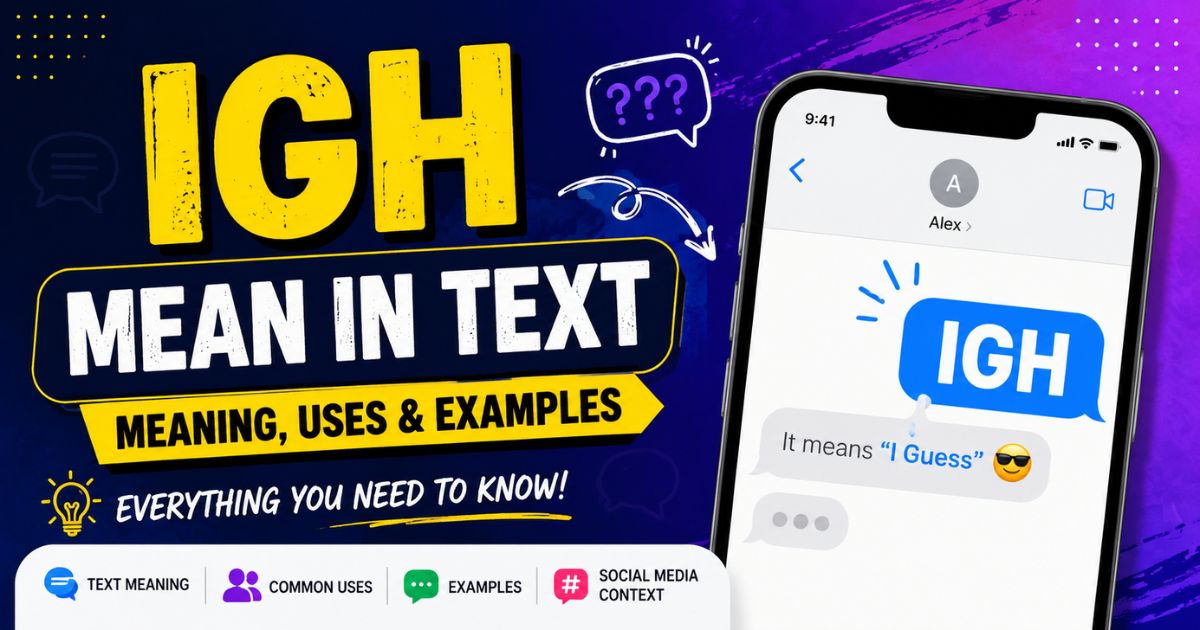
Have you ever received a text that simply says “IGH” and wondered what the person actually meant? It’s only three letters, but depending on the conversation, it can feel surprisingly unclear.
The IGH meaning in text is usually “alright,” “okay,” or “fine.” It’s a casual slang expression people use to agree, acknowledge a message, accept a plan, or keep a conversation moving without typing a longer response. It’s closely related to casual forms such as “aight” and “ight.”
However, there’s an important detail: IGH isn’t a standardized acronym with one official full form. In most online conversations, it works as a shortened spelling rather than an acronym where each letter represents a separate word.
So if someone texts:
“We’re meeting at 7.”
and you reply:
“IGH.”
you’re essentially saying, “Alright,” “Okay,” or “Sounds good.”
Let’s break down the IGH slang meaning, how people use it, where it comes from, how it compares with similar expressions, and how to respond when someone sends it to you.
What Does IGH Mean in Text?
The most common IGH meaning in text is “alright” or “okay.” It can also communicate “fine,” “I understand,” “sounds good,” or “I agree,” depending on the situation.
IGH is generally used in casual texting rather than formal writing. It’s especially suited to quick conversations where the people involved already understand each other.
For example:
Person 1: “I’ll pick you up after work.”
Person 2: “IGH.”
Here, IGH means “Alright” or “Okay.”
Another example:
Person 1: “Let’s watch the movie tonight.”
Person 2: “IGH, I’m down.”
In this case, IGH expresses agreement.
You might also see it in a short exchange:
“You still coming?”
“IGH.”
That could mean:
“Yeah, alright, I’m coming.”
The exact interpretation depends on the surrounding conversation. A single “IGH” can sound perfectly neutral in one situation but slightly dry or reluctant in another.
IGH Definition at a Glance
| Term | Common meaning | Typical tone |
|---|---|---|
| IGH | Alright / Okay | Casual |
| IGH | Fine | Neutral or slightly reluctant |
| IGH | Sounds good | Friendly |
| IGH | I understand | Acknowledging |
| IGH | I agree | Casual agreement |
In simple terms, think of IGH as a very short, informal way of saying “alright.”
It’s worth remembering that slang doesn’t always have one rigid definition. Context, punctuation, and the relationship between the people chatting can change the tone.
Is IGH an Acronym?
No, IGH is generally not considered a traditional acronym.
An acronym normally uses the first letters of several words to create a new term. For example, LOL stands for “laugh out loud,” and BRB stands for “be right back.”
IGH usually works differently.
In online slang, it is better understood as a shortened or clipped form related to “aight,” “ight,” and ultimately “alright.” Contemporary slang references describe the sequence as a progressive shortening of the original expression.
A simplified progression looks like this:
all right → alright → aight → ight → igh
That doesn’t mean every person consciously follows this exact sequence when typing. Slang develops organically, and different spellings can exist at the same time.
So when someone asks, “What does IGH stand for in text?”, the most useful answer is that it usually doesn’t stand for a separate phrase. Instead, it functions as a casual shorthand for “alright” or “okay.”
That distinction helps prevent one of the most common misunderstandings about IGH.
How Is IGH Used in Texting?
The IGH meaning in texting depends heavily on what the other person is saying. Most often, it serves as a quick acknowledgment or agreement.
Here are some of the most common situations.
IGH for Agreement
Someone may use IGH when they agree with a suggestion.
“Let’s get pizza tonight.”
“IGH.”
Meaning:
“Alright, let’s do it.”
IGH for Confirming a Plan
IGH can confirm that someone has received and accepted information.
“I’ll meet you outside at 8.”
“IGH, see you then.”
Here, IGH is basically “Okay.”
IGH for Acknowledgment
Sometimes the sender isn’t necessarily enthusiastic. They’re simply acknowledging what you said.
“Don’t forget to send me the file.”
“IGH.”
This could mean:
“Okay, I understand.”
IGH for Reluctant Acceptance
Context can make the word sound less enthusiastic.
“You have to redo the assignment.”
“Igh…”
The meaning is still close to “alright,” but the tone suggests reluctance.
IGH as a Quick Reply
Digital conversations often move quickly. Typing three letters can feel easier than writing a complete sentence.
“I’m heading home now.”
“IGH.”
It keeps the conversation moving without adding unnecessary detail.
IGH in Social Media Chats
The same slang appears in casual online conversations, including DMs, group chats, comments, and messaging platforms. Current slang references commonly describe its use across platforms such as Snapchat, TikTok, Instagram, WhatsApp, and Discord.
The platform doesn’t fundamentally change the definition. IGH still generally means “alright” or “okay.”
Where Did IGH Come From?
The exact history of IGH slang is difficult to pin to one person, date, or platform. Slang tends to develop gradually through speech, popular culture, online communities, and everyday texting.
IGH is commonly associated with shortened forms of “alright,” particularly “aight” and “ight.” Modern slang sources describe it as a further clipped spelling used in casual digital communication.
The development can be understood like this:
All right
↓
Alright
↓
Aight
↓
Ight
↓
Igh
The basic idea is simple: people often shorten familiar expressions when they speak casually or type quickly.
This isn’t unusual. Digital communication has produced countless shortened forms because people want to communicate quickly while maintaining a conversational tone.
The important point is that IGH doesn’t have a universally documented “official origin.” It’s safer to describe it as an informal evolution of casual forms associated with “alright” rather than claim that one website, app, or individual invented it.
Read More: KMG Meaning in Text: Meaning, Definition & Examples Explained
Is IGH Formal or Informal?
IGH is informal.
You can use it comfortably with friends, people you regularly chat with, or in casual online conversations. It generally doesn’t belong in formal writing.
For example, this is perfectly natural in a friendly text:
“Meeting at 6?”
“IGH.”
But it wouldn’t be appropriate in a professional email:
“IGH, I’ll review the document.”
A better professional version would be:
“Alright, I’ll review the document.”
or:
“Okay, I’ll review the document.”
Where IGH Works Well
IGH can fit naturally in:
- Text messages
- Group chats
- Casual DMs
- Friendly conversations
- Gaming chats
- Social media conversations
- Informal messages
Where You Should Avoid IGH
It’s better to avoid IGH in:
- Business emails
- Job applications
- Official documents
- Academic writing
- Formal reports
- Professional client communication
- Workplace messages where clarity matters
The reason is simple. IGH is slang, not standard professional English.
When you’re communicating with a customer, manager, professor, or business partner, “Okay,” “Certainly,” or “Understood” will usually sound clearer and more professional.
IGH vs Other Similar Text Slang
Several texting expressions can mean something similar to IGH, but they don’t always carry exactly the same tone.
| Slang | Basic meaning | Typical feeling |
|---|---|---|
| IGH | Alright / okay | Casual |
| Aight | Alright | Very casual |
| Ight | Alright | Casual slang |
| OK | Okay | Neutral |
| Okay | Agreement | Clear and neutral |
| Bet | Sounds good / agreed | Confident |
| Cool | Good / okay | Friendly |
| Sure | Yes / agreement | Direct |
| K | Okay | Can sound very short |
| Fine | Acceptable | Can sound reluctant |
| Alr | Alright | Casual and abbreviated |
| Yh | Yeah / yes | Informal |
| Yup | Yes | Casual |
| Yeah | Yes | Conversational |
IGH vs Alright
IGH and alright generally communicate the same basic idea, but the tone is different.
“Alright, I’ll see you later.”
sounds complete and natural in both casual and somewhat neutral settings.
“IGH, I’ll see you later.”
sounds much more casual.
IGH vs Aight
IGH is closely related to aight. Both are informal ways of expressing “alright.”
The difference is mainly spelling and style.
“Aight, see you later.”
“IGH, see you later.”
Both can communicate the same basic message.
IGH vs Bet
Bet often carries stronger confidence or enthusiasm.
“Meet me at 8.”
“Bet.”
This can sound like “Definitely” or “Sounds good.”
“Meet me at 8.”
“IGH.”
This is usually calmer and less emphatic.
IGH vs K
Both can be short acknowledgments, but K can sometimes sound colder or more dismissive.
“Okay, I’ll call you later.”
“IGH.”
usually feels casual.
“Okay, I’ll call you later.”
“K.”
may feel abrupt depending on the relationship and conversation.
How to Respond When Someone Says IGH
If someone sends you IGH, you usually don’t need to overthink your response. Reply based on what the conversation requires.
If they’re agreeing with your plan, you can simply continue the conversation.
For example:
You: “Let’s meet at 7.”
Them: “IGH.”
You: “Cool, see you then.”
If they’re acknowledging information:
You: “I’ll send it tonight.”
Them: “IGH.”
You: “Thanks.”
If the conversation is ending:
Them: “I’ll talk to you tomorrow.”
You: “IGH, later!”
Natural IGH Responses
Some casual responses include:
- “Cool.”
- “Bet.”
- “Sounds good.”
- “Alright.”
- “Okay.”
- “Perfect.”
- “See you then.”
- “No worries.”
- “Got you.”
You don’t necessarily have to use another slang term just because the other person did. The best response is the one that fits the situation.
Who Uses IGH the Most?
IGH is most likely to appear in informal digital communication, especially among people who are already comfortable using internet slang and shortened expressions.
You may encounter it in conversations between:
- Teenagers
- Young adults
- Friends
- Social media users
- Online gaming communities
- People participating in group chats
- Regular texting partners
That doesn’t mean only young people use IGH. Slang spreads between age groups, communities, and platforms.
Also, usage can vary by region and social group. Some people may use IGH regularly, while others may prefer aight, ight, alr, okay, or bet.
So it’s better not to assume someone’s age simply because they use IGH.
Why Do People Use Short Forms Like IGH?
Why type “alright” when three letters can communicate nearly the same idea?
That’s the basic appeal of texting slang.
It Saves Time
Typing fewer characters makes quick conversations easier.
“Alright” takes more effort than “IGH.”
The difference is tiny, but repeated hundreds of times across digital conversations, these shortcuts become natural.
It Feels More Casual
Compare:
“Alright, I understand.”
with:
“Igh, I got you.”
The second version sounds more relaxed and conversational.
It Matches Digital Communication
Texting isn’t the same as writing an essay. People often leave out unnecessary words, punctuation, and formal structures because both participants already understand the context.
It Creates a Conversational Tone
Slang can make a message feel more like spoken conversation.
That’s one reason shortened forms such as IGH, aight, ight, alr, yh, and yup continue to appear in online conversations.
It Provides a Quick Acknowledgment
Sometimes you don’t need a detailed answer.
If someone says:
“I’m leaving now.”
A simple:
“IGH.”
may be enough.
In that context, the purpose isn’t to add information. It’s simply to acknowledge the message.
Is IGH Rude?
IGH is not inherently rude.
However, it can sound rude, cold, dismissive, or uninterested depending on the context.
Consider these two examples.
“IGH 😂 that works!”
This feels relaxed and friendly.
Now compare:
“IGH.”
after someone has written a long, emotional message.
That response could feel dismissive because it offers very little emotional engagement.
The problem isn’t necessarily the word itself. It’s the brevity and context.
Factors That Change the Tone
The tone of IGH can change because of:
Punctuation:
“IGH!” feels more energetic than “IGH.”
Extra words:
“IGH, no worries” feels warmer than simply “IGH.”
Context:
A casual plan and a serious conversation require different kinds of responses.
Relationship:
A close friend may understand a one-word response without taking offense.
Previous messages:
If someone has been arguing with you, “igh” may sound like reluctant acceptance.
So if you’re wondering “is IGH rude in texting?”, the best answer is not by itself. Context determines the emotional meaning.
How IGH Reflects Modern Communication
The popularity of expressions like IGH shows how digital communication continues to evolve.
People have always shortened language in informal conversation. Texting simply makes this process more visible.
Modern digital communication often favors:
Speed + familiarity + context
Instead of spelling out every thought, people rely on shared understanding.
For example:
“Are you coming?”
“IGH.”
The sender and receiver may both understand that this means:
“Yeah, alright, I’m coming.”
There’s no need to write a complete sentence because the context fills in the missing information.
This is one reason texting slang can look confusing to someone unfamiliar with it. The letters alone don’t tell the entire story.
Digital language also changes quickly. A spelling that seems unusual today can become familiar tomorrow, while another expression may disappear from everyday use.
IGH is a good example of this flexible nature of online language. It shows how people adapt familiar words to fit fast, informal communication.
Common Mistakes About IGH
Understanding IGH meaning in text becomes much easier when you avoid a few common assumptions.
Mistake 1: Assuming IGH Is a Traditional Acronym
IGH generally isn’t an acronym like LOL or IDK.
It is better understood as a shortened slang form related to alright, aight, and ight.
Mistake 2: Assuming It Always Means “Yes”
IGH usually expresses agreement or acknowledgment, but it doesn’t necessarily show strong enthusiasm.
Sometimes it simply means:
“Okay, I understand.”
Mistake 3: Assuming IGH Is Always Rude
A one-word message can feel cold, but that doesn’t automatically mean the sender is angry.
Look at the conversation before deciding what they mean.
Mistake 4: Using IGH in Professional Writing
Even though IGH may be perfectly normal between friends, it’s not suitable for formal communication.
Use “alright,” “okay,” “understood,” or another clear expression instead.
Mistake 5: Thinking Every Platform Gives IGH a Different Meaning
You may see IGH on Snapchat, TikTok, Instagram, WhatsApp, or other messaging platforms. The platform usually doesn’t create a completely different definition.
The meaning remains broadly connected to “alright” or “okay.”
Mistake 6: Assuming There Is Only One Possible Tone
The basic meaning is relatively stable, but the emotional tone can vary.
“Igh, cool.” sounds different from “igh…”
Pay attention to the entire message rather than translating the three letters in isolation.
Final Words
The simplest answer to what does IGH mean in text is “alright,” “okay,” or “fine.”
It’s an informal texting expression generally used for agreement, acknowledgment, confirmation, or casual acceptance. It is closely connected to other shortened forms such as aight and ight, rather than functioning as a traditional acronym.
The most important thing to remember is context.
When a friend says:
“Igh, see you later.”
they’re probably just saying:
“Alright, see you later.”
But if someone responds:
“igh…”
after a serious discussion, the same word may communicate reluctance, boredom, or emotional distance.
So, when you see IGH in chat, don’t automatically assume it’s rude or enthusiastic. Read the surrounding messages, punctuation, and overall tone.
And if you’re deciding whether to use IGH yourself, keep it for casual conversations. In professional or formal situations, stick with clearer standard English such as “okay,” “alright,” or “understood.”
FAQs
Why do People use IGH Instead of Alright?
People use IGH because it’s shorter, faster, and more casual. It can communicate the same basic idea as “alright” without requiring a complete word.
For example:
“Alright, I’ll be there.”
can become:
“IGH, I’ll be there.”
The second version feels more relaxed and suited to informal texting.
Is IGH the Same as OK?
IGH and OK are very similar, but they aren’t identical in tone.
Both can express agreement or acknowledgment. However, IGH usually feels more like casual slang, while OK is more universally understood and can work in both casual and neutral situations.
For example:
“Can you call me later?”
“OK.”
sounds neutral.
“Can you call me later?”
“IGH.”
sounds more informal.
So, if you’re chatting with friends, either can work. In professional communication, OK or Okay is the safer choice.
What does IGH mean in text messages?
It usually means “alright,” “okay,” or “fine.” It can show agreement, acknowledgment, or acceptance.
What does IGH mean on Snapchat?
On Snapchat, IGH generally carries the same casual meaning: “alright,” “okay,” or “sounds good.” The surrounding conversation determines the tone.
What does IGH mean on TikTok?
In TikTok comments or messages, IGH can be used as a quick informal acknowledgment or agreement. It generally relates to “alright” or “okay.”
What does IGH mean on Instagram?
IGH in Instagram DMs usually means “alright,” “okay,” or “fine.” It’s most appropriate in casual conversations.
What does IGH mean on WhatsApp?
On WhatsApp, IGH is generally a shortened casual response meaning “alright” or “okay.”
Is IGH slang?
Yes. In the context of texting and online conversation, IGH is informal slang or shorthand, rather than standard formal English.
Is IGH the same as alright?
They have essentially the same basic meaning in many texting situations. The main difference is that IGH is much more informal and abbreviated.
Is IGH the same as aight?
They’re closely related and are often used to express the same idea: “alright” or “okay.” The spelling and style differ, but the intended meaning is usually similar.
Can IGH sound rude?
Yes, but only in certain contexts. A standalone “IGH.” can feel dry or dismissive, especially after an emotional or serious message. In a normal casual conversation, it may simply mean “okay.”
Can you use IGH professionally?
It’s best not to. Use “Okay,” “Alright,” “Understood,” or another professional expression in workplace and business communication.
What does IGH stand for in text?
IGH generally doesn’t stand for a separate phrase. It is usually used as a shortened slang form associated with “alright,” “aight,” or “ight.”
How do you respond to IGH?
You can respond naturally with “Cool,” “Bet,” “Sounds good,” “Alright,” “Perfect,” or simply continue the conversation. Your response should depend on what the other person is acknowledging.
Is IGH the same as fine?
Not exactly, although they can overlap. IGH usually expresses “alright” or “okay,” while fine can sometimes suggest reluctant acceptance. Context determines whether either one sounds positive, neutral, or annoyed.
What is the difference between IGH and OK?
Both can mean agreement or acknowledgment, but IGH is more casual and slang-like, while OK is more widely accepted across casual and formal situations.
What is the difference between IGH and aight?
Both are informal forms connected with “alright.” Aight is a more recognizable slang spelling, while IGH is an even shorter form commonly seen in casual digital communication.
What does IGH mean in chat?
In most chats, IGH means “alright,” “okay,” or “fine.” It can be used to accept a plan, acknowledge information, or give a quick response.
Why do people use IGH instead of writing full sentences?
The main reasons are speed, convenience, familiarity, and casual tone. Short forms let people communicate quickly without typing unnecessary words.
Is IGH a Gen Z word?
IGH is used by younger internet and social-media users, but it shouldn’t be treated as a word exclusive to Gen Z. Slang spreads across age groups and online communities, and usage varies from person to person.
What is IGH slang meaning in simple English?
In simple English, IGH = “alright” or “okay.” It usually shows casual agreement or acknowledgment.
