
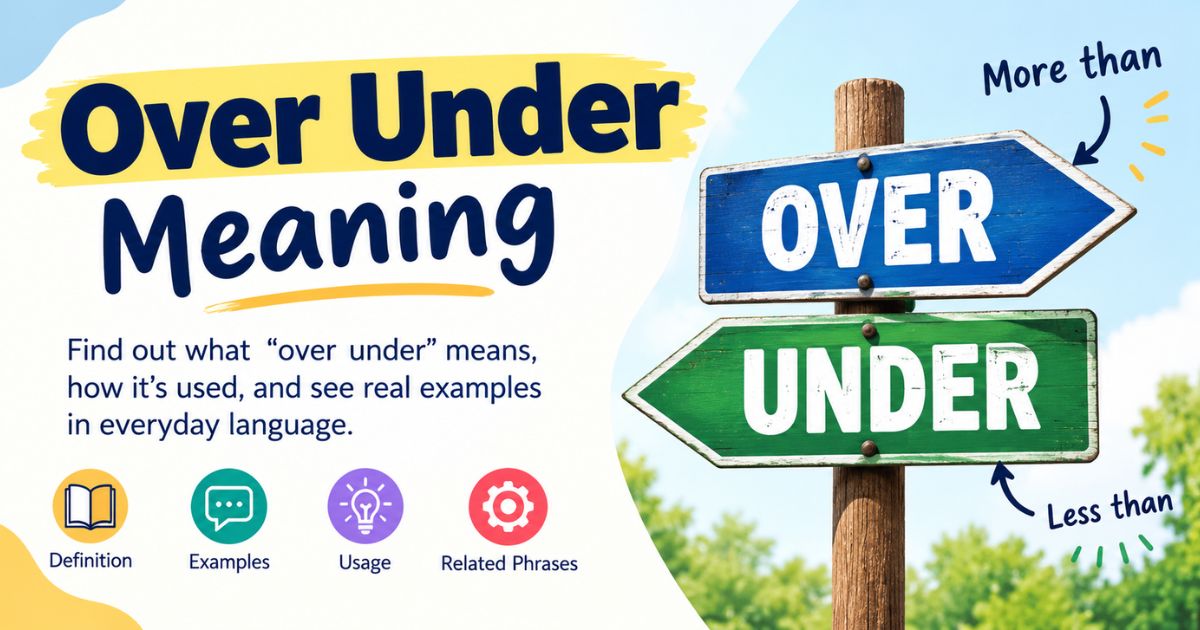
Have you ever heard someone say, “I’m taking the over” or “The line is set at 45.5”? If you’re unfamiliar with sports terminology, over under can sound confusing. The good news is that the basic idea is much simpler than it first appears.
The over under meaning depends on context, but in sports, it usually refers to a predicted total number of points, goals, runs, or other statistics in a game or for a player. You then compare the actual result with that number.
For example, if a basketball game’s over/under is 220.5 points, the two sides are straightforward: the final combined score will either be over 220.5 or under 220.5.
You may also hear over under in everyday conversation when someone is making a prediction about whether something will exceed or fall below a certain number.
Let’s break down exactly what this phrase means, how it works in sports, and how people use it in everyday English.
What Does Over Under Mean?
Over under means a prediction or dividing line between two possible outcomes: above a specific number or below it.
The phrase is especially common in sports, where an over/under line represents an expected total.
For example:
“The over/under for tonight’s game is 48.5.”
Here, 48.5 is the target number. The question is whether the combined total will finish above or below that number.
If the final total is 52, it goes over 48.5.
If the final total is 44, it goes under 48.5.
The phrase can apply to much more than points. Depending on the sport, an over/under can involve:
- Total points
- Total goals
- Total runs
- Passing yards
- Rushing yards
- Receiving yards
- Player points
- Rebounds
- Assists
- Home runs
- Strikeouts
So, when someone asks, “What does over under mean?”, the simplest answer is:
It means whether a result will be higher or lower than a specific number.
Read More: Slow Burn Meaning: What It Means in Love, Texting, Dating, Spirituality & Social Media
What Does Over Under Mean in Sports?
In sports, over under usually describes a projected total for a game or event.
Suppose two football teams are playing, and the over/under is 47.5 points.
The actual score could be:
Team A: 27
Team B: 24
Total: 51
Because 51 is higher than 47.5, the result is over.
Now imagine the final score is:
Team A: 20
Team B: 17
Total: 37
Because 37 is lower than 47.5, the result is under.
The important thing to remember is that the over/under generally concerns the combined total, not which team wins.
A team can win the game while the total goes under. Likewise, the total can go over even if your favorite team loses.
Game Total vs Winner
This is an important distinction.
If someone asks:
“Who will win?”
They’re talking about the game’s winner.
If someone asks:
“Over or under?”
They’re talking about whether the relevant statistic will finish above or below the specified line.
For example:
| Question | What it focuses on |
|---|---|
| Who will win? | Winner |
| What is the spread? | Margin of victory |
| What is the over/under? | Total result |
| Will Player X go over 25.5 points? | Player statistic |
This is why understanding the line matters before interpreting an over/under.
What Does Betting the Over Mean?
Betting the over means predicting that the actual total will be higher than the over/under line.
For example, suppose the line is:
Over/Under: 42.5 points
Choosing the over means you expect the combined score to exceed 42.5.
If the final total is 45 points, the result is over.
If the final total is 38 points, the result is under.
The same concept applies to player statistics.
Suppose a basketball player has an over/under line of 24.5 points.
Choosing the over means you’re predicting that the player will score 25 or more points.
Example
Imagine:
Player line: 24.5 points
The player scores:
27 points
Since 27 is greater than 24.5, the result is over.
The key idea is simple:
Over = more than the line.
What Does Betting the Under Mean?
Betting the under means predicting that the actual result will be lower than the over/under line.
For example:
Over/Under: 50.5 points
Choosing the under means you expect the combined score to finish below 50.5.
If the final total is 47, that’s under.
If the final total is 54, that’s over.
The same principle applies to player props.
For example:
Player rebounds: 8.5
If you choose the under, you’re predicting the player will finish with 8 or fewer rebounds.
If the player gets 9 rebounds, the result is over.
So the easiest way to remember it is:
Over = higher than the number.
Under = lower than the number.
Why Do Over Unders Use .5?
One of the most common questions about over/under lines is: Why do they use .5?
The reason is simple: it creates a clear dividing point.
Consider an over/under of 45.5 points.
A game cannot finish with exactly 45.5 points because points are whole numbers. Therefore, there is no tie between the over and under.
The result has to be either:
- 46 or more → Over
- 45 or fewer → Under
The same idea works for player statistics.
If a player’s line is 19.5 points:
- 20 points → Over
- 19 points → Under
Using a half-number removes the possibility of landing exactly on the line.
What If the Line Is a Whole Number?
Sometimes you’ll see a line such as 45 points rather than 45.5.
In certain betting markets, that can create the possibility of a result landing exactly on the line. What happens in that situation depends on the specific market’s rules.
That’s why you should always check the rules of the particular sportsbook or competition before assuming how a tied result is handled.
What Does Over Under Mean for a Player?
When the phrase applies to an individual athlete, the over/under usually refers to a specific player statistic.
For example, a basketball player’s line might be:
25.5 points
The question becomes:
Will the player score more or fewer than 25.5 points?
If the player scores 26 points, that’s over.
If the player scores 25 points, that’s under.
Player over/unders can cover many different statistics.
Common Player Over/Under Examples
A basketball player might have lines for:
- Points
- Rebounds
- Assists
- Steals
- Blocks
- Three-pointers
- Points + rebounds + assists
A football player might have lines for:
- Passing yards
- Rushing yards
- Receiving yards
- Receptions
- Touchdowns
A baseball player might have lines involving:
- Hits
- Strikeouts
- Runs
- Total bases
For example:
“The quarterback’s passing-yard over/under is 275.5.”
That means the relevant line is 275.5 passing yards.
A result above the line is over, while a result below it is under.
Why Player Lines Can Be Tricky
A player over/under isn’t simply about how good an athlete is.
Context matters.
A player’s opportunity can change because of:
- Injuries
- Playing time
- Opponent strength
- Team strategy
- Weather
- Game situation
- Coaching decisions
- Pace of play
For example, an excellent basketball player might normally score 28 points, but if the game becomes a one-sided blowout, they may play fewer minutes.
That’s why the line itself doesn’t guarantee what will happen.
What Does It Mean in Everyday Conversation?
Outside sports, over under can describe a prediction about whether something will exceed or fall below a particular number.
For example:
“What’s the over-under on how long this meeting will last?”
Someone might answer:
“I’d say about an hour.”
Here, they’re informally predicting whether the meeting will last longer or shorter than a chosen amount of time.
Another example:
“What’s the over-under on how many people will show up?”
The speaker is asking for an estimate or prediction.
You might hear the expression used jokingly among friends:
“What’s the over-under on how late he’ll be?”
This doesn’t necessarily involve sports or actual betting. It’s simply a playful way of asking for a prediction.
Over Under Meaning in Texting
In texting, people may use over under casually to make predictions.
For example:
“Over under 20 minutes before she calls back?”
This means:
“Do you think she’ll call back in more or less than 20 minutes?”
Another example:
“Over under five people at the party?”
The speaker is informally asking whether the number will be above or below five.
This kind of usage is common in casual conversation because the phrase quickly communicates the idea of making a numerical prediction.
Over Under Meaning on Social Media
You may also see over under on platforms such as Instagram, TikTok, X, Reddit, or Facebook when people make predictions about events.
For example:
“Over under 10 goals this weekend?”
Or:
“What’s the over-under on how many comments this post gets?”
In these situations, the phrase can be humorous or conversational rather than a reference to a formal betting market.
Over Under vs Over/Under: Is There a Difference?
Usually, over under and over/under refer to the same basic idea.
Over/under is the more common written form when discussing sports betting or a specific betting line.
Over under can appear without the slash in casual speech and informal writing.
For example:
“The over/under is 220.5.”
And:
“What’s the over under for tonight?”
Both communicate the same basic concept.
The context tells you whether the phrase refers to a formal sports market or simply an informal prediction.
Is Over Under Only Used for Sports?
No.
Sports are where you’ll most commonly encounter the term, particularly in discussions about betting and predictions. However, people also use it casually outside sports.
For example:
“What’s the over-under on the wedding starting late?”
Or:
“I’ll take the over on how long this project will take.”
In both examples, someone is making a prediction about whether an outcome will exceed a particular number.
So, the over under meaning isn’t limited to sports. The expression has become a convenient way to talk about numerical guesses and predictions.
FAQs
What does over under mean in simple words?
Over under means whether something will be higher or lower than a specific number. In sports, it usually refers to a predicted total for a game or an individual player’s statistic.
What does betting the over mean?
Betting the over means predicting that the actual result will be higher than the specified line.
What does betting the under mean?
Betting the under means predicting that the actual result will be lower than the specified line.
Why do over unders use .5?
The .5 helps create a clear dividing point. For example, with a 20.5 line, a result of 21 is over and 20 is under, so there’s no exact tie at 20.5.
What does over under mean for a player?
For a player, it usually refers to a projected statistic such as points, rebounds, assists, passing yards, rushing yards, or receiving yards.
What does “take the over” mean?
“Take the over” means choosing or predicting the outcome will finish above the stated number.
What does “take the under” mean?
“Take the under” means choosing or predicting the outcome will finish below the stated number.
Does over under always mean betting?
No. People also use over under informally when making predictions, such as guessing how long a meeting will last or how many people will attend an event.
What does over under mean in texting?
In texting, it usually means making a quick prediction about whether something will be above or below a particular number.
Is over under used outside sports?
Yes. The phrase can be used casually for predictions about time, numbers, attendance, costs, and other measurable things.
What does over under mean in football?
In football, the over/under usually refers to the combined points scored by both teams. A bettor or predictor considers whether the final total will be above or below the listed line.
What does over under mean in basketball?
In basketball, it commonly refers to the combined points scored by both teams, although over/under lines can also apply to individual player statistics.
Is over under the same as a point spread?
No. An over/under focuses on the total amount of something, such as combined points. A point spread focuses on the expected difference between two teams.
Conclusion
The over under meaning is straightforward once you understand the basic idea: compare an actual result with a specific number and determine whether it finishes above or below that number.
In sports, an over/under might predict the combined points in a game or a player’s performance in a particular statistic. If the result exceeds the line, it’s over. If it falls below the line, it’s under.
The phrase also appears in everyday conversation, texting, and social media when people make informal numerical predictions.
So, whenever you hear “What’s the over-under?”, think of one simple question:
Will the actual result be higher or lower than the number being predicted?
