Have you ever seen someone write “PSA” at the beginning of a message and wondered what they meant? Maybe it appeared in a group chat, on TikTok, Instagram, or even in a work email. The abbreviation is everywhere, but its meaning isn’t always the same.
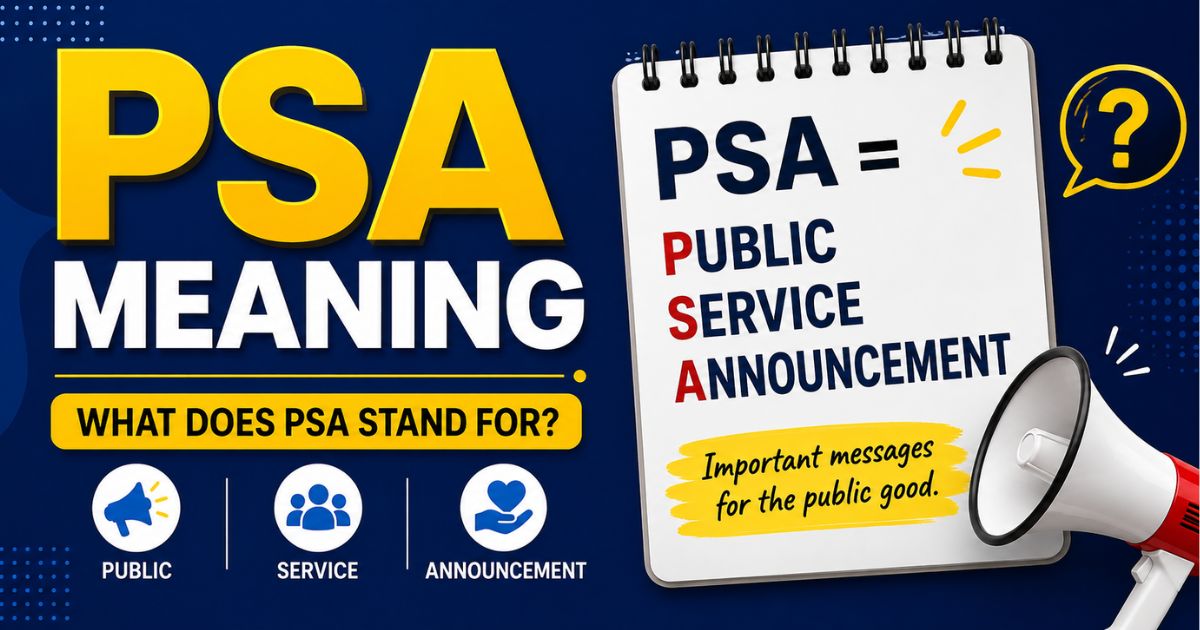
In most situations, PSA means “Public Service Announcement.” However, depending on the context, it can also refer to a medical test, an aviation term, or even an informal way to grab everyone’s attention online.
In this guide, you’ll learn what PSA means, how people use it in texting and social media, its different meanings across industries, and the right way to respond when someone posts a PSA. By the end, you’ll understand exactly what this common abbreviation means wherever you see it.
Meaning & Definition of PSA
The PSA meaning changes based on where it’s used. That’s why context matters.
For example, if someone posts “PSA: Don’t click suspicious links” on social media, they’re sharing important information with others. On the other hand, if a doctor mentions a PSA test, they’re talking about something completely different.
Here’s a quick overview:
| Context | PSA Meaning |
|---|---|
| Text messages | Public Service Announcement |
| Social media | Important notice or reminder |
| Healthcare | Prostate-Specific Antigen |
| Aviation | Pacific Southwest Airlines (historically) |
| Internet slang | Attention-grabbing announcement |
Public Service Announcement
The full form of PSA is Public Service Announcement.
Originally, public service announcements were messages created by governments, charities, television stations, or public organizations to educate people about important topics like:
- Road safety
- Health awareness
- Emergency alerts
- Fire prevention
- Disaster preparedness
- Environmental protection
Today, the meaning has expanded online.
People now use PSA before sharing useful advice, reminders, or warnings—even if they’re not official announcements.
Examples include:
PSA: Drink plenty of water during the heatwave.
PSA: Update your passwords regularly.
PSA: The mall closes early today.
Instead of writing:
“I just wanted everyone to know…”
People simply write:
PSA: followed by the message.
It immediately signals that the information is important.
Examples:
Text Message
PSA: The meeting starts at 8 instead of 9.
PSA: Sunscreen isn’t just for the beach.
TikTok
PSA: Don’t believe every viral life hack you see.
Discord
PSA: Server maintenance starts in 30 minutes.
Medical Meaning
In medicine, PSA stands for Prostate-Specific Antigen.
It refers to a protein produced by the prostate gland. Doctors measure PSA levels through a blood test to help evaluate prostate health.
A PSA test may be recommended to:
- Screen for prostate cancer
- Monitor prostate conditions
- Check treatment progress
- Detect prostate inflammation
This medical meaning is completely different from the internet slang version.
Read More: Cap Slang Meaning: What It Really Means in Text, TikTok & Social Media (2026 Guide)
Aviation Meaning
Historically, PSA also referred to Pacific Southwest Airlines, a U.S. airline that operated for decades before becoming part of another airline.
In aviation discussions today, you may still see PSA referring to:
- PSA Airlines
- Historical airline references
- Airline codes in aviation documents
Again, context tells you which meaning applies.
Gaming / Internet Slang
Among gamers and online communities, PSA has become shorthand for:
“Everyone should know this.”
It’s often used before sharing:
- Tips
- Bugs
- Updates
- Warnings
- Tricks
- Community announcements
Example:
PSA: The new update resets your settings.
Or:
PSA: Don’t sell this rare item—it becomes valuable later.
Rather than formal slang, it’s more of an attention label that tells readers the next message is important.
Background & Origin of PSA
The phrase Public Service Announcement first became popular through radio and television broadcasts during the mid-20th century.
Governments and nonprofit organizations used PSAs to spread messages about:
- Public health
- Safety campaigns
- Vaccination programs
- National emergencies
- Community awareness
As the internet grew, users adopted the abbreviation because it was short, recognizable, and effective.
Today, you’ll find PSA across nearly every digital platform—from WhatsApp groups to Reddit threads—where people use it to quickly introduce useful information.
The internet transformed PSA from an official broadcast into an everyday communication tool.
Usage in Different Contexts
Although the core idea stays the same, PSA looks a little different depending on where it’s appears.
In Chats & Messaging Apps
In private conversations, PSA meaning in text usually means:
“Here’s something everyone should know.”
Examples:
- PSA: The Wi-Fi password changed.
- PSA: Mom’s birthday is tomorrow.
- PSA: Bring cash because the card machine isn’t working.
Using PSA makes your message stand out immediately.
On Social Media
Social media users often write PSA before:
- Helpful advice
- Funny observations
- Product warnings
- Life hacks
- Trending information
- Travel updates
Example:
PSA: Delete unused apps—they may still collect your data.
On platforms like Instagram and TikTok, PSA posts often perform well because they promise valuable information upfront.
Professional Use
Outside of social media, PSA is also common in workplaces, schools, and organizations. In professional settings, it usually introduces an important reminder, update, or announcement that everyone should notice.
Unlike casual conversations, workplace PSAs are often more formal and concise.
Examples:
- PSA: The office will be closed on Monday for maintenance.
- PSA: Please submit your timesheets before Friday at 5 PM.
- PSA: Cybersecurity training is mandatory this week.
Using PSA at the beginning of a message helps readers understand that the information applies to a group rather than just one individual.
PSA Meanings Across Platforms
Although PSA meaning on social media is generally the same, the way people use it varies slightly from one platform to another.
In WhatsApp group chats, PSA usually introduces useful reminders or updates.
Examples:
- PSA: Tomorrow’s dinner has been moved to 8 PM.
- PSA: Don’t forget to bring your ID.
- PSA: The group video call starts in 10 minutes.
Families, workplaces, classrooms, and community groups frequently use PSA to grab everyone’s attention without tagging every member.
On Instagram, PSA often appears in captions, Stories, and Reels.
Creators use it to:
- Share lifestyle tips
- Raise awareness
- Give product recommendations
- Warn followers about scams
- Correct misinformation
Example:
PSA: Clean your makeup brushes every week to help prevent breakouts.
Many influencers also use PSA humorously, such as:
PSA: Coffee before meetings should be a human right.
This lighthearted style has become part of modern internet culture.
TikTok
On TikTok, PSA commonly introduces advice or information that creators believe everyone should know.
Popular examples include:
- PSA: Stop using this skincare ingredient together.
- PSA: Here’s how to save money while traveling.
- PSA: Don’t fall for this viral scam.
Because TikTok videos are short, starting with “PSA:” quickly tells viewers they’ll learn something useful.
Snapchat
On Snapchat, PSA is often used in Stories or private chats to notify friends about something important.
Examples include:
- PSA: I’ll be offline tonight.
- PSA: My account was hacked—ignore strange messages.
- PSA: Party starts at 7 instead of 8.
The abbreviation keeps messages brief while emphasizing that the information matters.
Other Fields Where PSA Is Used
While most people associate PSA with Public Service Announcement, several industries use the abbreviation differently.
Understanding these meanings helps prevent confusion.
Medical Field
In healthcare, PSA stands for Prostate-Specific Antigen.
A PSA blood test measures the level of a protein produced by the prostate gland. Doctors use the results to help assess prostate health and determine whether additional testing is needed.
Keep in mind that a higher PSA level does not automatically mean someone has prostate cancer. Factors such as age, prostate enlargement, infection, or inflammation can also affect PSA levels.
Example:
“My doctor scheduled a PSA test during my annual checkup.”
Aviation
Within aviation, PSA may refer to:
- PSA Airlines
- Historical references to Pacific Southwest Airlines
- Certain airline documentation and industry discussions
Someone reading an aviation article should interpret PSA differently than someone reading a social media post.
Science & Technical Use
Several scientific and technical fields also use the abbreviation PSA.
Examples include:
- Pressure Sensitive Adhesive (manufacturing)
- Particle Size Analysis (laboratory testing)
- Process Safety Analysis (engineering)
- Public Service Announcement (communication studies)
Because abbreviations often have multiple meanings, professionals rely on context to understand which definition applies.
Common Misconceptions & Mistakes
One reason people search “What does PSA mean?” is because the abbreviation has several meanings.
Here are a few common misconceptions.
Mistake 1: Assuming PSA always means Public Service Announcement
Not necessarily. In a hospital or medical report, PSA almost always refers to Prostate-Specific Antigen.
Mistake 2: Thinking PSA is only used by government organizations
While the term began as an official public announcement, today almost anyone can use PSA in everyday conversations.
Mistake 3: Believing PSA is internet slang only
Although it’s widely used online, PSA also appears in workplaces, schools, healthcare, and traditional media.
Common mistake example:
❌ Incorrect interpretation
“My doctor said my PSA level increased.”
This clearly refers to a medical test, not a public announcement.
✅ Correct interpretation
“PSA: The parking lot will be closed tomorrow.”
Here, PSA means an important notice for everyone.
Similar Terms & Alternatives
Depending on the situation, you might use other words instead of PSA.
Some common alternatives include:
- FYI (For Your Information)
- Notice
- Reminder
- Announcement
- Heads-up
- Alert
- Advisory
- Update
- Important notice
- Bulletin
Each has a slightly different tone.
For example, FYI simply shares information, while PSA usually emphasizes that the message is useful or important for a broader audience.
How to Respond to PSA
Most PSA messages don’t require a lengthy response. Your reply depends on the context.
If someone shares useful information, you can simply acknowledge it.
Common responses include:
- Thanks for the heads-up!
- Good to know.
- Appreciate the reminder.
- Thanks for sharing.
- I’ll keep that in mind.
- That’s helpful.
Examples:
Friend:
PSA: The restaurant now requires reservations.
Reply:
Thanks! I’ll book a table today.
Coworker:
PSA: Submit your expense reports before Friday.
Reply:
Thanks for the reminder. I’ll send mine this afternoon.
Social Media Post:
PSA: Never share your banking OTP with anyone.
Reply:
Great reminder—online security is so important.
These simple responses acknowledge the information while keeping the conversation natural.
Differences From Similar Words
Although PSA is often used interchangeably with other communication terms, there are subtle differences. Understanding them helps you choose the right word in the right situation.
| Term | Purpose | Typical Tone | Example |
|---|---|---|---|
| PSA | Share important information with a wide audience | Helpful, informative | “PSA: The website will be down tonight.” |
| Warning | Alert people about immediate danger or risk | Urgent | “Warning: Severe weather expected.” |
| Announcement | Inform people about news or updates | Neutral | “Announcement: Our new office opens Monday.” |
| Alert | Notify people about time-sensitive events | Immediate | “Security alert: Unusual login detected.” |
A good way to think about it is this:
- A PSA educates or reminds.
- A Warning helps people avoid danger.
- An Announcement shares news.
- An Alert demands immediate attention.
PSA vs Warning
Both terms are designed to inform people, but they serve different purposes.
A warning usually points to a possible danger or risk that requires action right away.
For example:
Warning: Wet floor.
or
Warning: Heavy storms expected this evening.
A PSA, however, focuses on sharing useful information that benefits others.
Example:
PSA: Remember to back up your files before updating your computer.
The message is important, but it isn’t necessarily about immediate danger.
PSA vs Announcement
An announcement is any message that communicates news or updates.
Examples include:
- A company announcing a new product
- A school announcing holiday dates
- A business announcing new opening hours
A PSA is more specific. It usually provides advice, awareness, or information intended to help people.
Example:
Announcement
Our new mobile app launches tomorrow.
PSA
PSA: Enable two-factor authentication to protect your account.
PSA vs Alert
An alert is generally more urgent than a PSA.
Alerts often involve situations where immediate action is necessary.
Examples include:
- Emergency weather alerts
- Security alerts
- Amber Alerts
- Fraud alerts from your bank
A PSA, on the other hand, can simply remind people about something useful without creating a sense of urgency.
Example:
Alert
Flash flood warning—evacuate immediately.
PSA
PSA: Keep an emergency kit in your vehicle.
PSA in Online Conversations & Dating Apps
Although PSA meaning in chat is consistent across most platforms, its tone changes depending on the conversation.
In online communities like Reddit, Discord, and Facebook Groups, people often use PSA to share tips, warnings, or updates.
Examples include:
PSA: This website is running a fake giveaway.
PSA: Today’s game server will restart at 6 PM.
PSA: This seller has been verified by moderators.
On dating apps such as Tinder, Bumble, or Hinge, PSA is less common but still appears occasionally.
People might write:
PSA: I’m terrible at replying during work hours.
or
PSA: If you love dogs, we’ll probably get along.
In these cases, PSA is used playfully to share personal information before a conversation begins.
Popularity & Trends Over Time
The meaning of PSA has remained remarkably consistent for decades, but the way people use it has evolved significantly.
Originally, the phrase Public Service Announcement was limited to radio, television, and government campaigns. As online communication grew, internet users adopted the abbreviation because it was short, recognizable, and easy to understand.
Today, PSA appears across almost every major platform, including:
- TikTok
- Snapchat
- X (formerly Twitter)
- Discord
- Messenger
- SMS text messages
Several factors have contributed to its continued popularity:
- People prefer short abbreviations in digital communication.
- Social media rewards content that quickly captures attention.
- PSA instantly signals that the following information is useful or important.
- It works equally well in formal and informal settings.
Unlike many internet slang terms that disappear after a few years, PSA has remained relevant because its purpose is timeless: helping people share information efficiently.
FAQs
1. What does PSA stand for in texting?
In texting, PSA usually stands for Public Service Announcement. People use it before sharing an important reminder, helpful tip, warning, or announcement with friends, family, or group chats.
2. Is PSA always serious?
No. While some PSAs discuss important topics like safety or health, many are lighthearted or humorous.
For example:
PSA: Never grocery shop when you’re hungry.
The message isn’t serious, but it still offers advice in a fun way.
3. What is PSA in medical terms?
In medicine, PSA stands for Prostate-Specific Antigen, a protein produced by the prostate gland. Doctors measure PSA levels through a blood test to help evaluate prostate health.
4. Why do people use PSA on TikTok?
Creators on TikTok use PSA to grab viewers’ attention before sharing useful advice, warnings, product recommendations, life hacks, or trending information. It signals that the upcoming content is worth watching.
5. Is PSA slang or formal?
It can be both.
Originally, PSA was a formal abbreviation for Public Service Announcement used by governments and organizations. Today, it’s also widely used in casual texting, social media, and online conversations, making it both a formal term and a common internet expression.
Conclusion
Understanding the PSA meaning is easier once you know the context. Most of the time, PSA stands for Public Service Announcement, serving as a quick way to introduce helpful information, reminders, warnings, or advice. Whether you’re reading a text message, scrolling through Instagram, watching TikTok, or chatting on Discord, a PSA tells you that the sender believes the information is worth your attention.
At the same time, remember that PSA has other meanings in fields like medicine, aviation, and science. Looking at the surrounding conversation will almost always tell you which definition is intended.
Now that you know what PSA means, you’ll be able to recognize and use this abbreviation confidently in text messages, social media posts, workplace communication, and everyday conversations.
